

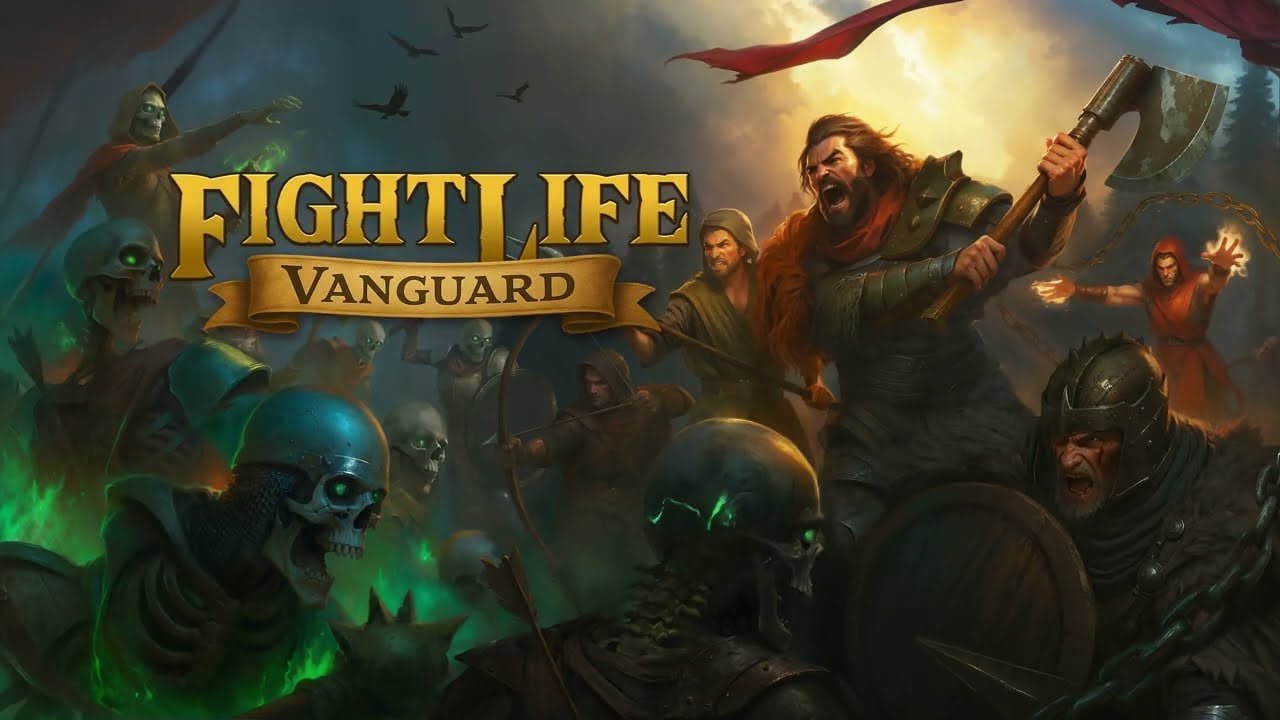
If you are looking for a break from those long 50+ hour strategy games and are looking for something a bit more bite-sized, then join me as we check out Fight Life: Vanguard. This is a very streamlined tactical turn-based RPG where you manage a party of heroes trying to save the land from evil. Let’s jump right in and see if it is any good.
In Fight Life: Vanguard, you are leading a band of mercenaries that start off just trying to defend a village from a recurring problem with wolves.
This quickly escalates, though, as you find the source of the problem with the wolves is in fact something much more powerful, stirring up trouble. With the help of a mysterious spirit, you must grow your recruits into brave heroes who will be strong enough to take down the evil forces and save humanity.
There are five base character classes in Fight Life. Those classes are Worker, Watchman, Savage, Hunter, and Neophyte. Each has varying stats and skills.
Each class has a skill tree that branches into different classes as the character levels up. For example, the Hunter class can level up to the Bowman class, then either the Robber class or the Archer class. Finally, that character can become either a Scout, a Sniper, or a Crossbowman.
With every starting class having three final classes that it can level to, there is a wide variety of party combinations. This is something to keep in mind throughout your journey. You might start out with two Hunters, but you might end with one character who has high dodge and poison blades while the other is a heavily armored soldier with a deadly crossbow.
There are a total of seven slots in your party. You don’t start with all of them. Instead, you slowly recruit more heroes throughout your journey. This allows you to build a better party composition over time and fill the gaps that you might find in your strategy as the battles get more difficult.
Speaking of difficulty. There are three levels of difficulty in the game. You are free to change the difficulty at any point between quests to fit your needs. It’s as easy as a click of a button before you start the next quest. Almost like the developers are encouraging you to change the difficulty until you find the one that fits you best.
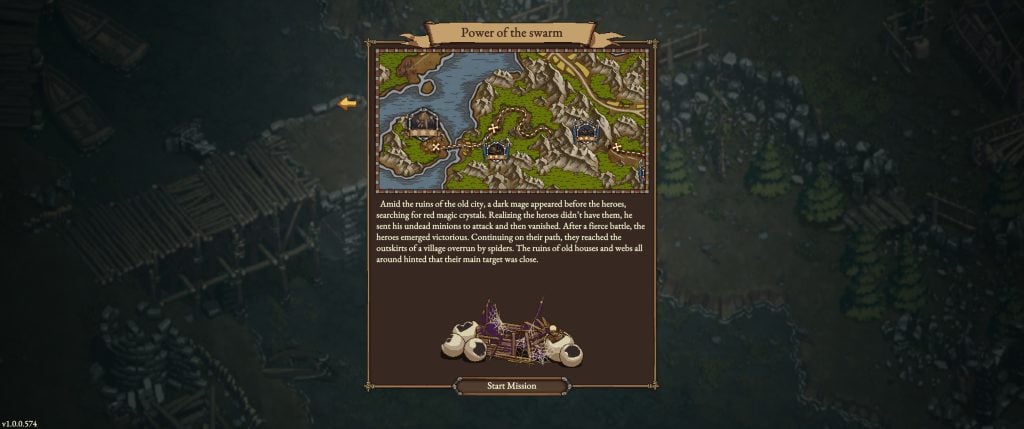
Each quest is laid out on a map. You can explore the map in real time. While exploring, you can find loot to help you in the coming battles. There are a handful of battles scattered through each map, starting as soon as you get close enough to an enemy location.
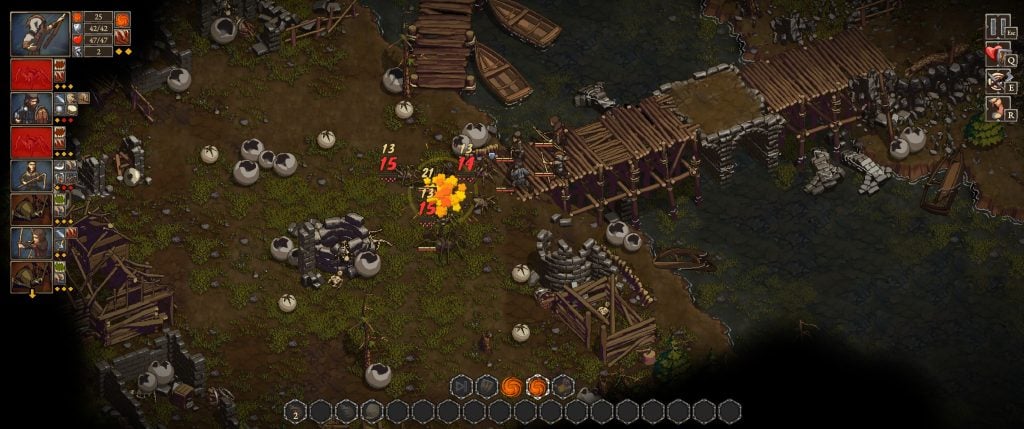
Combat begins by choosing the deployment location of each of your heroes. You can even change up their inventory and heal with potions during this time. It’s also a good idea to view the enemy units, so you have an idea of what you are going up against. Once you are confident with your positioning, you click Start Battle.
Combat is round-based, with each side alternating in activation. On your turn to activate, you are able to select any unit that has not already activated this round.
This is a feature that I am starting to see in more turn-based games recently, and it is something that I rather enjoy. I think it adds to the strategic depth to be able to choose who you want to activate when. The enemy units tend to stay in the same order.
However, if you kill the enemy unit that is supposed to go next, then the one after that will activate. This means you aren’t able to cheat the game and get back-to-back activations. At least not until you outnumber the enemy unit towards the end of the battle.
Combat is nice and crunchy. It feels challenging without being too difficult. Positioning is of the utmost importance.
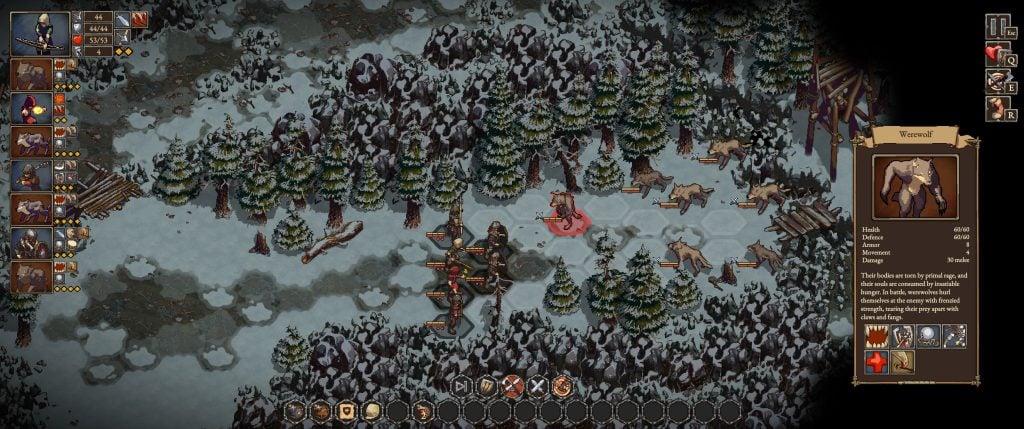
If the enemy sees an opening to one of your weaker units, it will not hesitate to strike. Combat in Fight Life also has a big focus on defense. Every time a unit is hit, it loses up to half of its max defense, and anything beyond that carries over to health damage.
Now, there are several ways to recover a unit’s defense so that it continues to not take any damage. One is to simply skip that unit’s turn. By doing so, they will recover 25% of their max defense. The unit can also go into a full defensive stand, which will restore 25% of their max defense and reduce incoming damage by 50%.
Another key element to combat in Fight Life is the melee penalty. The more a unit is attacked, the more surrounding damage they take.
This penalty also reduces a unit’s movement. This system can be used to your advantage or your detriment. Take too many hits, and your unit might not be able to relocate /to a more advantageous position. Similar to defense, different skills can reduce this penalty, such as skipping a unit’s turn or using the full defense stance.
Each combat encounter is pretty quick, with enemies averaging between five and ten units per battle. I think this helps prevent combat from becoming a slog and really increases the pace of the game. These are more like bite-sized combat encounters that fit nicely in a bite-sized game.
After your last encounter on that map, you will be given the option to move on to the next mission or continue exploring. It is almost always worth it to continue exploring to make sure you gather all the loot before moving on to the next quest. Once you have thoroughly searched the map, you can freely move on to the next adventure.
Other than that, things stay pretty simplistic. There is no real customization for your units other than equipping them with a few pieces of gear before combat. I didn’t see anywhere to name them or change their armor colors or anything like that. Not to say that it’s a bad thing, it’s just not there for the people that might be looking for it.
I think that Fight Life: Vanguard does a lot of things right. They have an interesting story with an interesting combat system. Those were clearly the focus of the game, and those are the highlights of it. I didn’t find it a problem that it was lacking in other areas, like customization or dense skill trees.
Fight Life does what it wants to do and does it well. It took me under ten hours to beat the campaign on a single difficulty.
That means I can go back and beat it at a greater difficulty without it feeling like a chore. To me, it felt like a nice change of pace from some of the more dense games that I have played recently.
If you are a turn-based fan who is looking for a game with a good combat system but doesn’t overstay its welcome, then Fight Life: Vanguard might be worth checking out. Head over to the Steam page if you are interested in picking up the game for yourself.
A review key was provided by the developers at StartImpulse and Two Cakes Studio.
