

Editor’s Note: this article is being republished with the permission of the Irregular Warfare Initiative as part of a republishing arrangement between IWI and SWJ. The original article was published on April 17, 2026 and is available here.
The U.S. is losing the war on sentiment in the Global South, where the world’s most economically vulnerable countries rely on larger powers for economic support and security. Russia and China have capitalized on this dynamic by seizing the economic initiative in this region, often at the expense of the U.S. To close the gap, the U.S. needs to refine its understanding of economic warfare. By embracing unorthodox strategies and innovative tools, the U.S. can more effectively wield economic power to win influence back from its adversaries.
Our occasional paper, published by Joint Special Operations University, outlines one such innovative tool called “insurance as economic security” (IAES). IAES leverages insurance to mitigate economic security challenges and allow the U.S. to improve engagement with the Global South. This approach could become a relevant, viable risk mitigation since the U.S.’ ability to deliver foreign aid atrophied in 2025. Moreover, IAES can be implemented without direct reliance on U.S. taxpayer funds.
Thus emerges an opportunity for the irregular warfare community to leverage a unique form of economic risk transfer—parametric insurance—as an implement of economic warfare at an unprecedented scale. Parametric insurance provides the ability to weaponize capital for scenarios involving specific economic stressors in sensitive regions and could productively expand the irregular warfare toolkit in non-combat driven environments.
Strategic Competition and Economic Security
The data are sobering for U.S. influence in the Global South. Seventy percent of people living outside liberal democracies have positive feelings toward China, with 66 percent feeling similarly toward Russia. Beijing maintains this level of influence mainly by leveraging international institutions and multilateral forums that shape elements of global governance towards its priorities. Russia, by contrast, pursues a more rhetorical strategy, portraying the Western bloc as “a powerful but historically retreating construct.” This narrative allows Russia to focus on the Global South as a long-term strategic imperative.
Against this backdrop of expanding engagement and strategic framing, China and Russia have a key advantage in the Global South. It might be easy to point to the greater flexibility they enjoy on issues like human rights, but that pales in comparison to the fact that the two nations don’t need to play to win. Russia, for example, considers neutrality in the Global South to be “itself beneficial.” In other words, it is sufficient for Russia to simply keep target states from U.S. alignment. Thus, the U.S. must not only overcome its adversaries’ relative advantage in the region, but it must also make further progress toward gaining local support.
The U.S. can regain its footing in part through an expansion of its irregular warfare toolkit, particularly when it comes to the “E” in the DIME model: economic warfare. Economic warfare is intended to “weaken the economic foundation of the enemy’s power” by constraining access to critical resources such as energy, food, other trade goods, and otherwise interfering with an adversary’s economic activity.
Periods of acute economic stress, such as armed conflict, famine, and natural disasters, provide a unique opportunity for economic warfare innovation. In the past, these conditions were the domain of direct foreign aid. Now these periods offer possibilities to deny and deter competitor access to affected regions. Such a strategy calls for a new paradigm for economic engagement. Rather than react to a natural disaster or conflict with economic support as a form of “disaster diplomacy,” the weaponization of insurance would enable the delivery of capital immediately when the need arises.
The Use of Insurance as an Economic Security Lever
Insurance is already an established economic security strategy because it helps shift the economic burden associated with risk management and can alleviate the threat of the unknown on businesses, their shareholders, and ultimately taxpayers. During times of acute economic vulnerability associated with the conditions above (conflict, famine, natural disasters, etc.), insurance can bring relief faster and more predictably. The benefits are tangible, with insurers contributing $4.3 trillion in capital from 1998 to 2021 for natural disaster relief—capital which otherwise would have come from government funds. Already a tool of economic security, IAES is simply waiting to be directed to productive effect.
The benefits of IAES as a tool of economic warfare are compelling. First, IAES is generally inexpensive. The cost consists solely of the insurance premium because the insurer would pay the protection amount when a triggering event occurs. Donor states would likely pay the premiums, representing a much smaller outlay compared to conventional aid. Next, unlike foreign aid, partnering developed states could implement this in advance, as part of an IAES approach. This means that the state covered can rely on high-velocity aid when needed, rather than having to negotiate from a position of weakness—when every moment of negotiation prolongs human suffering. Even if there is ultimately no triggering event, providing IAES is an exercise in soft power, as it shows positive steps today that mitigate the severity of potential future problems.
Being able to deliver purposeful economic assistance to civilian populations can give the U.S. the competitive edge in the Global South it has lost in recent years. IAES makes this possible with minimal investment, given that “[p]rivate insurance companies would write the big checks that the U.S. government wrote in the past.” For this reason, parametric insurance provides an approachable and accessible risk-transfer instrument in the developing world. The instrument pays out quickly when natural events breach pre-agreed triggers. Examples include hurricanes, typhoons, and earthquakes. The operational simplicity of parametric insurance makes IAES a potent instrument for influence operations. This utility uniquely positions it within the irregular warfare toolkit for application across the Global South.
Other appealing features of IAES are its cost efficiency and soft approach. Unlike the disbursement of aid, using parametric insurance as an influence tool requires only premium payment, not the full benefit. The capital for a settlement would come from the insurance industry, minimizing U.S. fiscal exposure. Thus, IAES could yield disproportionate impact for its beneficiary partners with minimal use of financial resources. This approach could deny adversaries access to the information space—rather than actively engaging in narrative warfare against them—by eliminating festering grievances and limiting foreign influence.
Parametrics and IAES deliver a creative alternative to large-scale and potentially misdirected aid packages, even mitigating the risks of leakage and corruption, because payment only results from qualifying natural events. This approach is directly applicable in today’s influence and information environment, as evident from the recent drought in Moldova.
This can happen in any region where floods, tornadoes, monsoons, and other natural threats leave local populations vulnerable. Neighbors, adversaries, or even distant global powers seeking to expand their spheres of influence will try to exploit those vulnerabilities in their favor. Yet, the targeted employment of parametric insurance can prevent such actors from doing so.
Putting IAES Into Practice: Implementing “Insurfare”
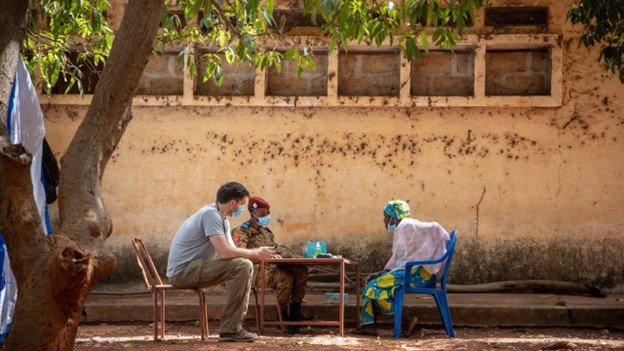
When it comes to executing IAES, private insurers write the policy, but the U.S. implements the programs through troops on the ground. Think of IAES like a power plant and a field team: insurers generate the electricity, but operators need to run the lines and deliver it to the people who need it. IAES fits nicely with civil affairs’ (CA) core mission of assessing vulnerabilities in humanitarian response and building collaboration between the interagency, non-government actors, and local populations. As such, CA operators can easily incorporate IAES into civil affairs units’ existing toolkits. While private insurers power IAES, local populations see its benefits delivered by uniformed U.S. personnel.
This approach, termed “insurance warfare” (or “insurfare”), employs economic coercion in shaping the operational environment and great power competition. Insurfare enables commanders and their partners in the diplomatic corps to exploit economic vulnerabilities, compel cooperation through the delivery of available or promissory resources, and align actors towards a preferred partnership with the U.S. rather than remaining neutral or leaning toward adversaries’ spheres of influence. Consistent with irregular warfare principles, insurfare is an inexpensive and high-impact way to achieve national security objectives.
The development and launch of an IAES program—such as insurfare—as an irregular and economic warfare capability requires clear roles and responsibilities. IAES likely would fall under civil affairs organizations within the irregular warfare community, forming part of a broader set of societal and economic programs that are designed to increase the resilience of communities exposed to undue influence from U.S. adversaries.
Within the IAES toolkit, insurfare would involve the use of civil affairs teams identifying the resource needs (including financial) of local leadership, particularly in environments vulnerable to natural disasters and foreign influence. As part of this approach, civil affairs operators could identify parameters needed for protection, such as rainfall amounts and earthquake magnitude. After that, it becomes a simple insurance discussion. While this would require some amount of education, the level of effort would be manageable and not require a significant time investment.
Contested Battlefield of Insurfare
Since IAES is relatively overt, the U.S. must consider how adversaries would respond to the U.S. broad adoption of IAES as part of its economic warfare toolkit. For instance, adversaries could develop counter-measures or adopt IAES for their own economic warfare purposes. The expected U.S. counter—to outspend adversaries looking to replicate the insurfare strategy—might work temporarily. However, adversary states like China and Russia would be able to respond quickly, given that they are sufficiently resourced and less impeded by government procedure than liberal democracies.
It’s natural to worry about the threat of manipulation by adversaries, a concern commanders would likely find almost immediately when contemplating the effectiveness of insurfare. Interestingly, weaponizing the commercial insurance market in this manner reduces the risk of manipulation by adversary states. In general, adversaries seeking to manipulate insurance outcomes would need to pressure insurers in inaccessible jurisdictions, but even this would be ineffective given the nature of the parametric insurance product. This is because the insurance product is simple, binary, and straightforward, making it resistant to market manipulation. The data used in these transactions (and to determine when a payment is warranted) comes from independent third-party sources, making it easily verifiable, difficult to manipulate, and relatively immune from doubt. Moreover, the insurance product exposes minimal litigation risk, since a legal challenge by an adversary state against an insurer with a policy in a different jurisdiction would likely not involve the U.S. entity that ultimately pays the premium.
The integration of insurfare into the broader U.S. economic and irregular warfare toolkit offers a new, unique approach to engage with states in the Global South. Insurfare could bolster U.S. efforts to combat adversarial influence and regain its own soft power advantage. By providing this contingent capital, insurfare provides a scalable, efficient, and proactive means of addressing economic shocks in vulnerable states that reinforces stability and trust. Moreover, insurance delivery is faster than the provision of traditional aid. This approach integrates with broader U.S. government programs and initiatives.
Insurfare represents an adaptation in irregular warfare and innovation of economic warfare, applying the best practices of financial markets towards a whole-of-government approach. Given the complex strategic environment, the U.S. must adopt such integrative initiatives to buy down security risks and deny space for adversarial inroads. If the U.S. fails to innovate with tools such as insurfare and fill the gap left by traditional aid mechanisms, it risks allowing more dangerous actors to occupy that space before it is too late.
