

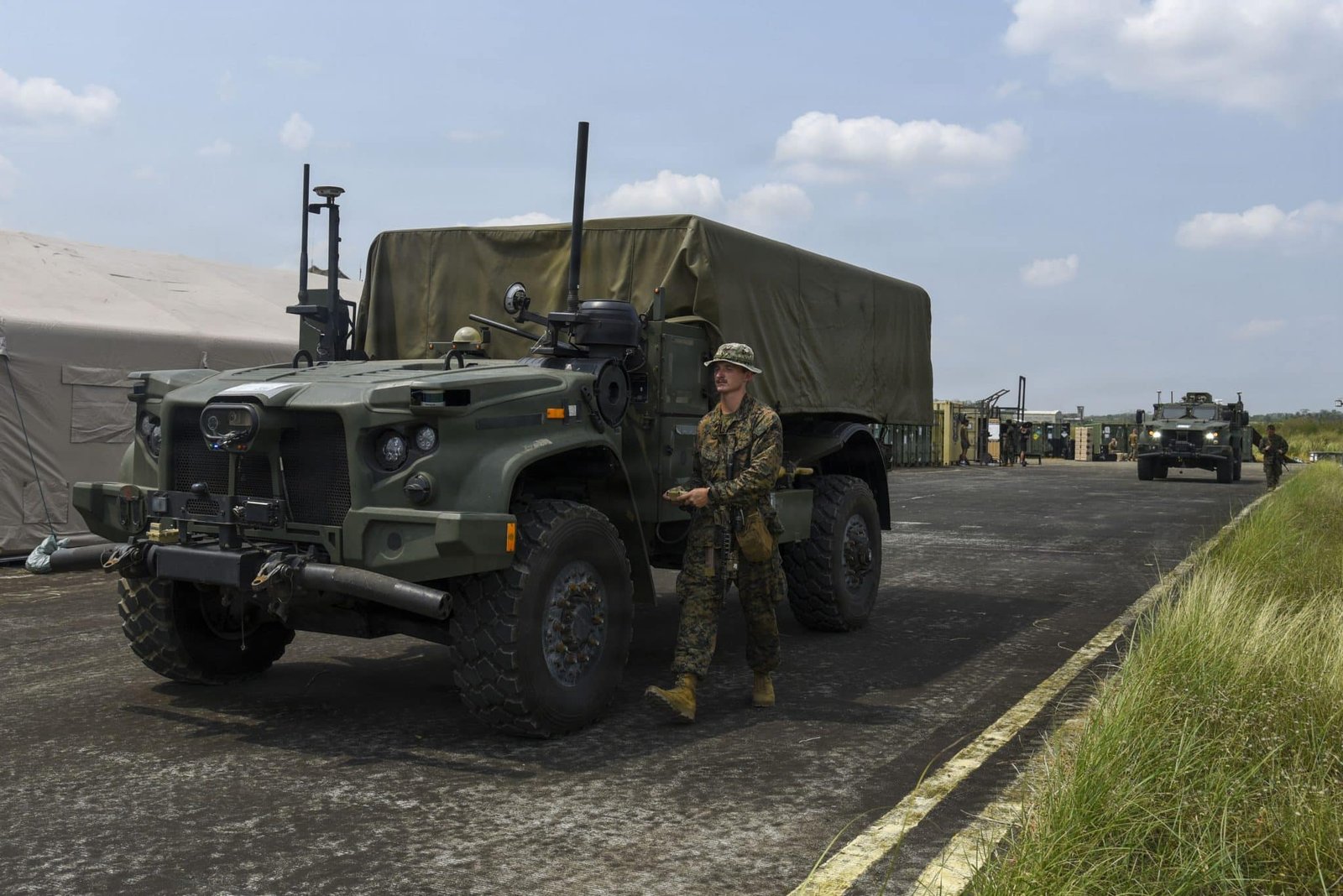
American anti-ship missile launchers have been deployed to the Northern Philippines near the Luzon Strait in support of planned maritime strike, coastal defense and sea denial operations during Balikatan 2026.
Around 1,300 Marines and Sailors from the Hawaii-based 3rd Marine Littoral Regiment are in the Southeast Asian archipelago for Washington and Manila’s largest annual military drills. The regiment, designed to provide maritime sensing and anti-ship capabilities in littoral environments to joint and allied forces, routinely deploys to the Philippines for drills with local forces. While this is not the first time American forces have deployed the Naval Strike Missile-equipped Navy-Marine Corps Expeditionary Ship Interdiction System (NMESIS) to the Philippines, their presence comes during an increased U.S.-Philippine alliance focus on the Luzon Strait amid concerns over a Taiwan contingency spillover.
According to media released by the Marines, the unit and its launchers have been staged at the Cagayan North International Airport, also known as Lal-lo Airport, one of nine sites throughout the Philippines that American forces can use under the Enhanced Defense Cooperation Agreement. From this Northern Luzon airfield, the dual missile-equipped unmanned launchers could strike targets up to 185 kilometers into waters separating the Philippines and Taiwan. As one of the primary passages in and out of the first island chain, Philippine military and political leadership have highlighted its strategic value.
“Continuing to deepen relationships with the Armed Forces of the Philippines, this iteration of Balikatan marks the fourth year of 3rd MLR’s participation. This year, the regiment is postured to exercise simulated sea denial operations, integrated air and missile defense operations, maritime key terrain security operations, and counter-landing defensive operations,” read a Marine Corps press release on the regiment’s deployment.
Balikatan Maritime Strike Activities
During last year’s Balikatan and Kamandag exercises, the regiment staged and deployed these anti-ship missile launchers across the Northern Philippines and islands within the Luzon Strait to demonstrate rapidly-deployable American area denial capabilities. The Marines used C-130s to deploy NMESIS to the Batanes Island Group, a grouping of the northernmost Philippine territories located in the middle of the strait.
NMESIS’ repeated Balikatan deployment reflects a pattern of increasingly sophisticated U.S. missile deployments to its Southeast Asian ally in recent years following a series of spats between Beijing and Manila in the South China Sea. Aside from NMESIS systems include High Mobility Rocket Artillery Systems capable of firing long-range anti-ship ballistic missiles, Mid-Range Capability/Typhon ground-based Mark 41 vertical launching systems at areas near strategic first island chain chokepoints.
A large area west of Batanes and in the middle of the Luzon Strait was designated as a “no sail zone” for mariners ahead of a planned special operation force-led maritime strike activity. Several coastal and maritime strike drills are set to occur throughout Northern Luzon for Balikatan 2026. Japanese and Philippine anti-ship launchers are also slated to join the drills, including Japan Ground Self-Defense Force Type 88 and Philippine Marine Corps BrahMos missiles in both live-fire and notional deployments.
