

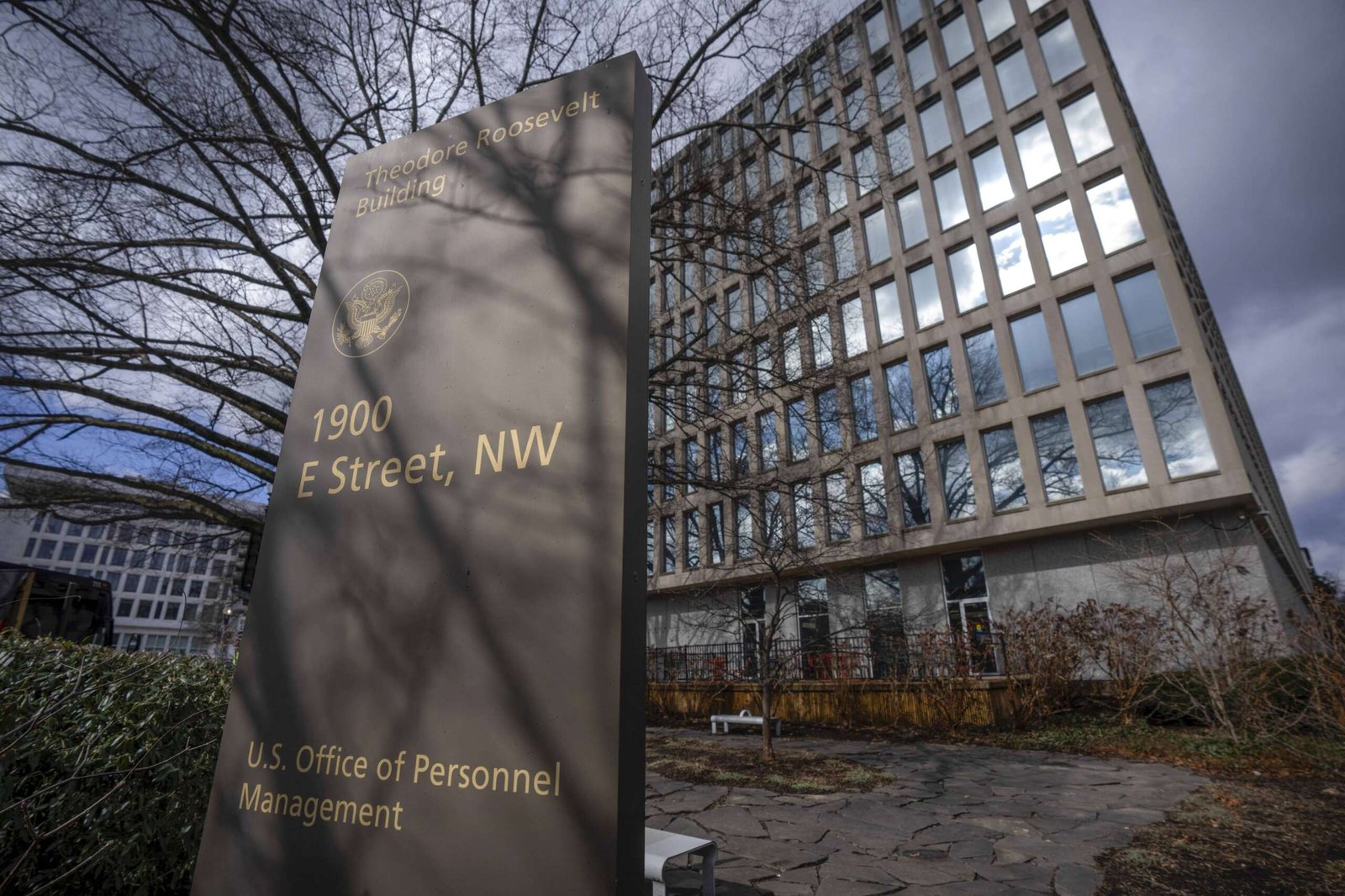
Federal workforce modernization has been a long-time goal at the Office of Personnel Management — and that doesn’t appear to be changing anytime soon.
In its fiscal 2027 congressional budget justification, published earlier this month, OPM outlined plans to prioritize spending on overhauling the government’s HR IT systems, bringing federal hiring into the modern era, and further digitizing the retirement process.
Still, the Trump administration’s topline request of $375 million in discretionary spending for OPM represents a decrease from the agency’s currently enacted spending levels. It’s also $43 million below the House Appropriations Committee’s proposed $418 million for OPM’s budget.
Part of OPM’s proposed spending decrease appears to come from a significant loss in personnel in 2025. More than 1,000 OPM employees have left their jobs since President Donald Trump took office, accounting for one-third of the agency’s total workforce.
Reflecting the agency’s current headcount, OPM’s proposed budget for 2027 would support approximately 2,074 full-time-equivalents (FTEs).
“Personnel compensation and benefits have decreased by approximately $12.1 million, reflecting the conclusion of residual personnel costs resulting from the agency restructuring efforts conducted in FY 2025 and extending into FY 2026,” OPM wrote.
The government’s fiscal 2027 spending levels are still far from finalized, but agencies’ congressional budget justifications generally provide more insight into their priority spending areas for the upcoming budget cycle. OPM’s latest budget document reveals where it may be heading for the next few years, as the agency seeks to ramp up modernization efforts, now with a much smaller workforce.
Overhauling federal hiring
As it opens up more hiring initiatives, OPM described plans to expand opportunities for pooled recruitment and shared certificates. Those strategies aim to streamline hiring and reduce HR workloads by letting multiple agencies pull from a single pool of qualified job applicants when recruiting for the same position.
There are already a few recent pooled hiring actions underway, including one for project managers, and others for technology experts through the Tech Force program. OPM said pooled hiring efforts and shared certificates “increase the efficiency of hiring and improve the applicant experience.”
The agency also said it would continue working toward implementing skills-based hiring by “replacing outdated degree-based hiring models with equitable, skills-first approaches.”
OPM recently updated the 2210 federal job series for IT managers to ease strict education requirements and instead focus on hands-on qualifications. In fiscal 2027, OPM said it would make similar updates “across all 22 occupational families,” to align them with skills-based recruitment practices.
OPM also plans to increase the availability of skills-based and technical assessments for federal job candidates, while phasing out applicant self-assessments.
The administration’s 2027 budget request includes $10 million to “establish a centralized, standardized HR training and certification program,” and another $2.5 million to work on skills-based hiring initiatives.
Consolidating HR IT systems
Another upcoming “major milestone,” OPM said, will be to modernize and consolidate the government’s human capital management (HCM) systems.
During fiscal 2027, OPM plans to finalize the first wave of agencies that have agreed to transition to the upcoming HCM system, which it’s calling “Core HCM.” OPM also intends to start transitioning “wave two” agencies.
“The system will support personnel action processing, employee records, employee and manager self-service, analytics and dashboards, time and attendance, and learning modules,” OPM wrote. “Core HCM will streamline HR operations, improve transparency through near real-time data, reduce friction in policy implementation, strengthen governmentwide data management, improve employee experience and generate savings on a governmentwide basis.”
OPM has recently laid out plans to consolidate the more than 100 disparate HR IT systems currently in use across government. In 2025, OPM issued a request for proposals (RFP), seeking a 10-year contract that could be worth more than $1 billion to accomplish that goal.
OPM’s Human Resources Solutions (HRS) office, which is tasked with managing the HR modernization initiative, is requesting an overall budget of about $520 million for 2027. That would be an increase of $218 million over currently enacted spending levels, which accounts for the 2025 consolidation of other OPM components into the HRS office.
Going forward, OPM said the HRS office will continue to “draw down its workforce as it gains efficiencies.”
Modernizing retirement processing
Modernization efforts in OPM’s Retirement Services (RS) office are also expected to continue. OPM requested $147.1 million for its RS division, an increase of $3.4 million over current spending levels. The funding would go toward “enhancing case processing, system integration, call center modernization and self-service expansion,” OPM said.
In June 2025, after several years in the making, OPM launched the Online Retirement Application (ORA) system to begin processing federal retirement claims digitally. Despite recent retirement delays due to an influx of applications, OPM officials have said the new system speeds up retirement processing, minimizes application errors and reduces manual rework.
For fiscal 2027, OPM outlined plans to expand ORA to be able to process more types of retirement cases, namely disability and deferred retirements.
“This investment will mean more retirement applications enter interim pay faster and more applications move to final approval sooner,” OPM wrote.
Going forward, OPM is looking to create a consolidated platform for the Digital File System. DFS manages retirement files, but it’s currently a fragmented platform involving multiple legacy systems. The JANUS retirement calculator would also get an overhaul, according to OPM’s budget justification.
Funding for the RS office would also be put toward automating some call center operations and expanding “self-service” options, in an attempt to reduce call volumes and wait times in OPM’s customer service center.
“Annuitants will be able to access real-time information, track case status and resolve common issues without direct intervention from call center staff,” OPM wrote, adding that the updates would also allow customer service representatives to focus on more complex requests.
Updating health insurance systems
Further modernization efforts at OPM would focus on systems involved in the Federal Employees Health Benefits (FEHB) and Postal Service Health Benefits (PSHB) programs.
OPM is requesting a budget in line with current spending levels for its healthcare and insurance office, which oversees the FEHB and PSHB programs, as well as dental, vision and life insurance programs.
Within that budget, OPM proposed using $1.2 million for “Carrier Connect,” the agency’s platform for managing carrier applications to join the FEHB and PSHB programs. With that funding, OPM said it would be able to consolidate and standardize the data into a single system, and remove manual processes.
Another requested $1.8 million would go toward the development of a new “decision support tool” — the system that program participants use to review plan options and update their enrollments. OPM described plans to add search capabilities for enrollees to sort through covered providers, medications and services.
The technology upgrades will “increase the accuracy, speed and user experience” of the government’s insurance programs, OPM said.
OPM also plans to do a “comprehensive” audit of enrollment eligibility in both FEHB and PSHB, as required by the 2025 FEHB Protection Act, to verify or otherwise remove ineligible members from the insurance programs.
Scrutiny over FEHB ineligibility costs arose after a 2022 Government Accountability Office report found that OPM was paying up to $1 billion annually on enrollees who are not technically eligible for coverage.
If you would like to contact this reporter about recent changes in the federal government, please email drew.friedman@federalnewsnetwork.com or reach out on Signal at drewfriedman.11
Copyright
© 2026 Federal News Network. All rights reserved. This website is not intended for users located within the European Economic Area.
