

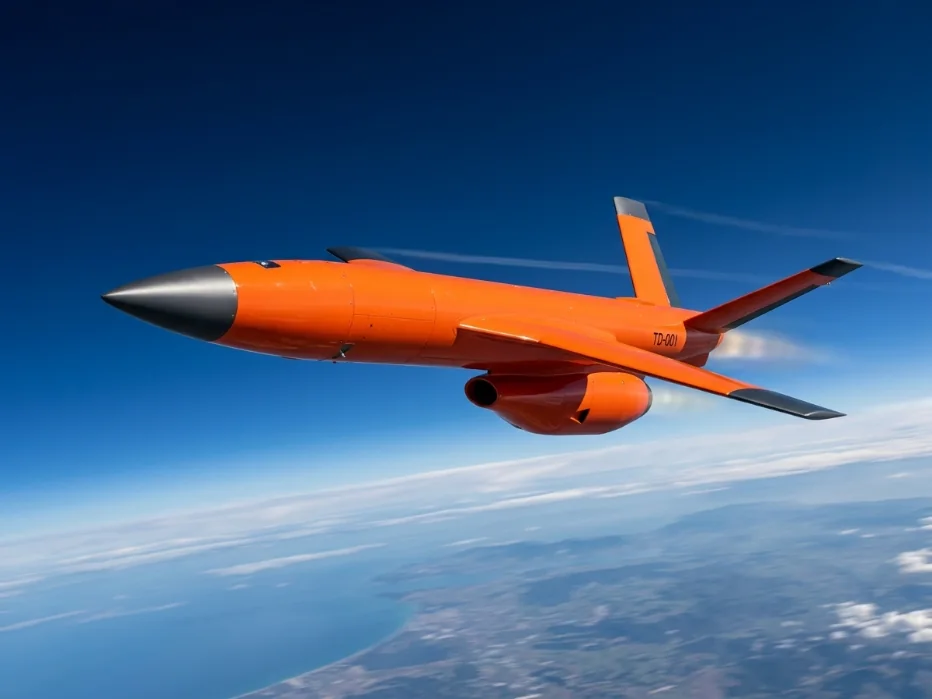
Defense Feeds, Washington — The United States is pushing forward in unmanned aerial development as the US Kratos Firejet drone advances with J85 engine flights following its first successful test runs.
The milestone marks a significant step in enhancing high-speed aerial target systems used for training and weapons testing. As military forces place greater emphasis on realistic combat simulation, platforms like the Firejet are becoming increasingly important.
Developed by Kratos Defense, the Firejet drone is designed to serve as a high-performance target and test platform. The integration of the J85 turbojet engine, widely known for its use in military aircraft, significantly improves speed and operational capability. This allows the drone to better replicate modern aerial threats, including fast-moving cruise missiles and advanced aircraft.
The completion of initial flight tests demonstrates progress in refining the platform’s performance. It also highlights the growing role of unmanned systems in supporting both training and development of advanced weapon systems. The focus now shifts to how this platform will be integrated into broader defense programs.
J85 Engine Enhances Speed and Realism
The integration of the J85 engine represents a major upgrade for the Firejet drone. This engine, originally used in aircraft such as the F-5 fighter, is known for its reliability and high thrust-to-weight ratio. By incorporating this propulsion system, the Firejet gains the ability to achieve higher speeds and more dynamic flight profiles.
This improvement is critical for training environments. Modern air defense systems must be tested against realistic threats that closely resemble actual combat conditions. A high-speed drone capable of simulating these threats provides a more accurate assessment of system performance.
In addition, the enhanced propulsion allows the Firejet to operate across a wider range of mission scenarios. It can replicate different types of aerial targets, from subsonic drones to faster, more maneuverable threats. This versatility increases its value as a testing platform.
The use of a proven engine also reduces development risk. By leveraging existing technology, Kratos can focus on optimizing the overall system rather than developing entirely new components. This approach supports faster deployment and improved reliability.

Supporting Training and Weapons Testing Programs
The Firejet drone plays a key role in military training and weapons testing. As a target drone, it allows air defense systems to engage realistic moving targets under controlled conditions. This helps ensure that personnel and equipment are prepared for real-world scenarios.
The platform is also used in testing advanced weapons systems. By providing a consistent and reliable target, it enables engineers to evaluate performance and identify potential improvements. This is essential for maintaining the effectiveness of modern military technology.
Another advantage of the Firejet is its reusability. Unlike traditional targets that are destroyed after use, certain drone systems can be recovered and reused. This reduces costs and allows for repeated testing without the need for constant replacement.
As military systems become more sophisticated, the demand for advanced training tools continues to grow. Platforms like the Firejet help bridge the gap between simulation and real-world testing. They provide a practical solution for preparing forces for complex operational environments.

Expanding Role of High-Speed Unmanned Systems
The successful flight tests of the J85-powered Firejet highlight a broader trend in defense technology. High-speed unmanned systems are becoming increasingly important across multiple domains. They are not only used for training but also for reconnaissance, strike and support missions.
For companies like Kratos, this development represents an opportunity to expand their role in defense innovation. By focusing on cost-effective and adaptable platforms, they can address emerging requirements across different military branches. The Firejet is one example of how unmanned systems are evolving to meet these needs.
The growing emphasis on realism in training is also driving innovation. As threats become more advanced, training systems must evolve accordingly. High-speed drones provide a way to replicate these threats without the risks associated with manned aircraft.
Looking ahead, the Firejet program is likely to continue evolving. Further testing and refinement will enhance its capabilities and expand its applications. Its development reflects a wider shift toward integrating unmanned systems into all aspects of military operations.
The completion of initial J85-powered flights marks an important milestone in this process. It demonstrates both technological progress and the increasing importance of unmanned platforms in modern defense strategies.
