

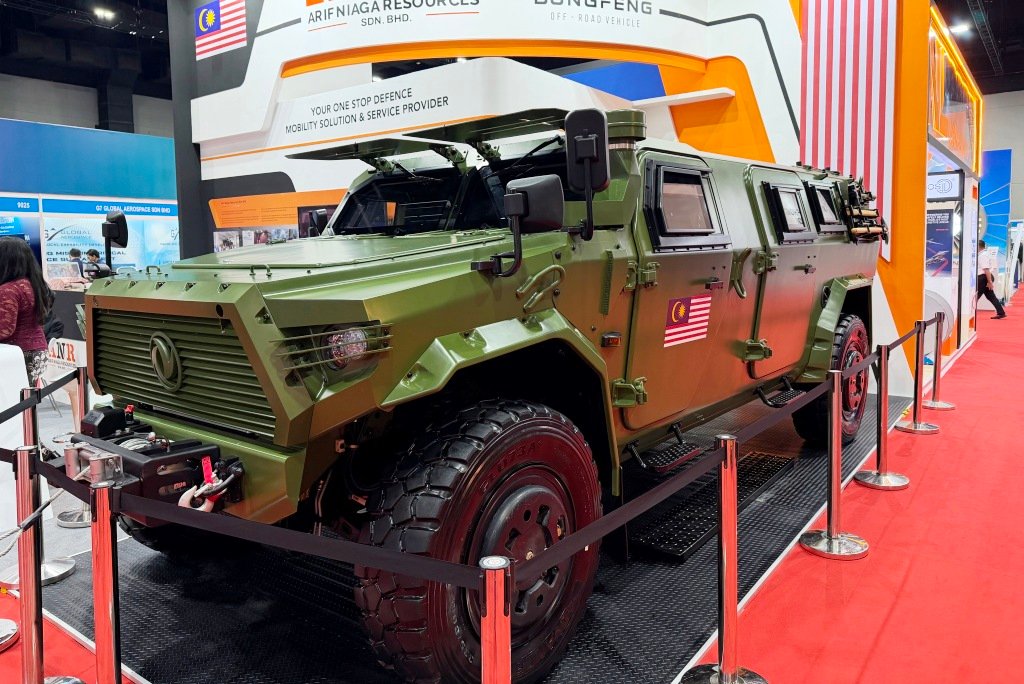
First exhibited at the DSA defence exhibition in Kuala Lumpur, the new 10-person protective assault vehicle developed by China’s Dongfeng Off-road Vehicle Co., Ltd which teamed with Malaysian company Arif Niaga Resources (ANR) following a transfer of technology agreement, to offer this highly mobile protected platform to the local armed forces targets armed and security forces. Combining strong off-road performance with credible ballistic and blast protection, the vehicle defined as the CSK181E/EQ2083MCTA but known in China as Mengshi, is designed for patrol, convoy escort, special forces insertion and internal security roles across a wide range of environments
Built around a full-time 4×4 drivetrain and a unitary construction body, the vehicle offers a compact yet spacious protected hull and seating for ten personnel, while the engine is located at the front. Measuring 5,765 mm in length, 2,360 mm in width and 2,125 mm in height, it balances internal volume with a footprint compatible with urban streets and narrow rural roads. A 4,000 mm wheelbase and generous suspension travel contribute to ride stability and comfort on long missions, while a ground clearance of up to 1,000 mm (400 mm under full load) underpins its cross‑country credentials.
With a gross vehicle mass of 8,500 kg and a curb mass of 6,700 kg, the platform offers a payload capacity of 1,800 kg to accommodate troops, armour kits, ammunition, and mission equipment. The maximum traction of 2,200 kg allows it to tow additional loads such as trailers or light weapons systems. An approach angle of 60°, a departure angle of 40°, a vertical obstacle clearance of 450 mm and a trench crossing capability of 700 mm enable the vehicle to negotiate demanding obstacles and broken terrain. Gradeability of 60% and a driving side slope capability of 40% further reinforce its off-road performance.
On road, the CSK181E/EQ2083MCTA, can reach speeds of up to 120 km/h and accelerate from 0 to 80 km/h in about 24 seconds, ensuring rapid redeployment and responsiveness. Fuel consumption is quoted at around 18 litres per 100 km (minimum specific fuel consumption is 195 g/kWh), and with a combined fuel capacity of 125 litres (65‑litre main tank and 60‑litre auxiliary tank) the vehicle offers an endurance of up to 600 km on highways. A minimum stable speed of 3 km/h allows for controlled movement in convoy, during urban patrolling or when approaching checkpoints.
Power is provided by a Dongfeng Cummins ISDE 300 40 turbocharged and intercooled six‑cylinder diesel engine with a displacement of 6.7 litres. Delivering 220 kW at 2,700 rpm (around 300 hp) and 850 Nm of torque between 1,200 and 2,000 rpm, the engine offers the flexibility and low‑end pull required for off-road operations with full payload. The unit meets China IV emission standards. Power is transmitted through a six‑speed mechanical manual gearbox to a transfer case with an aluminium alloy housing, featuring a built‑in gear pump for lubrication and an external oil cooler to maintain reliability under sustained load.
Electro‑pneumatic control of the high–low range and front–rear differential locks, with integrated sensors and signal outputs, supports optimal traction management and integration into digital fleet monitoring systems. The final drive ratio of 1.69 and wheel reduction ratio of 3.26 are matched to 305/80R18 MPT off-road tyres, providing strong torque at the wheels. These tyres benefit from a central inflation and deflation system, allowing pressure to be adjusted from the cabin to match terrain conditions. An internal support structure gives a run‑flat capability, permitting continued movement at 30 km/h for up to 30 km even after bullet punctures, an important advantage for survivability during ambushes.
The suspension system uses double cross‑arm independent suspension on all wheels, with helical springs and shock absorbers ensuring wheel contact and damping over rough ground. Steering is via a split rack‑and‑pinion power steering system, giving precise, low‑effort control in both urban and off-road scenarios. Braking is ensured by fixed calliper disc brakes with a gas‑cap liquid energy transfer arrangement, complemented by a central disc brake under pneumatic control. A hydraulically controlled ABS system and an exhaust brake provide additional safety and braking performance on long descents and in emergency stops.
Ballistic protection is a key feature of the design. The front of the vehicle is rated to withstand 53‑type 7.62 mm armour‑piercing ammunition at 100 metres, while 5 mm bullet‑resistant steel plates on the sides, rear and floor protect against 53‑type 7.62 mm standard steel‑core rounds at the same distance, corresponding to European B5 level protection. Bulletproof glass and run‑flat tyres are integrated into the protection suite to mitigate the effects of small‑arms fire and tyre‑shot tactics. The vehicle also offers explosion‑resistant protection against grenade fragments, adding resilience against common close‑range threats in asymmetric warfare environments.
The two-man crew access the vehicle via two side doors, right and left, hinged at the front; two more side doors allow dismounts to access the vehicle, a fifth door being located at the rear. At DSA the infantry compartment layout saw six seats in a single row, facing outside, for personnel using side doors, and two more seats, one left and one right, for those entering via the rear door.
The CSK181E/EQ2083MCTA is built for deployment in harsh climates, with an operating temperature range from –41°C to +55°C and an altitude capability up to 5,000 metres. Prepared wading depth is 1,200 mm, while 750 mm can be crossed without preparation, allowing it to tackle rivers, flooded streets and irrigation canals that are typical obstacles in many operational theatres. Interior noise at the driver’s ear is controlled to around 80 dB(A) at a constant 60 km/h, enhancing crew comfort and facilitating radio communications.
A wide selection of standard and optional equipment allows users to configure the platform to national requirements. Standard fit includes air‑conditioning, spare wheel and holder, internal wheel supports, rear boarding step, fuel drums with mounting brackets, and an on‑board toolbox with tools, ensuring immediate operational readiness on delivery. Options include night vision systems, electric capstan, weapon racks and clips, coolant and fuel heaters, super capacitor, air heater, multifunction display, civil engineering tools, extended wading tailpipe, front windscreen fender, front‑end towing and push‑back devices, wire rope, hard traction device, first aid kit and an automatic transmission, as well as a mechanical weapon station for a heavy machine gun or grenade launcher. The vehicle is prepared for the integration of information‑technology interfaces, enabling the installation of radios, battle management systems and other digital equipment, while colour schemes and language options are tailored to customer preferences. An option for a 6×6 version is being considered. A bid for an armoured transport vehicle for the Malaysian forces should be launched soon.
Photos J. Roukoz
