

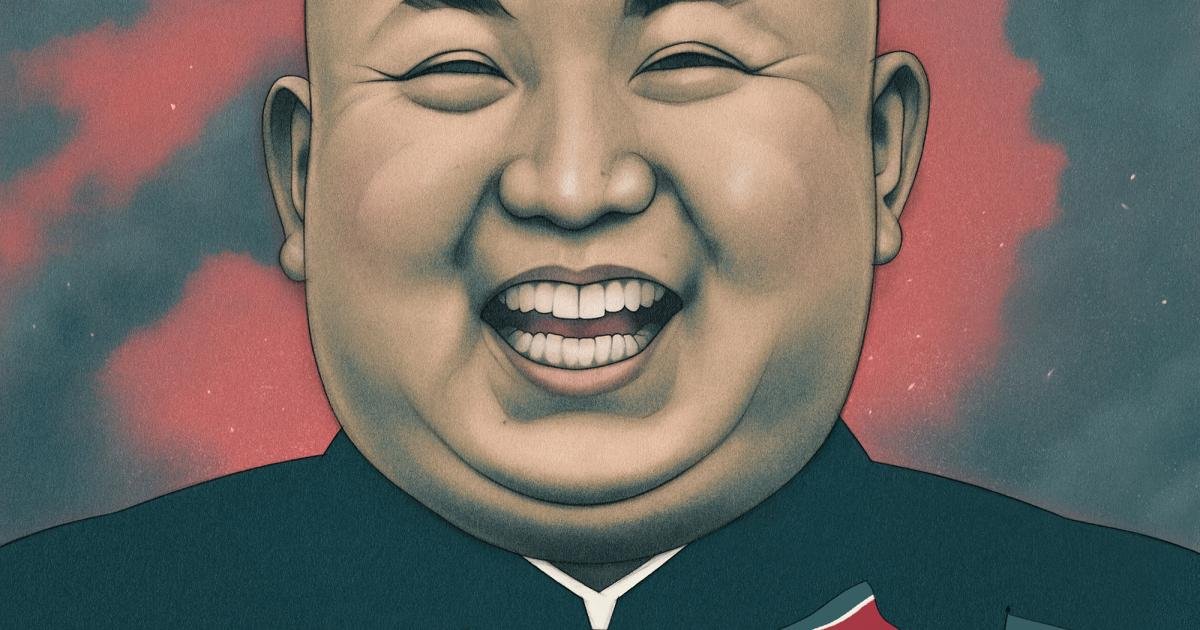
The 75th anniversary of the Korean Workers Party in October 2020 was not the festive affair that North Korean leader Kim Jong Un wanted it to be. Despite the fireworks, military flyover, and procession of new intercontinental missiles, Kim appeared to wipe away tears when he approached the lectern and apologized to the crowd: “My efforts and sincerity have not been sufficient enough to rid our people of the difficulties in their lives.” The COVID-19 pandemic had been tough for most countries, but it seemed especially portentous for North Korea, which was largely food-insecure, home to a notoriously dilapidated public health-care system, and struggling with a battered economy. Kim himself was humiliated and isolated, both domestically and internationally, after failing to deliver much-needed sanctions relief in some heady high-profile summitry with the leaders of the United States, South Korea, China, and Russia. It was arguably the lowest moment in the Democratic People’s Republic of North Korea’s 78-year history.
And yet, just five years later, in September 2025, Kim was beaming at a different military parade—in Beijing, where he stood with Chinese leader Xi Jinping and Russian leader Vladimir Putin. North Korean soldiers were now fighting alongside Russian troops in Ukraine, North Korean trade with China had reached healthy pre-pandemic levels, and Kim had been welcomed into a unified cohort of leaders countering U.S. and Western influence. In a stunning reversal of fortune, North Korea today is ascendant in ways not even the most imaginative analyst could have predicted. Kim, whose grip on power has never been stronger, has transformed himself from a global pariah into a global power player in record time.
This metamorphosis is the product of both circumstance and skill. The dawn of a new era of great-power competition has been an unwelcome development for many small countries and middle powers, but North Korea has fared better than most by leveraging its nuclear arsenal to avoid getting trampled by bigger players. Kim has also proved uniquely adept at exploiting the opportunities and navigating the currents of this new geopolitics. In approaching relations with China and Russia, he has taken surprising risks, such as fighting a war in Europe and escalating nuclear weapons development, that have paid off.
As a result, his ability to shape regional dynamics is now greater than ever. In the past, Washington has been able to work with Beijing and Moscow, albeit to a limited extent, to restrain North Korea and prevent a military confrontation. But today, the North Korea challenge is both more formidable and more durable. The confluence of U.S.-Chinese tension, Russia’s war in Ukraine, and U.S. allies’ growing distrust of Washington’s intentions and commitment has made for an unpredictable and volatile global situation. North Korea is thus a preview of the obstacles the United States will face as this new order takes shape.
ROCKET MAN
When Kim came to power in 2011 as a fresh-faced 27–year-old, North Korea’s moribund economy overwhelmingly depended on foreign aid and trade with China. International aid organizations had long reported that more than 40 percent of North Korea’s 26 million citizens suffered from malnutrition, even as the elite inhabitants of Pyongyang enjoyed restaurants and shopping malls. U.S. officials and analysts at the time predicted that the young successor, with no known military or leadership experience, was likely to fail, either quickly usurped by his elders or marginalized as a figurehead.
But Kim came out swinging. He conducted systematic purges to cow the elite into absolute loyalty, and in very public fashion killed his powerful uncle and assassinated his half-brother. He also ramped up the country’s nuclear weapons program, conducting over 100 missile tests between 2012 and 2019—more than triple the number his father and grandfather combined had overseen—and four of the country’s six nuclear tests, including a hydrogen bomb in September 2017 that had an estimated yield of 100 to 150 kilotons. (For comparison, the atomic bomb dropped on Hiroshima yielded an estimated 15 kilotons.) By the end of 2017, he had even successfully tested an intercontinental ballistic missile for the first time in North Korea’s history.
The fall of 2017 was therefore particularly tense. Kim and U.S. President Donald Trump were exchanging insults—Trump called Kim “Little Rocket Man,” while Kim called Trump “mentally deranged”—and Trump warned that the U.S. military was “locked and loaded.” James Mattis, the secretary of defense at the time, pledged “a massive military response” to any further North Korean threats, and H. R. McMaster, then the national security adviser, talked about a “preventive war” against North Korea. The tension was so thick that even China and Russia supported more stringent UN sanctions on Pyongyang.
Kim has gone from global pariah to global power player.
Kim, however, is adept at reading the room. In January 2018, he expressed an interest in attending the Winter Olympics in South Korea, providing what Sheila Miyoshi Jager, a scholar of Korean history, has called a “reassuring pause in a terrifying global game of chicken.” As the world let out a collective sigh of relief, Kim and Trump stepped back from the brink, and the two leaders engaged in an unprecedented summit in Singapore that June mediated by an eager Moon Jae-in, then South Korea’s president. Although Trump declared on social media that there was “no longer a Nuclear Threat from North Korea,” the meeting achieved little, and negotiations remained deadlocked in the ensuing months, culminating in a failed second summit in Hanoi in February 2019.
By then, it was clear that North Korea’s economy was suffering. South Korea’s central bank reported that North Korea’s economy had shrunk by four to five percent in 2018. In the negotiations, Kim offered to close part of an aging nuclear research site in exchange for the lifting of sanctions imposed in 2016 and 2017 by the United Nations, which banned North Korean exports of textiles, seafood, coal, iron ore, and labor and limited imports of refined petroleum products. Surmising that Kim would funnel the regained income back into his nuclear program, however, the United States rejected the deal, and Kim returned to Pyongyang with his tail between his legs.
To add injury to insult, a record drought then threatened North Korea’s crops, and multiple typhoons battered the country. Thus, the country’s citizens were already in an exceedingly vulnerable position when the pandemic hit in January 2020. Trade with China, North Korea’s economic lifeline, plummeted more than 80 percent as borders closed, and prognostications for the country grew increasingly grim.
LOCKDOWNS AND CRACKDOWNS
Kim, however, proved he was not one to waste a crisis. In fact, the pandemic gave him more leeway to tighten his grip on power and a tangible excuse for not delivering on the economy. Since mingling with the outside world was suddenly not just dangerous but also deadly, Kim used the pandemic to expel foreign diplomats and aid workers and further tighten security at North Korea’s borders. His propaganda machine kicked into high gear, with the spread of COVID an apt metaphor for the disease of outside influence.
The pandemic also presented North Korea with a unique economic opportunity. Pyongyang had used malicious cyber-schemes for years to mitigate the effects of sanctions and generate revenue for the regime. It stole from friend and foe alike: the UN Panel of Experts, which had been created in 2009 to investigate Pyongyang’s evasion of sanctions, reported that from 2017 to 2023, North Korean hackers amassed an estimated $3 billion. During the pandemic, this illegal operation kicked into high gear. As the world was forced online, there was a corresponding surge in online scams, frauds, and security breaches—many of them by North Korean cybercriminals. North Koreans even obtained jobs with legitimate companies in the United States, posing as remote information technology workers and earning as much as $300,000 per year.
Kim ensured that this money was put to good use. Despite the public health crisis, he did not waver from prioritizing the nuclear weapons program, and in January 2021, he unveiled an ambitious five-year defense plan to develop tactical nuclear weapons, “supersized nuclear warheads,” hypersonic glide vehicles, nuclear-powered submarines, and uncrewed underwater vehicles and reconnaissance drones. The effort paid off. In April 2025, the air force general who heads the U.S. Northern Command testified before Congress that North Korea had tested a new solid-fueled intercontinental ballistic missile that could probably “deliver a nuclear payload to targets throughout North America.”
BEIJING’S BULLY PULPIT
With his regime at the height of its power at home, Kim also saw opportunities abroad. Strategic competition between the United States and China was picking up, and Pyongyang was certainly aware of Beijing’s unease as the Biden administration worked to strengthen ties with allies in the Indo-Pacific after taking over in early 2021. Although it is not surprising that Pyongyang would hew more closely to Beijing than Washington, it was a noteworthy break from tradition when Kim began voicing more enthusiastic support for China and responding to steps taken by the United States that had little to do with North Korea.
As early as March 2021, for instance, in a letter to Xi, Kim expressed their shared need “to cope with the hostile forces’ all-round challenges and obstructive moves,” a reference to the new Biden administration’s policy of stepping up cooperation with allies and partners to counter Beijing’s coercive actions in Asia and beyond. Then, in October 2021, the regime slammed the United States for inflaming military tensions in the Taiwan Strait by conducting so-called freedom-of-navigation operations and providing Taiwan with weapons. For the first time in decades, Pyongyang was issuing statements supporting Beijing’s positions on Taiwan. In August 2022, a spokesperson for North Korea’s foreign ministry denounced a visit to Taiwan by then U.S. House Speaker Nancy Pelosi, saying that Taiwan was an “inseparable part of China” and that the United States was the “root cause of harassed peace and security in the region.”
Pyongyang had also condemned the advent of AUKUS, an agreement among Australia, the United Kingdom, and the United States under which the United States provides nuclear-powered submarines to Australia, as “an extremely dangerous act.” It went on to criticize Washington’s trilateral summit in 2022 with Japan and South Korea, the first in five years, as a “dangerous prelude to the establishment of an ‘Asian version of NATO.’” Of NATO itself, Pyongyang said the grouping was a “confrontational alliance” intent on building “a trans-Pacific encirclement to contain and isolate China.”
These were all rhetorical, low-risk, low-cost ways that North Korea could show its support for China. As a small and impoverished country, it had little else to offer its giant neighbor. But given the deterioration of his relationship with Washington and Seoul, Kim needed to keep Xi on his side. As in the past, Kim probably hoped that warmer ties with the Chinese president would soften Beijing’s enforcement of UN sanctions and impede any potential coordination between Beijing and Washington on North Korean denuclearization.
Beijing delivered. Although China had signed on to UN sanctions, Beijing threw Pyongyang a lifeline in 2020 that, according to U.S. intelligence and UN reports, included 32 instances of fuel smuggling, 555 instances of ships carrying UN-banned goods from North Korea to China, and 155 incidents of Chinese-flagged coal barges traveling to North Korea and returning to China with illicit cargo. Beijing, which has long prioritized stability along its border, was likely concerned about the pandemic’s effects on Pyongyang’s domestic situation. Xi wanted to keep Kim in his sights.
Kim also benefited as U.S.-Chinese cooperation withered because of strategic competition. Chinese officials often blandly called for U.S. “restraint,” argued that North Korea has “legitimate” security concerns, and blamed Washington and Seoul for holding joint military exercises in the region and inflaming tensions. This was all music to Kim’s ears.
THE PUTIN PIVOT
Despite his attempts to flatter Beijing, Kim, like his father before him, has long bristled at his country’s overreliance on China. The dynamic gets especially prickly because Beijing favors stability on the peninsula and has used its economic leverage to rein in the regime’s provocations. In 2003, for instance, China cut off oil supplies to North Korea for three days after Pyongyang test-fired a missile into the waters between the Korean Peninsula and Japan.
Kim, however, has not been shy about showing Xi he is beholden to no one. In May 2017, for instance, he provoked Xi by conducting ballistic missile tests near the border with China before Xi hosted the Belt and Road Forum. Even as Kim courted Beijing and offered it his support at the outset of the pandemic, he was looking for ways to preserve his autonomy.
When Russia launched its unlawful war against Ukraine in 2022, luck met preparation. Pyongyang’s connections to Moscow had been lukewarm since the end of the Cold War, but both sides saw some benefit to maintaining ties: Putin wanted to be a player in Northeast Asia, and Kim had always seen Putin as a way to balance his relationships with China, South Korea, and the United States. Russia’s desperation for military support in its war against Ukraine created an unprecedentedly favorable environment in which Kim could assert his usefulness.
In September 2022, seven months into the war, Washington released declassified intelligence warning that Russia was seeking to purchase millions of artillery shells and rockets from North Korea, an indication that Moscow was so squeezed by international sanctions that Putin had to resort to asking North Korea for help. By the summer and fall of 2023, according to South Korean military and intelligence estimates, North Korea had shipped short-range ballistic missiles, antitank missiles, and portable antiaircraft missiles to Russia, in addition to more than a million North Korean artillery shells.
North Korea now supplies as much as 40 percent of the Russian army’s munitions.
At first, Pyongyang denied involvement, possibly to increase its leverage with Moscow and to preserve maximum flexibility in its next moves. But North Korea’s material support to Russia soon proved too valuable a development for Kim, as he sought to position himself as part of a larger bloc of self-proclaimed anti-Western, anti-imperialist powers. In September 2023, Kim made his first trip outside the country since the start of the pandemic to a space launch facility in the Russian Far East. Kim and Putin spent at least four hours together, according to a Russian state news agency, with Putin offering technological assistance on satellites as well as possibilities for military cooperation, and Kim endorsing Russia’s “special operation” in Ukraine and a “fight against imperialism.”
In June 2024, Putin then traveled to Pyongyang, where the two leaders upgraded their relationship to a “comprehensive strategic partnership” and pledged that if either country went to war after being invaded, the other would provide military assistance. This striking agreement, echoing language from a 1961 pact between the Soviet Union and North Korea, turned on the spigot of North Korean support for Putin. By the end of 2024, Pyongyang had sent 11,000 troops to Russia to fight against Ukraine and more than 20,000 shipping containers of munitions, including at least six million heavy artillery rounds and 100 ballistic missiles, according to monitoring by the United States and its allies.
Putin, meanwhile, in addition to paying North Korea for arms and troops, was likely providing it with oil, wheat flour, sugar, fish, and soybeans and helping it to access the global financial system and pay its workers in violation of UN sanctions. By the end of 2024, the two countries had also traded delegations on AI, cyber-operations, intelligence, science and technology, sports, agriculture, and culture.
It was only in April 2025 that Kim publicly acknowledged that he had sent troops to Russia to “annihilate and wipe out the Ukrainian neo-Nazi occupiers.” The move was likely driven in part by Kim’s inability to hide the estimated 6,000 North Korean casualties in the war but also by Russian–North Korean successes on the battlefield—giving him another great propaganda opportunity.
MAKE NEW FRIENDS, KEEP THE OLD
For Kim, who had long been a belittled leader of a rogue state, the alliance with Putin was a major accomplishment. His ability to frame North Korea as contributing to an anti-Western project also gave him the luster of ideological legitimacy among his people and globally—his was a country now embraced by two permanent members of the UN Security Council. This came with tangible benefits. In 2022, for instance, Russia and China blocked Security Council efforts to strengthen sanctions against Pyongyang. They also banded together in 2024 to blow up the UN Panel of Experts, vetoing a Security Council resolution to extend its mandate.
Yet even though Putin and Xi have said their friendship has “no limits,” Beijing was likely irked by North Korea’s new coziness with Russia. Not to be outdone and to remind Pyongyang of its economic center of gravity, China increased its trade with North Korea by more than 25 percent from 2024 to 2025. Moreover, to assert Beijing’s influence over its neighbors, Xi invited Kim to attend the 2025 military parade and featured him prominently in the programming. This gesture went a long way toward chipping away at Kim’s pariah status: there was no mention of denuclearization in Beijing’s formal summary of their private bilateral meeting, as there had been in previous Chinese readouts, suggesting that China was willing to accept North Korea as a nuclear weapons power.
North Korea’s military, meanwhile, has made rapid gains thanks to Russia’s use of its missiles, artillery, and soldiers. In April 2025, the commander of U.S. forces in Korea testified that Russia’s expertise will “enable advancements of [North Korea’s] weapons of mass destruction program over the next three to five years.” Although there were problems with North Korean missiles at first, Ukraine’s chief of defense intelligence said in August 2025 that their “accuracy, unfortunately, has increased after Russian modernization.”
Reports highlighting new forms of cooperation continue to trickle in. Ukrainian military intelligence has assessed that North Korea now supplies as much as 40 percent of the Russian army’s munitions. A British research group found that Russian forces are using previously unknown North Korean cluster munitions in their attack drones. And according to Ukrainian defense officials, North Korean troops are becoming better fighters. The commander of a Ukrainian assault battalion told National Public Radio last year that North Koreans are learning electronic warfare and “went from using World War II tactics to managing on the battlefield with drones.”
With its improved military, its recovering economy, and its various new relationships at the regional and subnational levels, Pyongyang thus has more strategic and tactical flexibility than ever before. Kim, in other words, poses an unprecedented threat to the region.
TESTING THE LIMITS
It remains unlikely that Kim would pursue an outright invasion of South Korea, which could invite regime-ending retaliation from Seoul and Washington. Kim is bold and opportunistic, not suicidal. But given his new standing and strength, he is now more likely to threaten and coerce his neighbors, which would create strategic dilemmas for the United States.
For instance, Kim could conduct kinetic activities—covert and overt—aimed at testing the U.S.–South Korean alliance and gauging how Beijing and Moscow would respond. North Korea has conducted such activities against Seoul in the past, but the combination of material and technical support from Moscow and the perception that the Trump administration has a reduced commitment to alliances has probably increased Kim’s confidence and appetite for risk.
Consider the Yellow Sea, for example. Home to the Northern Limit Line, the de facto maritime border between North and South Korea, the sea is rich in fishery resources and close to major South Korean ports, not to mention large population centers. But Pyongyang has never recognized the NLL, and it has long been a source of North Korean ire and the site of numerous tit-for-tat exchanges.
Kim now appears intent on placing more pressure on the legitimacy of the NLL. He has called it a “ghost line” and, seemingly taking cues from Beijing’s “gray zone” activities in the South China Sea, is testing Seoul’s tolerance for incursions. In September 2025, for example, a North Korean merchant vessel crossed the NLL, eliciting warning broadcasts and warning shots from South Korea. In claiming that Pyongyang would hit back at any “invasions” across the maritime border as an “infringement of [the North’s] sovereignty and as armed provocations,” Kim signaled his willingness to challenge the status quo, even at the risk of sparking a military conflict.

A series of North Korean actions and official pronouncements underscore Kim’s growing appetite for risk. In November 2022, for instance, North Korea fired close to two dozen ballistic missiles from its east and west coasts, ostensibly as a response to routine U.S.–South Korean military exercises. One missile landed in South Korea’s territorial waters less than 40 miles from the South Korean city of Sokcho. It was the first time such an event had occurred since the Korean War in the 1950s.
In total, Kim lobbed almost 70 missiles in 2022 alone, the most in North Korean history. Then, in late 2023, Kim jettisoned his father and grandfather’s policy of peaceful reunification and declared South Korea “a hostile state.”
North Korea has also stepped up its nuclear threats. In July 2022, in a strident speech aimed at the United States and Yoon Suk-yeol, then the new South Korean president, Kim claimed that the North’s nuclear program was “ready to mobilize its absolute power dutifully, exactly, and swiftly,” according to official state media. When a nuclear-powered U.S. aircraft carrier arrived in South Korea for trilateral maritime drills with Japan in October 2023, Pyongyang lashed out and threatened preemptive use of nuclear weapons. And after unveiling its new naval destroyer—its largest warship—in April 2025, which Kim bragged could handle nuclear-capable missiles, North Korea conducted a nuclear counterstrike simulation against U.S. and South Korean forces.
For years, the superiority of South Korea’s military, which is bolstered by the U.S. nuclear umbrella and armed forces stationed in the country, served as a deterrent for North Korean aggression. But with the improved capabilities acquired from Moscow and advances in his nuclear program, Kim’s calculus has likely changed. As a U.S. National Intelligence Estimate noted in January 2023, Kim “may be willing to take greater conventional military risks, believing that nuclear weapons will deter an unacceptably strong U.S. or South Korean response.” It also suggested that the North Korean leader would be more emboldened if he were confident that China and Russia would not oppose him.
THE COMEBACK KIM
Kim has a new arsenal of diplomatic maneuvers to soften blowback from his military moves aimed at altering the status quo. Consider a scenario in which North Korea acts aggressively in the Yellow Sea, perhaps by sending a large number of naval and merchant vessels past the NLL and harassing South Korean fishing boats, while declaring again that Pyongyang does not recognize the Korean armistice or the legitimacy of the maritime boundary.
As in the past, the two sides might exchange fire. But unlike when such clashes occurred in 1973, 1999, 2002, 2009, and 2010, North Korea has more advanced and diverse weapons today. Kim could threaten or hint at tactical nuclear weapons use in the standoff, which in turn would complicate coordination between the South Korean and U.S. militaries. He could then pivot to diplomatic engagement with Trump—not on denuclearization but on the status of the NLL—and trigger South Korean doubts about U.S. commitment to the alliance, extended deterrence, and disarming North Korea.
Beijing, for its part, would typically oppose any such military confrontation, but it would likely support a dialogue between the United States and North Korea, especially if it weakened Washington’s alliance with Seoul. Kim could thus score a meaningful victory: encroachment across the NLL while diverting attention away from his nuclear weapons program.
Kim could easily draw Xi and Putin into a situation that they would not have chosen.
He could play his diplomatic cards in other ways as well. To show his value to Putin, for instance, Kim could start talks with South Korea as leverage to limit Seoul’s support for Ukraine. Seoul provided nearly $400 million in reconstruction and humanitarian aid to Ukraine in 2024 and pledged more than $2 billion in low-interest loans and expanded economic cooperation. Scaling back support for Ukraine would likely strain South Korea’s ties with Europe, but if Kim made positive overtures to Seoul, its progressive presidential administration—traditionally the party that has preferred a softer touch with Pyongyang—would find them hard to ignore, particularly since ties between the peninsula’s two governments have been frozen since 2019. President Lee Jae-myung would likely welcome the opportunity to pursue inter-Korean diplomacy, including the resumption of reunions of families separated by the Korean War. Kim would walk away from the exchange with more fuel or more sensitive military technologies from Russia, while Putin would secure decreased support for Ukraine. Both would benefit from driving a wedge between South Korea and Europe.
Given that China’s and Russia’s interests are not aligned on the peninsula—Beijing wants stability, and Moscow wants distraction—there are also countless other scenarios in which Kim could play Xi and Putin off each other. Indeed, it is important to remember that beneath the pageantry, this three-way partnership is shot through with suspicion. The New York Times, for instance, obtained a Russian intelligence report that called China an “enemy” and warned of Chinese espionage.
Chinese officials and experts, meanwhile, are expressing concern in private conversations with American interlocutors about what kinds of military technology Russia might be sharing with North Korea and how that might embolden Kim to take escalatory actions. They want the United States to know that China is not supportive of Russia’s closer ties with North Korea. As Zhu Feng, dean of the School of International Relations of Nanjing University, told the Associated Press, “Though the Russia–North Korea tie has resumed to a military alliance, China refuses to return to the year of 1950.”
Kim could easily draw Xi and Putin into a situation that they would not have chosen and that is not in either’s national interest. China, for instance, still has considerable economic leverage with North Korea, but Kim could play on Beijing’s unease about Russia’s growing influence to extract more concessions. And if Kim becomes impatient with the level of military materiel and know-how he’s getting from Russia—North Korea has been hacking into Russia’s foreign ministry and defense firms since at least 2022, suggesting Kim might not be satisfied with current levels of support—he could dial down his support for the war in Ukraine and undermine Putin’s war effort.
HERMIT KINGDOM NO MORE
North Korea, to everyone’s surprise, holds quite a few cards. Kim has proved himself to be a skillful regional player and, like his father and grandfather before him, has honed the craft of juggling, flattering, threatening, and frustrating his larger neighbors. Because North Korea’s internal and external conditions have dramatically changed over the past five years, his actions now have the potential to challenge the status quo, sow confusion, and undermine U.S. interests far beyond the Korean Peninsula.
In the past, Washington has offered sanctions relief, economic assistance, and humanitarian aid to engage Pyongyang and restrain its actions. Now, if the United States chooses to revive dialogue, it will have to be prepared to offer much more than that. Kim has new networks, new capabilities, and tacit acceptance that North Korea will remain a nuclear power. Washington must reckon with the new geostrategic landscape because however Kim chooses to advance his goals—through diplomatic or military means or a combination of both—what happens on the Korean Peninsula won’t stay on the Korean Peninsula.
Loading…
