

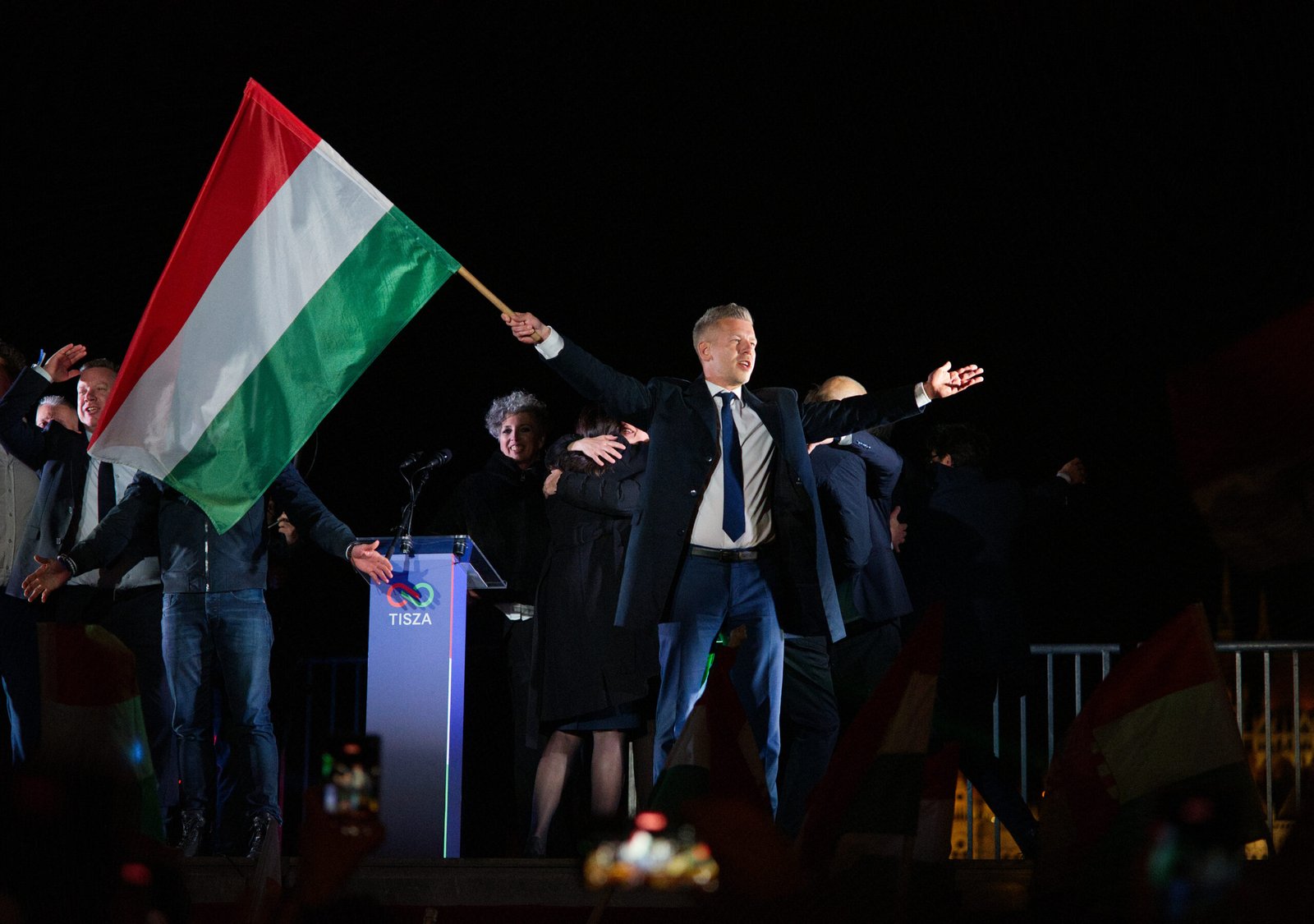
WASHINGTON—In the first week after his party’s victory in Hungary’s national elections on April 12, the prime minister-apparent, Péter Magyar, vowed to bring independence to state media and counter corruption, including by joining the European Public Prosecutor’s Office.
Hungary’s pro-European turn was far from certain. As recently as the 2022 parliamentary elections, Viktor Orbán’s Fidesz party secured its highest vote share since Hungary’s transition from communism in 1989. Orbán’s sixteen-year tenure was widely described as corrupt, illiberal, and aligned with Moscow, and protests against Orbán’s government were a mainstay of the Hungarian opposition.
Under Orbán, Hungary had become what some called a “competitive authoritarian” system, in which elections occur but are tilted by incumbents through coercive tactics. Hungary is far from the only country with such a system, and Magyar’s victory offers lessons for other opposition groups. Perhaps most important is the lesson that success depends less on the scale of protests than on opposition unity and a credible electoral path to power.
What did Magyar and the Hungarian opposition get right?
First, they prioritized unity over ideological purity. Rather than splintering across multiple candidates, opposition forces consolidated behind a single challenger once it became clear that Magyar had momentum, even when there were sharp differences on issues such as migration. Absent the unifying effect of opposing Orbán, the opposition parties that aligned with Magyar’s Tisza would probably have preferred that their own standard-bearers become the next prime minister. After all, Magyar had been a member of Fidesz before leading Tisza, and his center-right politics are markedly different from the more left-leaning elements of the coalition that defeated Orbán. But the opposition made a strategic calculation to prioritize defeating the entrenched system over holding fast to their ideologies.
Second, Magyar’s message connected his geopolitical orientation to citizens’ material concerns. He recounted the benefits of Hungary moving toward the West while highlighting the country’s poor economic conditions under Orbán, including rising inflation and near-stagnant growth. He also highlighted the blatant corruption within Fidesz that enriched Orbán’s loyalists.
Third, Magyar expanded the opposition’s reach beyond its traditional base. By appealing to rural voters through a grassroots campaign focused on the cost of living, Magyar built a broader coalition capable of challenging the ruling party’s dominance by tapping into a demographic previously loyal to Orbán.
The combined effect of these elements proved a success. Opposition groups channeled public discontent with Fidesz’s rule into a landslide electoral victory for Tisza—even with Moscow’s hand on the scale and a public endorsement from US President Donald Trump. Turning public outrage into electoral success is precisely where other countries facing competitive authoritarian systems have fallen short.
In Georgia, sustained protests erupted in 2024 after the ruling Georgian Dream party advanced a “foreign agents” law widely seen as mirroring Russian legislation used to suppress civil society. Discontent deepened following a disputed parliamentary election that kept Georgian Dream in power. Despite the scale and persistence of the protest movement that followed—which remains active today—the opposition has failed to present a unified electoral alternative. In fact, opposition parties decided to boycott parliament, leaving the ruling party to consolidate power.
Georgia’s contrast with Hungary is stark. Whereas Magyar’s victory depended on coordination and compromise, Georgia’s opposition has struggled to move beyond protest to tangible electoral results.
A similar dynamic is unfolding in Serbia. Mass demonstrations, sparked by the deadly collapse of a train station canopy in November 2024, mobilized students and civil society in sustained opposition to President Aleksandar Vučić and his Serbian Progressive Party. The protests have been remarkably well-organized, with daily and widespread participation.
But mobilization has not translated into political power in Serbia’s increasingly illiberal system. Student protest leaders have largely rejected cooperation with established opposition parties, reflecting deep distrust. Protest leaders have called for early parliamentary elections, and they plan to produce a “student list” of candidates for the next election. It remains unclear whether this list will overlap with traditional opposition forces or compete against them and risk fragmentation. Even as ruling party margins have narrowed, the absence of a unified opposition has allowed Vučić to maintain his grip on power.
In both Georgia and Serbia, opposition movements currently lack a strategy to channel that anger into a viable, unified electoral challenge.
Hungary demonstrates that opposition forces that are willing to subordinate internal divisions to a common objective can disrupt even entrenched systems. Protest movements can expose the weaknesses of a regime, but—especially in competitive authoritarian systems—they face systematic barriers that, by design, prevent discontent alone from dislodging the ruling party.
