

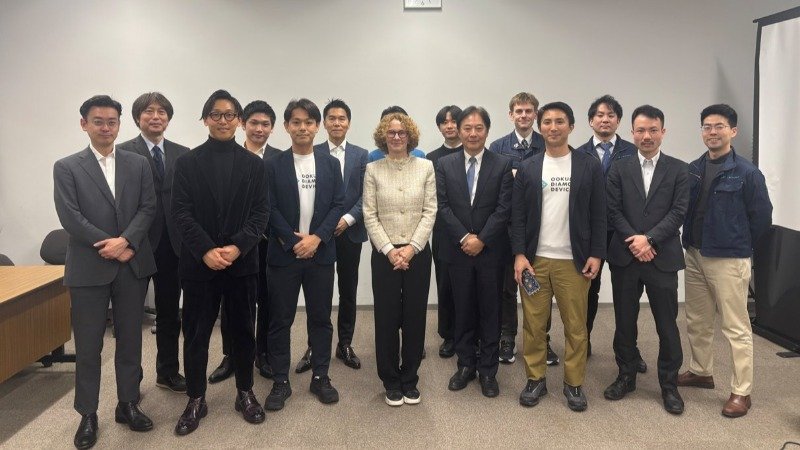
On March 6, NATO Deputy Secretary General Radmila Shekerinska met with Japanese startups developing advanced dual-use technologies for both civilian and defense applications. The event, organized by Japan’s Ministry of Economy, Trade and Industry (METI), was part of Shekerinska’s March 5–6 visit to Japan at the invitation of the Ministry of Foreign Affairs (MOFA).[1]
During the METI startup session, companies pitched their technologies and exchanged views on the dual-use capabilities of Japan’s startup sector and NATO’s priority areas.
One company that has publicly confirmed its participation is SpaceData Inc., a Tokyo-based startup specializing in space technology and AI-driven digital platforms.[2]
Separately, Shekerinska also visited an R&D facility operated by Synspective Inc., a Japanese startup developer of small Synthetic Aperture Radar (SAR) satellites and SAR-based data analytics services.[3]
The Deputy Secretary General’s visit coincided with a Nikkei report[4] that Japan has formally approached NATO about joining its innovation hub, DIANA (Defence Innovation Accelerator for the North Atlantic), to expand opportunities for Japanese startups in AI and space.
Japan’s Talks to Enter NATO DIANA
Japan is reportedly in formal negotiations to join NATO’s DIANA, which identifies startups with promising dual-use technologies in fields such as AI, space, unmanned systems, and biotechnology.
The initiative is part of NATO’s effort to strengthen its technological edge and military superiority amid growing global competition in emerging and disruptive technologies (EDT).[5]
If Japan’s talks on DIANA are successful, it would become the first NATO non-member country to participate in the program, which is currently limited to companies based in NATO’s 32 member states.
NATO is said to have responded positively to Tokyo’s interest, though a final decision will likely require approval from the alliance’s member countries.
A NATO source also reportedly expressed strong expectations for Japanese startups, particularly in AI and space.
These two specific sectors were also emphasized by Japan during Shekerinska’s visit, including presentations by companies such as SpaceData, illustrating alignment with DIANA’s priority areas.
SpaceData as a Case Study in Japan’s DIANA-Relevant Technologies
SpaceData is a Tokyo-based startup specializing in both fields that Tokyo is reportedly targeting for the country’s participation in DIANA: space technology and AI-driven platforms.
SpaceData introduced to NATO Deputy Secretary General Shekerinska its “PROVIDENCE” platform, an AI-powered digital twin system designed to simulate Earth and space environments for dual-use applications.[6]
When integrated with real-world robotic systems, the PROVIDENCE platform can be used for defense, disaster response, space development, and urban planning.[7] The platform also supports the testing and training of aerial drones by simulating diverse operational scenarios in a virtual environment.[8]
For defense , PROVIDENCE is being developed to support cross-domain operations by integrating data traditionally managed separately by land, naval, and air forces into a unified 3D environment powered by physical simulation and AI.[9]

PROVIDENCE combines AI with data collected from satellites, drones and other sources of information into a single platform, allowing commanders to visualize operational environments in near real time and support faster decision-making.
Such digital twin systems have become an increasing focus for NATO as part of its efforts to enhance multidomain operations and crisis response.
In its 2026 Defence Challenge Programme, DIANA identified “data-assisted decision making” as a key solution area, emphasizing a need for fused and visualized heterogeneous data streams in support of multidomain operations.[10]
NATO also highlights strong commercial momentum in this sector, noting that the global digital twin market is projected to have a compound annual growth rate of 34% and be valued at around USD 156 billion by 2030.
Thus, if Japan succeeds in joining NATO DIANA, there would be strong opportunities for SpaceData and other domestic firms to contribute to transatlantic requirements for digital twin technologies.
Synspective and NATO’s Space Operations Needs
In addition to the startup session, NATO Deputy Secretary General Shekerinska’s visit to a Synspective facility[11] indicates a transatlantic interest in Japanese space capabilities.

Synspective specializes in the design, construction, and operation of small SAR satellites. The company also provides SAR-based data analytics services.
In February 2026, the space startup secured a role in a major Japan Ministry of Defense (JMOD) satellite constellation project worth 283.1 billion yen (approx. USD 1.8 billion). Under the program, Synspective will provide SAR imagery and related services to a constellation designed to detect and track targets as part of Japan’s stand-off capabilities.[12]

Synspective is also engaged in European space ecosystems. In February 2026, the company signed a strategic agreement with Airbus Defence and Space to supply SAR data, integrating its capabilities into Airbus’ global Earth observation portfolio.[13]
Such capabilities align with NATO’s ownspace priorities. The alliance has outlined plans for a space surveillance constellation known as “Aquila,” and has emphasized the need to reduce reliance on ground-based detection by expanding orbital sensors.[14]
NATO has also highlighted the importance of integrating these orbital sensors with secure communications networks, data processing infrastructure, and analytics platforms. These are areas where Japanese companies like Synspective are well positioned to contribute.
Conclusion: Emerging Japan-NATO Alignment on Dual-Use Technology
NATO’s engagement by Shekerinska with Japanese startups follows a similar initiative that METI organized for NATO Secretary General Mark Rutte last year. This highlights growing awareness of the emerging alignment between NATO strategic priorities and Japanese technological capabilities.
During the latest NATO visit, JMOD was keen to emphasize how it had raised awareness of Japan’s defense industry. Meanwhile, NATO Deputy Secretary General Shekerinska emphasized how defense industrial cooperation, space and innovation were the transatlantic alliance’s priority areas in its partnership with Japan.[15]
Japanese firms are thus positioned to contribute to the transatlantic alliance’s requirements, particularly in space, AI and digital twinning. Tokyo’s potential participation in DIANA would both expand business opportunities for Japanese startups and strengthen Japan-NATO cooperation in dual-use innovation.
The move would be an important step for both Japan and NATO to pursue acquisition of EDTs and maintain their military edge amidst global competition while also enhancing interoperability between the JSDF and the transatlantic allied forces.
Notes:
** 1 USD = 160 JPY
[1] MOFA, “Visit to Japan by H.E. Shekerinska, NATO Deputy Secretary General”, March 4, 2026, METI, “シェケリンスカNATO(北大西洋条約機構)事務次長と井野経済産業副大臣との会談及び日本のデュアルユース・スタートアップ企業との対話が行われました” [A meeting was held between NATO Deputy Secretary-General Shekerinska and Vice Minister of Economy, Trade and Industry Ino, as well as a dialogue with Japanese dual-use startup companies], March 6, 2026, https://www.meti.go.jp/press/2025/03/20260306002/20260306002.html.
[2] SpaceData Inc., “NATO事務次長、日本のデュアルユース企業と意見交換” [NATO Deputy Secretary-General exchanges views with Japanese dual-use companies], March 11, 2026, https://spacedata.jp/news/202603_NATO.
[3] JMOD, “Deputy Secretary General of NATO’s visit to Naval Air Facility Atsugi and Synspective Yamato Technology Center”, March 6, 2026, .
[4] Nikkei Shimbun, “日本、NATOスタートアップ育成枠組みに参加打診 AI・宇宙で商機” [Japan exploring participation in NATO startup incubator, seeking business opportunities in AI and space], March 5, 2026, https://www.nikkei.com/article/DGXZQOGR012XS0R00C26A3000000/.
[5] NATO, “Emerging and disruptive technologies”. Updated: 25 June 2025, https://www.nato.int/en/what-we-do/deterrence-and-defence/emerging-and-disruptive-technologies.
[6] SpaceData Inc., “NATO事務次長、日本のデュアルユース企業と意見交換” [NATO Deputy Secretary-General exchanges views with Japanese dual-use companies], March 11, 2026, https://spacedata.jp/news/202603_NATO.
[7] SpaceData Inc., Platform, https://en.spacedata.jp/business/planetary-computing.
[8] SpaceData Inc., “NATO事務次長、日本のデュアルユース企業と意見交換” [NATO Deputy Secretary-General exchanges views with Japanese dual-use companies], March 11, 2026, https://spacedata.jp/news/202603_NATO.
[9] SpaceData Inc., “Solutions for Defense”, ; SpaceData Inc., “スペースデータ、統合技術基盤「PROVIDENCE」の防衛分野への提供を大幅拡大” [SpaceData significantly expands its provision of integrated technology platform “PROVIDENCE” to the defense sector]. PR Times, January 21, 2026, https://prtimes.jp/main/html/rd/p/000000103.000080352.html.
[10] NATO DIANA, “10. Data Assisted Decision Making”. Challenges 2026, https://www.diana.nato.int/resources/site1/general/challenges/docs/cha-26-10-data-assisted-decision-making.pdf.
[11] JMOD, “Deputy Secretary General of NATO’s visit to Naval Air Facility Atsugi and Synspective Yamato Technology Center”, March 6, 2026, .
[12] Synspective Inc., “Synspective Joins Ministry of Defense Satellite Constellation Project Following SPC Establishment and Contract Execution”, February 20, 2026, JMOD, “Progress and Budget in Fundamental Reinforcement of Defense Capabilities – Overview of FY2025 Budget -”, p.8, https://www.mod.go.jp/en/d_act/d_budget/pdf/fy2025_20250411a.pdf.
[13] Synspective Inc., “Synspective and Airbus Defence and Space Announce Strategic Partnership to Expand SAR Satellite Data Access”, February 10, 2026, https://synspective.com/press-release/2026/airbus_partnership/.
[14] NATO, “NATO’s approach to space”. Updated: 30 July 2025, DIANA, “8. Resilient Space Operations”. Challenges 2026, https://www.diana.nato.int/resources/site1/general/challenges/docs/cha-26-08-space-operations.pdf.
[15] JMOD, “Deputy Secretary General of NATO’s visit to Naval Air Facility Atsugi and Synspective Yamato Technology Center”, March 6, 2026, ; NATO, “NATO Deputy Secretary General in Tokyo, reaffirms the strategic importance of the NATO-Japan partnership”, March 6, 2026, https://www.nato.int/en/news-and-events/articles/news/2026/03/06/nato-deputy-secretary-general-in-tokyo-reaffirms-the-strategic-importance-of-the-nato-japan-partnership.
