

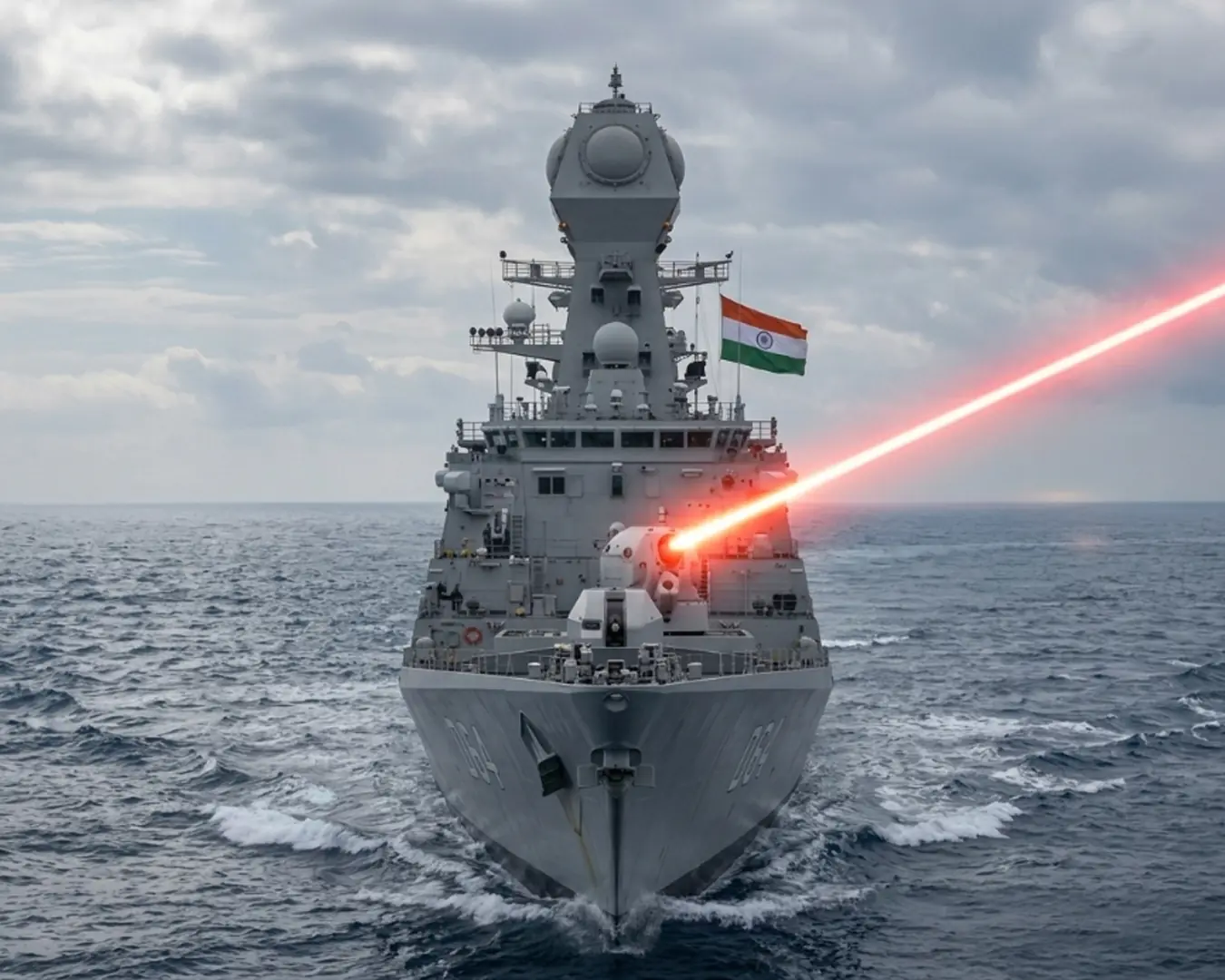
Defense Feeds, New Delhi – India is moving closer to deploying ship-mounted directed energy weapons on its frontline naval fleet. The Defence Research and Development Organisation is preparing to test a 100-kilowatt high-power laser system designed for integration on Indian Navy destroyers.
The Indian Navy laser weapon DURGA-II program aims to provide advanced defensive capability against drones, missiles and other aerial threats that modern naval forces increasingly face.
The upcoming test represents major advancement over earlier Indian laser weapon generations. Previous systems operated in 25-kilowatt class, designed primarily to “dazzle” or temporarily blind electro-optical sensors on hostile platforms.
The new 100-kilowatt DURGA-II laser system represents a transformational leap in destructive capability. At this power level, the laser beam can deliver sufficient thermal energy to burn through incoming drone structures, destroying airframes mid-flight. The weapon is also expected to disrupt or disable infrared seekers on anti-ship cruise missiles, offering additional ship defense layer.
The Indian Navy laser weapon DURGA-II program builds on earlier demonstrations conducted by DRDO. In April 2025, the Indian Navy successfully tested a 30-kilowatt truck-mounted Directed Energy Weapon at Kurnool Test Range.
During that trial, the laser system destroyed fixed-wing drone targets at approximately five kilometers range, demonstrating viability of laser-based air defense against unmanned aerial threats. Those results provided confidence that scaling to 100 kilowatts would deliver even more robust capability.
Technical Adaptation and Maritime Integration
The 100-kilowatt system is currently undergoing “marinization”—adapting the technology to operate reliably in harsh maritime conditions including high humidity, salt spray and constant ship movement. Naval environments present unique technical challenges that ground-based systems never encounter.
Laser optics must maintain alignment despite corrosive salt air, thermal fluctuations and platform vibration from ship motion. DRDO engineers are addressing these challenges to ensure operational reliability in demanding sea conditions.
Once operational, the Indian Navy laser weapon system is expected to deploy on the Visakhapatnam-class destroyer fleet. These stealth destroyers represent among the most advanced surface combatants operated by the Indian Navy, providing ideal platforms for integrating new directed energy systems.
The integration will give these warships unprecedented capability against emerging aerial threats that traditional air defense systems struggle to address effectively.
High-power laser weapons are increasingly recognized as critical elements of next-generation naval defense architecture worldwide. They prove particularly effective against low-cost swarm drones, which can overwhelm traditional missile defenses through sheer numbers and relatively low cost per unit.
An Indian Navy laser weapon DURGA-II system can engage multiple targets rapidly with minimal logistical burden, making it ideal for defending warships against drone swarms, loitering munitions and incoming missiles simultaneously.

Strategic Significance and Threat Environment
India faces growing aerial threats from unmanned systems as regional competitors expand drone and missile arsenals. The DURGA-II program addresses this vulnerability by providing organic ship-based defense against targets that traditional naval air defense systems were never designed to counter.
Laser weapons offer distinct advantages over kinetic missiles: unlimited magazine capacity in theory, negligible logistical footprint and ability to engage targets at speed-of-light velocity. This program marks significant step toward building indigenous directed energy capabilities for Indian armed forces.
Unlike imported air defense systems requiring foreign support and spare parts, the DURGA-II system represents Indian technological achievement. That indigenous development strengthens the country’s ability to defend naval assets against emerging aerial threats while reducing dependence on foreign military technology providers.
The Visakhapatnam-class destroyers selected for laser weapon integration carry advanced radar, combat management systems and multi-layered air defense architecture. Adding directed energy capability creates unprecedented defensive depth. These ships will possess layered defenses combining missiles, guns and directed energy weapons—a comprehensive approach to maritime security in contested waters.
DRDO’s commitment to laser weapon development reflects India’s recognition that future naval warfare requires diverse defensive options. Traditional air defense missiles remain important for high-value target engagement. Guns provide close-in defensive capability.
Laser weapons address the critical gap against drone swarms and low-cost unmanned platforms. That layered approach maximizes defensive effectiveness against diverse threat scenarios.
The Indian Navy laser weapon DURGA-II program also supports India’s broader defense modernization strategy. As indigenous defense technology development accelerates, Indian Navy receives increasingly sophisticated systems designed specifically for operational requirements. This approach builds defense industrial capability while ensuring warship capabilities match regional threat environments precisely.
