

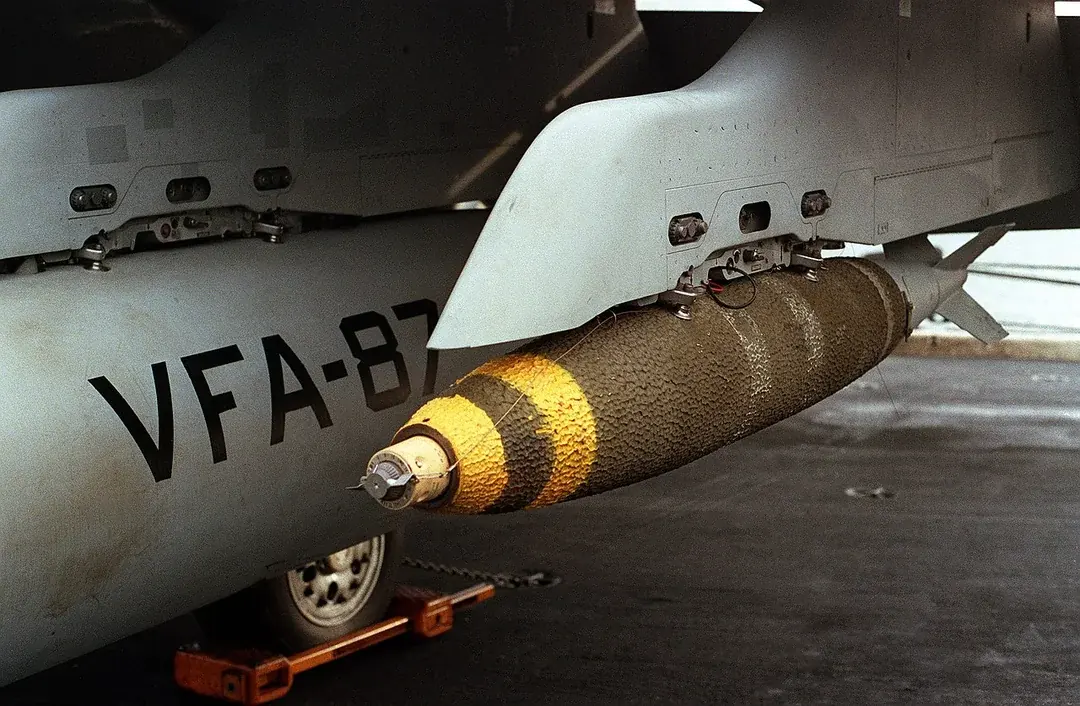
There’s something oddly paradoxical about the Mark 82 bomb. On paper, it’s “just” a 500-pound general-purpose bomb, simple, even old-school. But in practice? It’s one of the most enduring and widely used aerial weapons ever built. Decades old, yet still hanging under the wings of modern fighter jets. That alone should make you pause.
Think about this for a second: in an age of drones, AI targeting, and precision-guided everything, why does a gravity-dropped bomb from the mid-20th century still matter? The answer is a mix of engineering elegance, adaptability, and, frankly, cost-efficiency.
The Mk 82 sits in a sweet spot, powerful enough to do serious damage, yet small and flexible enough to be used in a wide range of missions.
At its core, the Mark 82 bomb belongs to the broader Mark 80 series, a family designed to standardize aerial munitions.
The idea was simple: create bombs that could be easily modified, fitted with different tails, or upgraded with guidance kits. That modularity is a big reason the Mk 82 hasn’t faded into obscurity.
You’ll often hear it referred to as a “500 lb bomb,” but that label barely scratches the surface. Depending on configuration, it can behave very differently, fall fast, fall slow, hit precisely, or saturate an area with fragmentation.
So if you’ve ever wondered how one weapon can span generations of warfare, and still stay relevant, you’re in the right place.
What Is the Mark 82 Bomb?
At its simplest, the Mark 82 bomb is a free-fall, unguided aerial weapon, what people often call a “dumb bomb.” No onboard computer. No propulsion. Once released, it obeys gravity and physics, nothing more. And yet, that simplicity is precisely what makes it so dependable.

The Mk 82 belongs to the Mark 80 series, a lineup engineered with a kind of plug-and-play philosophy long before that term became trendy. Instead of designing entirely new bombs for every mission, engineers created a standardized body that could be adapted. Swap the tail, change the fuze, add a guidance kit, and suddenly, the same bomb behaves like a completely different tool.
Physically, it’s a streamlined steel casing packed with high explosive. When it detonates, two things happen almost instantly: a powerful blast wave expands outward, and the casing shatters into high-velocity fragments. That dual effect, blast plus fragmentation, is why it’s classified as a general-purpose bomb. It’s not specialized, but it’s extremely versatile.
Now here’s where it gets interesting.
The Mk 82 isn’t locked into being “dumb.” Attach a laser guidance kit, and it becomes a precision weapon. Add a GPS-based JDAM kit, and it can hit targets in poor weather or at night. Same core bomb, completely different capabilities.
You might think of it like a basic camera body. On its own, it’s limited. But swap lenses, tweak settings, and suddenly you’re shooting landscapes, portraits, or low-light scenes.
The Mark 82 works in a surprisingly similar way, modular, adaptable, and still very much relevant in modern air operations.
Mark 82 Bomb Specifications
Numbers tell a clearer story than adjectives ever could. The Mark 82 bomb might sound modest labeled as a “500 lb bomb,” but its design is surprisingly refined when you break it down piece by piece.
Let’s start with the essentials:
| Specification | Details |
| Total Weight | ~500 lb (227 kg) |
| Length | ~2.2 meters |
| Diameter | ~273 mm |
| Explosive Filling | Tritonal / Comp H-6 |
| Explosive Weight | ~87–89 kg |
| Casing Material | High-strength forged steel |
Now, here’s the subtle detail most people overlook: only about 40% of the bomb’s weight is explosive.
The rest is casing, and that’s intentional. When the bomb detonates, that steel shell doesn’t just disappear. It fractures into thousands of jagged fragments, each moving at lethal speeds. In other words, the casing is part of the weapon.
Design-wise, the Mk 82 follows a low-drag, aerodynamic shape. It’s built to fall cleanly through the air when equipped with a standard “slick” tail. But swap that out for a high-drag fin assembly, like the Snake Eye, and suddenly the bomb slows dramatically after release. Same body, different behavior.

Another overlooked feature? Modularity. The nose and tail sections can accept different fuzes and kits. Delayed detonation, airburst, impact, it’s all configurable depending on mission needs.
So while the specs may look straightforward, they hide a deeper truth: the Mark 82 isn’t just a single weapon. It’s more like a flexible platform disguised as a bomb.
History and Development
The story of the Mark 82 bomb doesn’t begin with cutting-edge tech or futuristic warfare; it starts with a problem.
Back in the 1950s, military planners (particularly in the United States) were dealing with a messy inventory of bombs: different shapes, sizes, and behaviors, all complicating logistics and mission planning: too many options, not enough standardization.
So the solution? Simplify everything.
That idea gave rise to the Mark 80 series, a family of bombs designed with uniformity in mind.
The Mk 82, as the 500 lb member of that lineup, quickly became the “middle child”, not the smallest, not the largest, but arguably the most useful. It struck a balance that pilots and planners both appreciated.

What made it stand out wasn’t just its size. It was the design philosophy behind it. Engineers focused on aerodynamics (for predictable flight), modular construction (for adaptability), and mass production (for scalability). In other words, it wasn’t just built to work, it was built to work everywhere.
By the time conflicts like the Vietnam War unfolded, the Mk 82 had already proven its value. It was deployed in large numbers, partly because it was effective, but also because it was practical. Easy to transport, easy to configure, and compatible with a wide range of aircraft.
And here’s the interesting part, it never really went away. While newer technologies emerged, the Mk 82 quietly adapted. Instead of being replaced, it absorbed innovation: new fuzes, new tails, guidance kits.
So rather than becoming obsolete, it became something else entirely, a legacy design that learned how to keep up.
Variants and Modifications
If there’s one thing that explains the staying power of the Mark 82 bomb, it’s this: it refuses to stay just one thing. Over the years, it has quietly evolved into a whole ecosystem of variants, each tuned for a slightly different purpose. Same core body, completely different personalities.
Let’s start with the standard versions. The BLU-111/B is the baseline configuration, your classic Mk 82 with a conventional steel casing and high-explosive fill. Reliable, widely used, nothing fancy, but that’s kind of the point.

Then things get more specialized. Take the BLU-126/B, designed for low collateral damage. Instead of a thick steel casing that produces heavy fragmentation, it uses a lighter case, reducing the spread of lethal debris. It’s still destructive, just… more controlled. A subtle shift, but a meaningful one in modern conflict zones.
Another variation, the BLU-129/B, pushes that idea further by limiting fragmentation even more. Think of it as an attempt to make a blunt instrument behave with a bit more precision, philosophically interesting, if nothing else.
Now, the tail kits. This is where the bomb’s behavior really changes:
- Slick (low-drag): fast descent, cleaner trajectory
- Snake Eye (high-drag): fins pop open, slowing the fall dramatically
And then come the game-changers, guidance kits. Attach a laser seeker, and you get something like the GBU-12. Add GPS guidance, and you’re looking at JDAM conversions. Suddenly, the Mk 82 isn’t just falling, it’s navigating.

It’s almost strange, really. One bomb body, endlessly reinterpreted. Like a tool that keeps reinventing itself depending on who’s holding it, and why.
Mark 82 vs Other Bombs
The Mark 82 bomb only really makes sense when you see where it sits in the bigger picture. It’s part of a family, the Mark 80 series, and each member has a distinct role. Think of them less as competitors and more like tools of different sizes in the same toolbox.
Here’s a quick comparison:
| Bomb Model | Weight Class | Typical Use Case | Relative Blast Power |
| Mk 81 | ~250 lb | Light targets, minimal damage | Low |
| Mk 82 | ~500 lb | General-purpose, versatile | Medium |
| Mk 83 | ~1,000 lb | Hardened targets, larger areas | High |
| Mk 84 | ~2,000 lb | Deep penetration, heavy targets | Very High |
So where does the Mk 82 shine? Right in the middle. It’s powerful enough to be effective against a wide range of targets, but not so large that it becomes impractical. Larger bombs like the Mk 84 can cause massive destruction, but they’re heavier, reduce aircraft payload flexibility, and increase the risk of unintended damage.
On the flip side, smaller bombs like the Mk 81 are easier to carry in larger numbers, but they lack the punch needed for tougher targets.
There’s also a tactical angle here. Carrying multiple Mk 82s allows pilots to engage several targets in a single sortie, or adjust mid-mission if conditions change. That kind of flexibility isn’t always possible with heavier munitions.
And then there’s precision. Once fitted with guidance kits, the Mk 82 often overlaps with roles traditionally handled by larger bombs, just with less explosive yield and, ideally, more control.
In a way, it’s the “just right” option. Not extreme. Not specialized. But consistently useful.
Advantages and Limitations
The Mark 82 bomb has stuck around this long for a reason, but it’s not flawless. Like any tool, it shines in some situations and falls short in others. Understanding both sides gives you a clearer picture of why it’s still used… and why it’s sometimes not.
Where the Mk 82 Excels
First off, versatility. Few munitions can shift roles as easily. With different tail kits, fuze settings, and guidance add-ons, the Mk 82 can adapt to a wide range of missions without needing an entirely new weapon system.
Then there’s cost-effectiveness. Compared to fully integrated smart bombs, the Mk 82 is relatively inexpensive, especially when upgraded with bolt-on kits like JDAM. Militaries can essentially modernize older stockpiles instead of starting from scratch. That’s a big deal in long-term operations.
Another advantage is payload flexibility. Aircraft can carry multiple Mk 82s without being overly burdened, allowing for multi-target engagement in a single flight. It’s a practical balance between firepower and efficiency.

Where It Falls Short
Now, the limitations, because they matter.
In its basic form, the Mk 82 is unguided. That means accuracy depends heavily on pilot skill, altitude, and environmental conditions. Wind, speed, even slight miscalculations… they all add up.
There’s also the issue of collateral damage. Even at 500 pounds, the blast and fragmentation can extend beyond the intended target area. In dense or civilian-heavy environments, that becomes a serious concern.
And finally, risk during low-altitude delivery. High-drag fins help, sure, but getting close enough to drop unguided bombs still exposes aircraft to threats.
So, while the Mk 82 is adaptable and reliable, it’s not always the perfect fit. It’s a compromise, one that’s been carefully managed over time.
Final Thoughts
The Mark 82 bomb is a bit of an odd survivor. Not flashy, not new, yet still deeply relevant in a world that’s constantly chasing the next breakthrough. And maybe that’s the real story here.
What makes the Mk 82 stand out isn’t just its raw capability, but its adaptability. It started as a simple, gravity-driven weapon, then gradually absorbed decades of innovation, guidance kits, safer variants, smarter deployment methods, without losing its core identity. That kind of evolution is rare. Most systems get replaced. This one just… keeps updating itself.
There’s also a lesson in balance. The Mk 82 sits right between extremes: power and control, cost and capability, simplicity and sophistication. It’s not the biggest or the smartest, but it often ends up being the most practical choice.
At the same time, its continued use raises important questions, about precision, responsibility, and how technology shapes decision-making in high-stakes environments.
So in the end, the Mark 82 isn’t just a bomb. It’s a case study in engineering longevity. A reminder that sometimes, the most enduring designs aren’t the most complex, they’re the ones flexible enough to change without starting over.
