

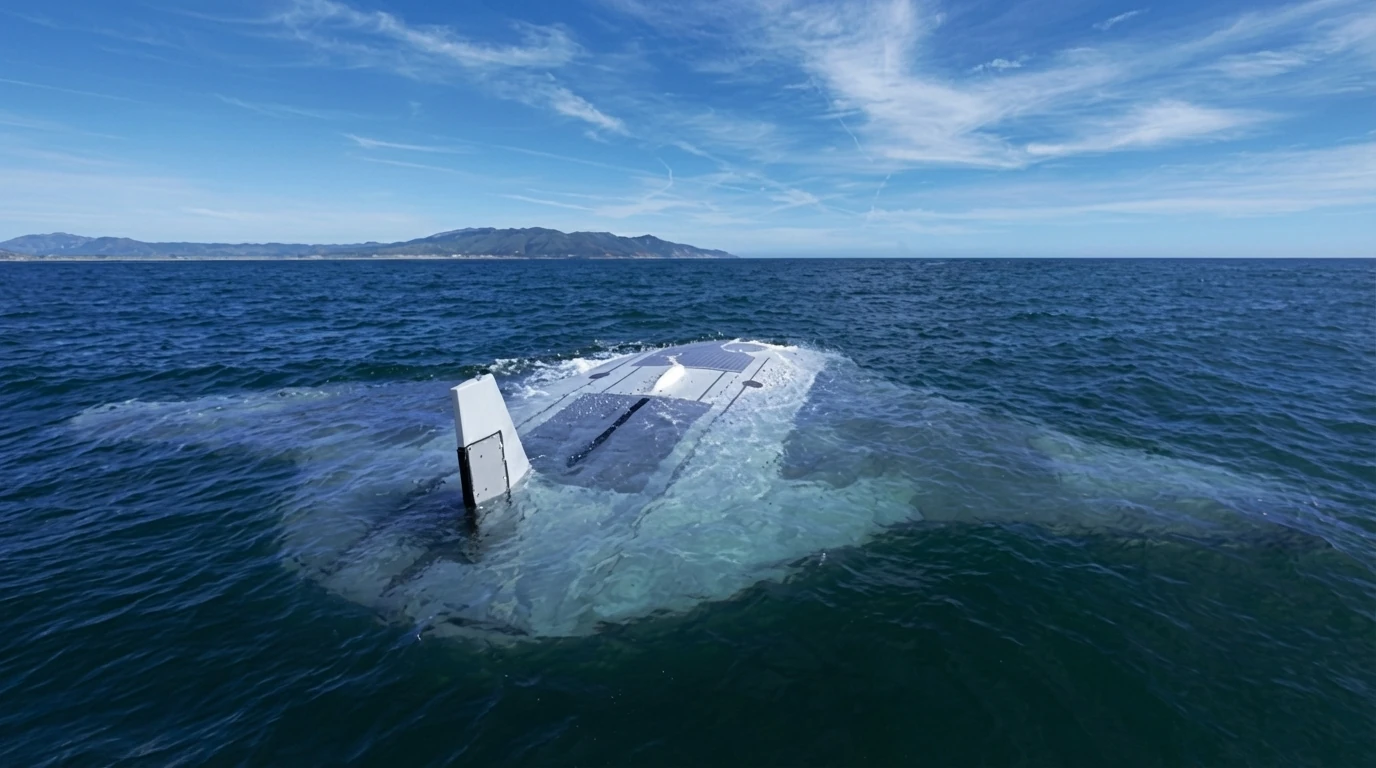
Imagine a machine the size of a small aircraft gliding silently through the ocean for weeks, maybe months, without a crew, without a support ship, and without ever surfacing. No noisy propellers churning like a submarine in an action movie. No frantic operators staring at screens. Just a ghost moving through dark water, patient and almost eerily calm.
That’s the idea behind the Manta Ray Drone.
Developed as part of a next-generation military program, this autonomous underwater vehicle isn’t just another underwater robot with a sleek name.
The Manta Ray Drone was designed to solve a very specific problem: modern navies can’t be everywhere at once. Oceans are too big, ships are expensive, and sending people into dangerous waters carries obvious risks.
So engineers borrowed a trick from nature.
Real manta rays travel with astonishing efficiency. They glide rather than fight the water, conserving energy in a way that seems almost unfair.
The Manta Ray Drone uses a similar philosophy. Its wide, wing-like body is built to drift, coast, and quietly patrol huge stretches of ocean while using surprisingly little power.
What makes this project fascinating isn’t just the hardware, it’s the shift in thinking behind it. For decades, military technology chased speed and brute force.
The Manta Ray Drone chases endurance. Persistence. The ability to wait underwater, almost invisible, like a chess player holding a piece in reserve until exactly the right moment.
And that subtle change may end up being far more important than raw firepower.
What Is the Manta Ray Drone?
So, what exactly is the Manta Ray Drone, and why is it getting so much attention in defense and tech circles?
At its core, the Manta Ray Drone is an autonomous uncrewed underwater vehicle (UUV) built to operate independently for long stretches of time. No pilot. No tether. No constant human oversight.
You set its mission parameters, drop it into the ocean, and… it just goes. Quietly. Methodically. Almost like it has a mind of its own (it doesn’t, but it can feel that way).
Here’s a simple breakdown to anchor the concept:
| Feature | Description |
| Vehicle Type | Autonomous UUV (Uncrewed Underwater Vehicle) |
| Primary Purpose | Long-duration underwater missions |
| Control | Pre-programmed + adaptive autonomy |
| Deployment | Modular, can be transported in parts |
| Operational Style | Low-power, stealth-focused |
Unlike traditional underwater drones, which often rely on support ships or frequent retrieval, the Manta Ray Drone is built for true independence. Think of it less like a remote-controlled tool and more like a long-distance explorer that occasionally checks back in.
One of its defining traits? It doesn’t rush.
Most military systems prioritize speed, get in, get out, mission done. The Manta Ray Drone flips that idea. It’s designed to linger.
To stay in contested or remote waters for extended periods, collecting data, observing patterns, or simply being present where a human crew can’t afford to be.
And here’s where it gets interesting: it can even power down on the seafloor, essentially “sleeping” to conserve energy before continuing its mission later. That’s not just efficient, it’s strategic.
In a world where visibility often equals vulnerability, a system that can disappear and wait might be the most powerful tool of all.
Key Features and Capabilities of the Manta Ray Drone
If the idea of the Manta Ray Drone sounds a bit abstract so far, its capabilities are where things snap into focus. This isn’t just a clever concept; it’s packed with features that quietly rewrite what underwater machines can do.
Let’s unpack the most important ones.
Long-Endurance, Low-Drama Operation
The standout trait? Endurance. Not hours. Not days. We’re talking missions that could stretch into weeks or longer without human intervention.
Instead of burning energy aggressively, the drone behaves more like a marathon swimmer than a speedboat. It moves efficiently, conserves power, and avoids unnecessary activity. That’s how it stays operational far longer than traditional UUVs.

Energy Efficiency That Borders on Unfair
Here’s where the manta ray inspiration really shows.
Rather than constantly using propellers, the drone can glide using buoyancy changes, rising and sinking through the water column. It’s subtle, almost lazy-looking, but incredibly efficient.
Think of it like this:
Most underwater drones = sprinting
Manta Ray Drone = drifting with intent
Modular Payload System
This isn’t a one-trick machine. The Manta Ray Drone is built with multiple payload bays, meaning it can carry different tools depending on the mission.
| Payload Type | Possible Use Case |
| Sensors | Ocean mapping, surveillance |
| Acoustic Systems | Submarine detection |
| Environmental Kits | Data collection (temperature, salinity) |
| Custom Modules | Mission-specific equipment |
That flexibility makes it more of a platform than a single-purpose drone.
Seafloor “Hibernate Mode”
This one feels almost sci-fi.
When energy runs low, or when it simply needs to wait, the drone can settle on the ocean floor and power down. No movement. Minimal energy use. Just… stillness.
Then, when needed, it wakes up and continues.
Put all of this together, and you get something unusual:
Not the fastest. Not the loudest. But possibly one of the most persistent underwater systems ever built.
And in modern strategy, persistence often beats power.
Why the Manta Ray Drone Looks Like a Sea Creature
The first time you see the Manta Ray Drone, it doesn’t scream “military technology.” It barely even whispers it. There’s no aggressive posture, no sharp-edged intimidation. Instead, it looks… calm. Wide, flat, almost elegant, like it belongs in the ocean rather than operating as a machine inside it.
That design choice isn’t aesthetic. It’s strategic.

Engineers leaned into biomimicry, borrowing directly from how real manta rays move through water. And here’s the thing, nature has already solved most of the problems engineers struggle with. Efficiency, balance, energy conservation, it’s all been refined over millions of years. So instead of forcing a mechanical solution into the ocean, the Manta Ray Drone adapts to it.
Its broad, wing-like body allows it to glide rather than push. That difference matters more than it sounds. Traditional underwater drones rely heavily on propellers, constantly burning energy just to stay in motion.
This one can drift, using subtle buoyancy changes to move up and down through the water column, covering distance without constantly “working” for it. It’s the difference between walking on a treadmill and floating down a slow river.
There’s also a quiet practicality baked into the design.

The drone can be disassembled into modular sections, shipped in standard containers, and reassembled near its deployment zone. Not glamorous, but incredibly useful. Moving large underwater systems is usually complicated and expensive, this sidesteps that problem almost entirely.
And then there’s the silence. The smooth contours and reduced mechanical strain mean less noise. Underwater, noise travels far. So being quiet isn’t just a nice feature, it’s survival.
Altogether, the Manta Ray Drone feels less like a machine built to conquer the ocean and more like one designed to exist within it. Subtle. Efficient. And a little unsettling in how naturally it fits in.
How the Manta Ray Drone Works
Understanding how the Manta Ray Drone actually operates is where things shift from “interesting concept” to “quietly impressive engineering.”
At a basic level, it doesn’t behave like most drones. There’s no constant remote control, no joystick inputs guiding every move. Instead, it’s given a mission profile, a set of objectives, routes, and conditions, and then it handles the rest on its own. Not perfectly autonomous in a sci-fi sense, but close enough that human involvement becomes minimal once it’s deployed.
Movement is where things get especially clever. Rather than relying purely on propellers, the drone uses a mix of traditional propulsion and buoyancy-driven motion. It can adjust its internal buoyancy to rise or sink, then glide forward using its wide body. That means it doesn’t have to “push” through the water the entire time. It coasts when it can, swims when it needs to. Small decision, big energy savings.
Navigation happens through a blend of onboard sensors and preloaded mapping systems. GPS doesn’t work underwater, so the drone depends on inertial navigation, sonar, and environmental sensing to understand where it is. It’s constantly reading its surroundings, depth, terrain, obstacles, and making quiet adjustments along the way.
Here’s a simplified look at its core systems:
| System | Function |
| Buoyancy Control | Enables gliding and vertical movement |
| Propulsion Units | Provides thrust when needed |
| Sonar Sensors | Detects obstacles and maps surroundings |
| Navigation System | Tracks position without GPS |
| Control AI | Executes mission logic autonomously |
One of the more unusual capabilities is its ability to pause operations completely. It can settle onto the seafloor, reduce activity to near zero, and essentially wait. Then resume later, like nothing happened.
It doesn’t rush. It doesn’t panic. It just… continues.
Military and Strategic Uses of the Manta Ray Drone
If you strip away the engineering details, the Manta Ray Drone exists for one reason: to change how navies operate in places that are too vast, too risky, or just too inconvenient for humans to stay in for long.
Think about the ocean for a second. It covers over 70% of the Earth’s surface, and much of it is still poorly monitored in real time. Traditional naval operations rely on ships and submarines, both expensive, both limited by crew endurance, fuel, and logistics.
You can’t just leave a destroyer parked in the middle of nowhere for months waiting for something to happen. It’s inefficient.
That’s where the Manta Ray Drone slips in.

One of its primary roles is persistent surveillance. Not flashy reconnaissance runs, but long-term observation. It can monitor specific regions, shipping lanes, chokepoints, or contested waters, quietly collecting data over extended periods. Patterns matter more than snapshots, and this drone is built to watch patterns unfold.
There’s also a strong case for anti-submarine support. Modern submarines are designed to be stealthy, but tracking them often requires constant presence. A network of low-noise, long-endurance drones could act like underwater sentinels, listening, mapping, and flagging anomalies without revealing themselves.
Here’s how its strategic value stacks up:
| Use Case | Strategic Advantage |
| Ocean Surveillance | Continuous monitoring without crew fatigue |
| Anti-Submarine Support | Passive detection over long durations |
| Intelligence Gathering | Low-risk data collection in sensitive zones |
| Presence Operations | Maintains influence without visible force |
But maybe the biggest shift is philosophical.
The Manta Ray Drone isn’t about projecting power loudly, it’s about being there quietly, consistently, and almost invisibly. And in modern naval strategy, that kind of presence can be more powerful than a fleet sailing in formation.
Why the Manta Ray Drone Matters
It’s easy to look at the Manta Ray Drone and see just another piece of advanced military tech. Sleek design, autonomous systems, impressive endurance, sure, all of that stands out. But the real significance sits a layer deeper, in what it changes about how power works in the ocean.
For decades, naval strength has been tied to visibility. Big ships, nuclear submarines, carrier groups, physical presence meant control. If you wanted influence in a region, you sent something large and unmistakable.

The Manta Ray Drone quietly flips that idea.
Instead of dominance through visibility, it introduces persistence through invisibility. A system that doesn’t need to surface, doesn’t need resupply ships hovering nearby, and doesn’t announce itself just by existing. It can be present in a region without anyone being entirely sure it’s there. That uncertainty alone? Strategically powerful.
There’s also a cost equation hiding in plain sight.
Operating a single naval vessel can cost tens of thousands of dollars per day, not counting crew logistics and long-term maintenance. A long-endurance autonomous drone shifts that balance. Once deployed, it requires minimal oversight, no onboard personnel, and far fewer resources to keep it active.
And then there’s risk. Sending humans into contested waters always carries political and ethical weight. A drone doesn’t eliminate risk, but it redistributes it.
So in a way, the Manta Ray Drone isn’t just a new tool. It’s a shift in mindset. Less about force, more about endurance. Less about being seen, more about never really leaving.
