

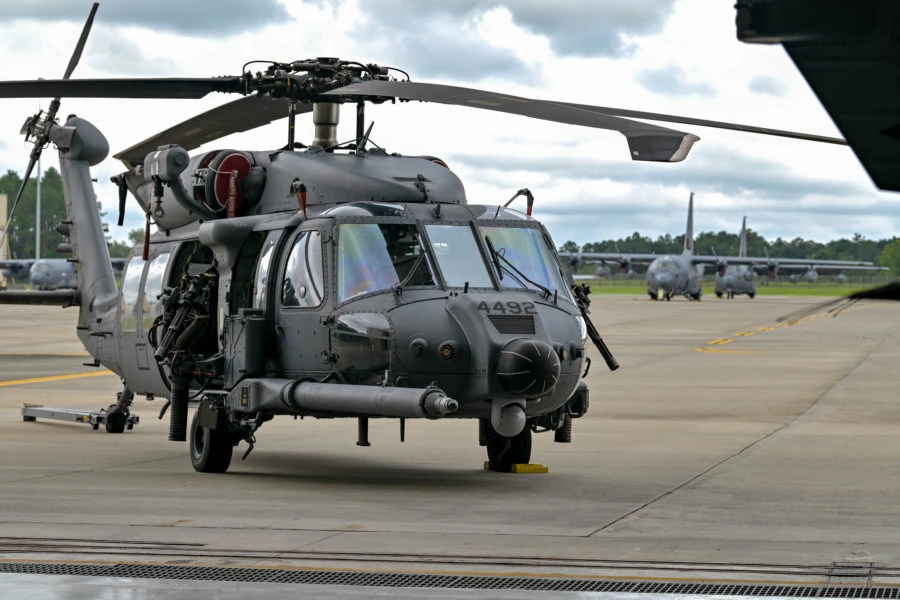
Defense Feeds, Washington — HH-60W laser defense system integration marks a critical survivability upgrade for US Air Force rescue helicopters facing modern infrared missile threats.
The Air Force Life Cycle Management Center issued a Sources Sought notice on April 7, 2026, seeking industry partners to equip the entire HH-60W Jolly Green II fleet with advanced infrared countermeasures. Contract award is planned for the second quarter of fiscal year 2027, with full fleet integration as the ultimate objective.
The current HH-60W lacks active missile defeat capability despite being equipped with missile warning sensors. Crews receive threat alerts but cannot automatically counter incoming infrared-guided missiles during low-altitude rescue missions. This critical gap forces pilots to rely solely on evasive maneuvering against MANPADS and shoulder-fired systems.
Closing the Survivability Gap
Recent combat operations exposed the vulnerability of unprotected rescue helicopters during contested environments. During rescue missions in Iran following the downing of an F-15E, some HH-60W aircraft came under hostile fire without defensive systems to counter the threat.
The Air Force identified this gap as significantly increasing enemy engagement success probability and threatening crew safety.
HH-60W laser defense system integration addresses this by adding automatic threat detection, tracking, and neutralization capability. The system must engage incoming threats within seconds of launch detection. Integration must occur without altering aircraft flight performance, structural integrity, or mission system reliability.
CIRCM and DAIRCM Technology Candidates
The Air Force has identified two mature laser-based countermeasure systems as potential candidates for HH-60W integration.
The Common Infrared Countermeasure (CIRCM) from Northrop Grumman is a directional laser system already deployed on AH-64 Apache, CH-47 Chinook, and UH-60 Black Hawk helicopters. CIRCM components weigh approximately 46 pounds total and operate on 28V DC power, making them compatible with HH-60W electrical systems.
CIRCM systems have accumulated over 30,000 operational flight hours across approximately 1,500 aircraft and 80 different aircraft types.
The system automatically engages threats by emitting modulated laser energy at incoming missile seekers, breaking lock and causing missiles to miss target. The technology supports open architecture upgrades, allowing future enhancements without major redesign requirements.
The Distributed Aperture Infrared Countermeasure (DAIRCM) from Leonardo DRS provides full 360-degree helicopter coverage using multiple infrared sensors distributed around the aircraft.
A central processor controls laser emitters distributed across beam directors, enabling simultaneous engagement of threats approaching from different directions. DAIRCM has been tested and deployed on HH-60G, MH-60S, AH-1Z, and UH-1Y helicopters.
DAIRCM testing included live missile firings and operational evaluations conducted between May and July 2018, with subsequent fielding decisions in 2020.
The system provides additional functions beyond missile defense, including hostile fire indication and laser warning capabilities. Like CIRCM, DAIRCM operates automatically once threats are detected, requiring no manual pilot intervention.

Technical Integration Challenges
HH-60W laser defense system integration requires careful engineering to accommodate aircraft constraints and limitations.
The helicopter’s 28V DC electrical power system must support countermeasure system operation without exceeding available capacity margins. Thermal management and cooling requirements must function within aircraft environmental limits.
Available mounting space for laser emitters, processors, and pointer-tracker assemblies is limited on the HH-60W fuselage and airframe. Integration must address MIL-STD-1553 data bus compatibility with existing avionics networks ensuring real-time communication between missile warning sensors and countermeasure systems. No degradation of existing avionics, communications, or navigation systems is acceptable.
Contractors must design and produce A-Kits including structural mounts, wiring harnesses, power distribution modifications, and avionics interfaces specific to HH-60W aircraft.
Structural modifications require validation through analysis and testing to ensure no impact on fatigue life or flight safety margins. Software integration must prevent interference with other avionics while maintaining reliable countermeasure operation.
Program Timeline and Industry Requirements
Industry responses to the Sources Sought notice are due by April 23, 2026, with contract award expected in the second quarter of fiscal year 2027.
Contractors must demonstrate prior experience integrating defensive systems on H-60 series or similar helicopter platforms. AS9100 quality certifications are required for production activities supporting long-term aircraft fleet sustainment.
The Air Force requires comprehensive data rights for both hardware and software, including source code and design documentation, ensuring long-term flexibility in sustainment and future modifications.
Participation from small businesses is encouraged as prime contractors or subcontractors. Program schedules must include timelines for prototype installation, testing, and transition to production across the entire HH-60W fleet.
HH-60W laser defense system integration represents a Modular Open Systems Approach, allowing future upgrades and interoperability with evolving threat detection capabilities.
The Air Force is encouraging accelerated schedules provided that technical risks are addressed and integration feasibility is demonstrated. The objective is fielding operational capability addressing the survivability gap within a relatively short timeframe.
