

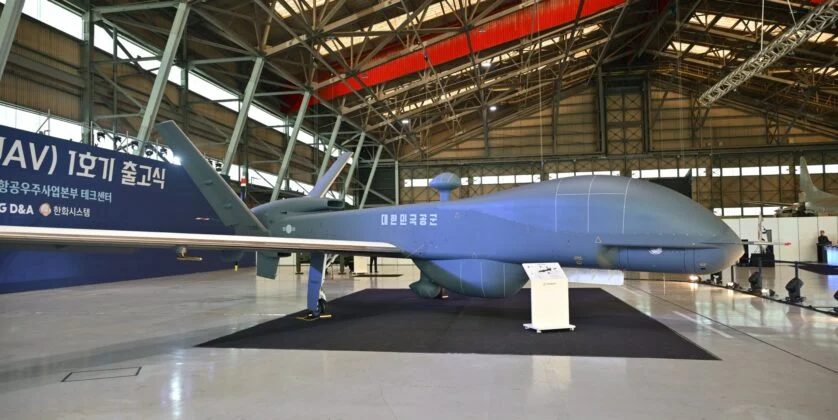
Defense Feeds, Busan – South Korea just took another step toward military self-sufficiency. The state unveiled its first truly homegrown medium-altitude unmanned aircraft during an April ceremony in Busan. This isn’t just another drone development. The MUAV represents a strategic pivot toward building advanced defense systems using mostly domestic components.
The Defense Acquisition Program Administration rolled out the system alongside Korean industry partners. Nearly 90 percent of the unmanned aircraft uses homegrown technology. That’s a significant achievement in a field where most nations rely heavily on foreign suppliers or imported subsystems.
Why does this matter? Because dependency on external suppliers carries real risk during conflicts. South Korea’s approach addresses that vulnerability head-on.
Advanced Surveillance and Real-Time Capabilities
The South Korea homegrown MUAV unmanned aircraft brings serious operational capability to the table. The system conducts reconnaissance operations against key enemy command posts using integrated cameras and sensor packages. Real-time data transmission enables commanders to make faster decisions based on current intelligence rather than delayed analysis.
Development of this platform began in December 2023. That timeline shows rapid progress from concept to field-ready system. The MUAV can maintain extended presence over target areas, observing and collecting intelligence for hours without rotating crews or returning to base for refueling like manned aircraft require.
The surveillance capability extends beyond simple observation. The integrated sensor package distinguishes between civilian and military targets, identifies specific vehicle types, and tracks movement patterns. This precision reduces the risk of misidentification that plagues less sophisticated systems.
LIG Defense and Aerospace and Hanwha Systems handled the actual development and production work. The state-run Agency for Defense Development provided technical oversight. This government-industry partnership model proved effective, keeping development timelines compressed and costs manageable.
Domestic Production Advantages and Industrial Implications
Building 90 percent of the MUAV with domestic components creates multiple strategic advantages. Manufacturing capability stays within Korea, reducing vulnerability to international supply chain disruptions. During conflicts or sanctions, maintaining indigenous production keeps systems operational when imports become impossible.
This production approach also builds expertise across Korea’s defense industrial base. Multiple companies gain experience with advanced unmanned systems. That knowledge transfers to future projects, accelerating development of next-generation platforms. Workers trained on MUAV production become resources for other advanced defense initiatives.
The homegrown approach strengthens Korean defense independence. Historically, reliance on imported platforms created vulnerabilities when diplomatic tensions strained relationships with suppliers. Building indigenous capability eliminates that pressure point. South Korea can now make acquisition decisions based purely on military requirements rather than political constraints imposed by foreign manufacturers.
Integration into Broader Defense Architecture
The MUAV fills a specific niche within Korea’s overall air defense and reconnaissance structure. The system operates at medium altitudes, above short-range threats but below satellite orbits. That altitude band previously required expensive manned aircraft sorties or reliance on foreign-supplied systems.
The unmanned platform’s extended loitering capability addresses persistent surveillance requirements. Commanders can maintain continuous monitoring of specific areas without rotating aircraft every few hours. This persistence generates intelligence patterns that shorter-duration missions miss. Adversary movement becomes predictable when observed over extended periods.
Integration into existing Korean Air Force command structures proceeded smoothly. The MUAV connects to established intelligence, surveillance, and reconnaissance networks. Operators trained on the system learned familiar procedures rather than adapting to completely novel platforms. That reduced training time and accelerated operational readiness.
Future operational deployment starts in 2027 following additional flight testing. The Air Force will conduct final verification before committing the system to active service. That testing regimen ensures reliability and identifies any performance issues before units deploy to sensitive missions.

Strategic Significance for Korean Defense
This MUAV represents more than just another weapons system. It demonstrates Korea’s growing capability to develop and produce advanced defense technology independently. Nations that master indigenous production of sophisticated military systems gain strategic leverage in regional security equations.
The South Korea homegrown MUAV unmanned aircraft showcases technological maturity across multiple domains. Aerodynamic design, propulsion systems, sensor integration, and command and control networks all incorporated domestic expertise. Combining these capabilities into a functioning system required exceptional coordination across industry partners and government agencies.
Regional competitors watched this development carefully. Demonstrating indigenous advanced capability influences threat assessments and strategic calculations. Korea’s peers must recognize that Seoul can rapidly expand and modify systems without waiting for foreign vendor decisions.
This achievement also strengthens Korea’s position in international defense technology partnerships. Nations seeking reliable suppliers increasingly value partners with demonstrated indigenous capability. Relying solely on imports creates dependency that complicates alliance relationships. Korea’s homegrown success positions the nation as a potential technology exporter and credible partner for collaborative defense projects with allied nations facing similar challenges.
