

The proximity of Taiwan to China’s mainland puts it within easy reach of many of the types of unmanned aerial systems (UAS) that have featured prominently in the battlefields of Ukraine and, more recently, in the Middle East. Recognising this, Taipei is developing and fielding counter-UAS systems (C-UAS) focused particularly on defeating reconnaissance and attack drones of the People’s Liberation Army.
As already demonstrated in ongoing conflicts, the large drone threat demands that defensive systems be effective, able to be deployed in sufficient numbers and have a low cost per kill, so as to prevent depletion of stocks.
Taiwan’s National Chung-Shan Institute of Science and Technology (NCSIST), the country’s primary weapons research and development agency, is taking a leading role in this C-UAS effort.
Li Shih-chiang, NCSIST’s President, shared that the institute is developing solutions that are fully domestically manufactured, can be supported with minimal risk, and are able to be introduced on an accelerated schedule.
For example, one weapon system in development by NCSIST is based on the 2.75-inch (70mm) rocket, a type of munition introduced more than 80 years ago.
The 2.75-inch folding fin aerial rocket is used from fixed-wing aircraft and helicopters to engage ground targets. It is simple, inexpensive and, because it is entirely unguided, it is typically used against area targets firing multiple rockets in succession (ripple fire). It is, however, highly adaptable.
With a range of different warheads available for various roles – from target marking to light anti-armour – this adaptably was demonstrated when BAE Systems modified standard rockets by adding a midsection with a laser seeker to give it precision accuracy. The result was the Advanced Precision Kill Weapon System (APKWS).
Initially, the APKWS was used from airborne platforms in highly accurate ground strikes. However, as the drone threat grew, the potential for using them against drone platforms became evident.
These 70mm rocket with a laser homing seeker offer point-target accuracy at a third of the price of comparable-performing weapons. The effectiveness of the APKWS against drones has been further enhanced by adding proximity-fused detonation, as well as dual laser/infrared seekers.
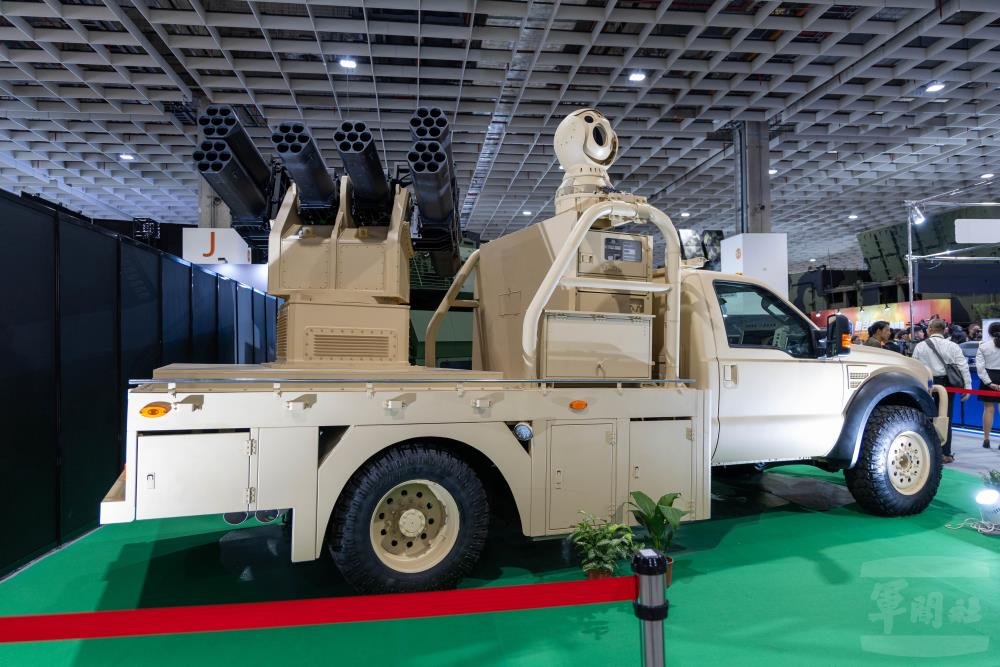
NCSIST’s solution for Taiwanese forces couples seven-tube 70mm rocket pods with an electro-optic director on a powered mount. This stabilised director contains daylight and thermal cameras, plus a laser rangefinder to acquire, track and engage drones.
The design allows for acquisition of a target while moving, and then firing from a short halt, thus reducing exposure to enemy attack. Once acquired, the target is optically locked and tracked, then digital fire controls compute the ballistics and the gunner fires.
A steel-ball warhead is optimised to disable and down drone targets. The system can, when required, receive external designations from a radar or other surveillance network.
In addition to the steel-ball warhead, the system can utilise other 70mm rocket warheads such as illuminating flares, acoustic/flash or high explosive, therefore giving the system the ability to take on other roles.
The weapon has also been configured with different-sized rocket pods, and has been shown integrated on light vehicles, vessels and stationary ground installations.
The system’s optics can detect targets at ranges of 10km, and it has an effective interception range of up to 8km. Subsequent targets can be rapidly engaged, with the system having a rate of fire of one rocket every 1.5 seconds.
First fielding of NCSIST’s 2.75-inch rocket system was with Taiwan’s Coast Guard Administration. It has been installed on the CGA’s Anping and Yunlin-class cutters, and also incorporated into coastal defences.
Adoption of 70mm rockets allows not only the use of existing domestic munitions production, but also facilitates rapid expansion of rocket output to increase stockpiles. Introduction of this low-cost and widely deployed C-UAS capability also means that more sophisticated and limited numbers of high-end air defence missiles can be reserved for more challenging threats.
Further initiatives are being made towards adoption of this approach to the army’s ground-based C-UAS capabilities, and indeed the concept has been successfully proven in combat in Ukraine with systems like the L3Harris Vampire vehicle-mounted system.
The 70mm C-UAS, as developed by NCSIST, is viewed as a strong candidate in providing a viable layered response to unmanned aerial threats.
by Stephen W. Miller
