


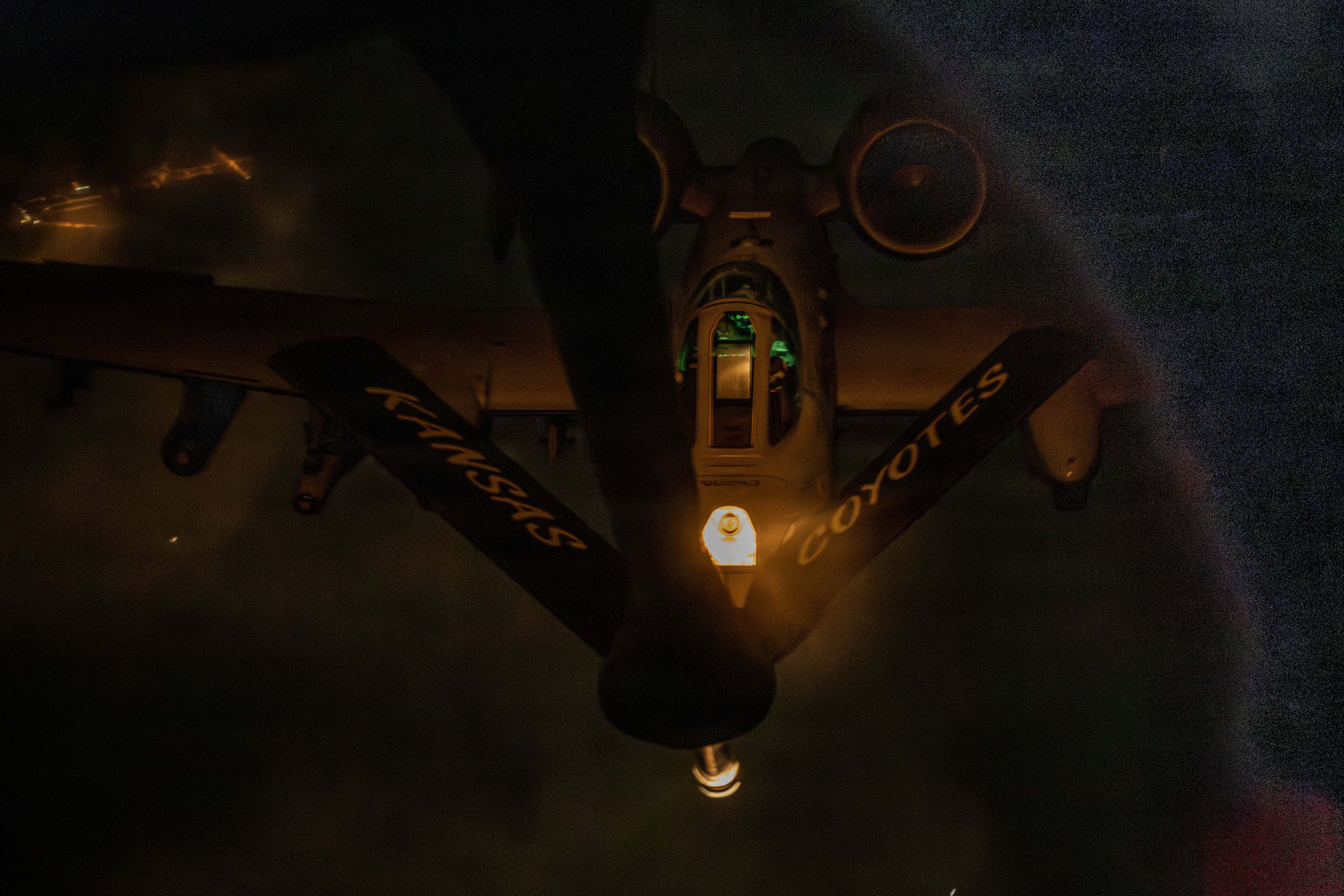
With the iconic attack jet now in the twilight of its career, there are signs that the A-10C Warthog is set to deploy to the Middle East region for Operation Epic Fury. Such a deployment might well provide the combat swansong for the A-10, which the U.S. Air Force plans to retire for good by the end of the decade, if not sooner. The development comes as U.S. President Donald Trump ramps up his threats against Iran, including threatening to eliminate its civilian infrastructure and oil-producing capability.
Publicly available flight-tracking data today suggested that the Air Force was preparing to send a flight of A-10s across the Atlantic, with three KC-135 Stratotankers already airborne from RAF Mildenhall in England, apparently to meet TABOR 71, a flight of eight Warthogs headed in the opposite direction. Two of those jets were spares, according to unverified reports based on radio traffic.
Meanwhile, there are indications that as many as 20 A-10Cs have gathered at Portsmouth International Airport at Pease, New Hampshire, which is a standard jump-off point for a flight across to RAF Lakenheath in England, which has seen a major influx of U.S. combat jets in recent weeks.
Unconfirmed reports suggest these Warthogs are drawn from the 124th Fighter Wing of the Idaho Air National Guard at Gowen Field, and from the Michigan Air National Guard’s 127th Wing at Selfridge Air National Guard Base.
As we have discussed, A-10s are already helping dismantle Iran’s Navy, operating in the region in their long-standing, if often overlooked, maritime role. This is part of broader efforts by the U.S. military to find ways to reopen the critical waterway to normal maritime commerce, which has ground to a virtual halt in the face of Iranian attacks on shipping and its declaration that the strait is closed.
Above all else, A-10s have also been seen repeatedly attacking Iranian-backed militias in Iraq, operating in their best-known overland role. You can read our coverage of the A-10’s use in Iraq, including its notably long strafing runs on targets, in this feature.
Having more A-10s in theater would provide additional capability, were the U.S. military to occupy or blockade Iran’s strategically vital Kharg Island, a prospect that we have discussed in detail in the past. A-10s could also provide valuable close air support for commando raids deeper into Iran.
UPDATES:
We have concluded updates for the day.
UPDATE: 6:15 PM EST-
Open source flight trackers say that two U.S. Air Force EA-37B Compass Call electronic warfare jets are on their way to Mildenhall Air Base in the U.K. and from there to the Middle East.
The jets – tail numbers 19-1587 and 17-5579 – are flying as AXIS41 and AXIS43. The claim is that this marks the first operational deployment of these aircraft. The Air Force is planning to procure 10 of these jets to replace the aging and ever smaller fleet of turboprop EC-130H Compass Call planes, of which only four remain. The 55th Wing at Offutt Air Force Base, which operates the Compass Calls, declined comment, deferring us to CENTCOM, which could not immediately comment.
The aircraft are designed to provide critical stand-off jamming support, including against enemy radars and communications systems. They also have a secondary intelligence, surveillance, and reconnaissance (ISR) function given their ability to spot, track, and geolocate various types of emitters. One of the EA/37Bs was in Germany in January to introduce airmen to the platform, but was not yet operational. You can read more about that here.
Iranian Foreign Minister Seyed Abbas Araghchi urged Saudi Arabia to kick U.S. forces out of the country. His statement, posted on X, comes as the kingdom is ramping up its efforts against Iran in the wake of repeated attacks.
“Iran respects the Kingdom of Saudi Arabia and considers it a brotherly nation,” Araghchi said in a post that includes a photo of an E-3 Sentry AWACS destroyed during an Iranian missile attack, which you can read more about here. “Our operations are aimed at enemy aggressors who have no respect for Arabs or Iranians, nor can provide any security. Just look at what we did to their aerial command. High time to eject U.S. forces.”
Iran is pushing the Houthis to prepare for a renewed campaign against Red Sea shipping, contingent upon any further escalation by the U.S. in its war on the Islamic Republic, Bloomberg News reported, citing European officials familiar with the matter.
Leaders of the Yemen-based Iranian proxy “are weighing options for more aggressive action after launching ballistic missiles at Israel,” Bloomberg posited.
Trump may ask Gulf states to help pay for the war, says the White House.
UPDATE: 5:30 PM EST-
Trey Yingst of Fox News says Iranians have spent nearly 30 days without internet access, which has been cut off by the regime in Tehran.
“700+ hours without internet in Iran,” Yingst wrote in a post on X. “Israeli officials are now sounding the alarm about the ongoing blackout.”
“When this blackout is lifted, the full extent of the damage to the regime will become clear,” a senior Israeli intelligence official told Fox News.
UPDATE: 5:20 PM EST-
As expected, A-10s began to arrive at RAF Lakenheath, England, this evening, local time.
UPDATE: 5:15 PM EST-
The United States and Israel reportedly devised a plan early in the war for Kurdish militia forces to enter Iran, aiming to trigger an uprising that could topple the Islamic Republic. However, according to a report published by Channel 12, media leaks, pressure from allies, and hesitation among the Kurds themselves ultimately led Washington to abandon the proposal.
The investigation followed earlier reports in Israeli and international outlets suggesting that a ground offensive from Iraqi Kurdistan was either imminent or already underway.
While Washington never officially confirmed its role, President Trump initially signaled support for Kurdish involvement before later backing away from the idea.
UPDATE: 3:50 PM EST-
The final recorded delivery of jet fuel from the Middle East to the United Kingdom is set to arrive this week, highlighting how quickly the effects of the Iran conflict are beginning to hit airlines and passengers, the Financial Times reports.
According to data from Kpler and Vortexa, the cargo — carried by the Libyan-flagged vessel Maetiga — is expected to reach the United Kingdom around Thursday after departing from Saudi Arabia. They also noted that no additional shipments bound for the United Kingdom are currently in transit from the region, due to the disruption in the Strait of Hormuz.
UPDATE: 2:50 PM EST-
During a press briefing today, White House press secretary Karoline Leavitt was asked whether Trump would seek approval from Congress if he decided to launch a ground war against Iran.
She said the Trump administration would “always” abide by Congress and the “rule of law.” Leavitt said: “The president has been asked about boots on the ground or alleged ground operations various times … He’s obviously declined to rule them out. It’s the Pentagon’s job to provide maximum optionality to the president.”
She added it “does not mean he’s made a decision, nor would he ever notify the media of such decision as not to tipoff our enemy.”
Leavitt also responded to a question about whether Trump’s threat to “completely obliterate,” all Iranian electrical-generation plants and oil wells meant the U.S. military was being primed to commit potential war crimes under international law.
Levitt said the statement shows that Iran’s “best move is to make a deal.”
“The United States Armed Forces has capabilities beyond their wildest imagination, and the president is not afraid to use them,” she said.
She added: “Of course, this administration and the United States Armed Forces will always act within the confines of the law, but with respect to achieving the full objectives of Operation Epic Fury, President Trump is going to move forward unabated, and he expects the Iranian regime to make a deal with the administration.”
UPDATE: 2:00 PM EST-
White House press secretary Karoline Leavitt was also asked about the current timeline of the war with Iran.
She says he has said from the start that the operation in Iran will last about four to six weeks in total.
“We’re on day 30,” she says. “So, you do the math on how much longer the Pentagon needs to fully achieve the objectives of Operation Epic Fury.”
Reports suggest that troops from the storied 82nd Airborne Division of the U.S. Army have begun to arrive in the Middle East, including elements of the 1st Brigade Combat Team and personnel specializing in logistics and communications.
There had been earlier signs that the 82nd Airborne was at least being prepared for a possible deployment, with the cancellation of a major training exercise in which its headquarters unit would have been involved.
As we reported last week, the movement of cargo flights between Fort Bragg in North Carolina and the Middle East suggested that the Pentagon might have begun moving elements of the elite paratrooper unit into the region.
A U.S. move against Kharg Island, as well as a potential commando raid to seize Iranian uranium, are two options apparently now on the table.
In his latest threat against Iran, President Donald Trump declared that the U.S. military will “obliterate” Iran’s Kharg Island if a deal is not reached shortly.
In a post on Truth Social, Trump today claimed the United States is in “serious discussions” with a “new and more reasonable regime” to end the war, but made direct threats against Kharg Island, as well as Iranian civilian infrastructure and oil-producing capability:
Great progress has been made but, if for any reason a deal is not shortly reached, which it probably will be, and if the Hormuz Strait is not immediately “Open for Business,” we will conclude our lovely “stay” in Iran by blowing up and completely obliterating all of their Electric Generating Plants, Oil Wells and Kharg Island (and possibly all desalinization plants!), which we have purposefully not yet “touched.”
In the same Truth Social post, Trump also raised the possibility of the United States declaring victory in the conflict without Iran reopening the Strait. This could come along with destroying much of Iran’s civilian infrastructure, including the Iranian people’s access to electricity and possibly clean drinking water.
Over the weekend, Trump said his “preference would be to take the oil” in Iran and that U.S. forces could seize the regime’s export hub on Kharg Island. Trump told the Financial Times that “my favourite thing is to take the oil in Iran, but some stupid people back in the US say: ‘why are you doing that?’” He also said: “Maybe we take Kharg Island, maybe we don’t. We have a lot of options.”
Over the weekend, The New York Times reported that around a hundred U.S. special operations forces have arrived in the Middle East, joining thousands of Marines and Army paratroopers already in the region.
“The commandos, including Army Rangers and Navy SEALs, have not yet been assigned specific missions,” the report stated, citing unnamed U.S. officials, although a mission to try to seize Kharg Island is certainly a possibility.
Trump confirmed to Caitlin Doornbos of the New York Post that U.S. officials are negotiating with Iranian parliamentary speaker Mohammad Bagher Ghalibaf. The U.S. leader added that he expected to “find out in about a week” whether he is someone America can truly work with.
On the nuclear issue, The Wall Street Journal is reporting that Trump is weighing up a military operation to extract nearly 1,000 pounds of uranium from Iran, citing unnamed U.S. officials.
TWZ had previously explored the possibility of U.S. and/or Israeli authorities launching a special operations ground raid to extract or otherwise neutralize Iran’s stockpile of enriched uranium. Given that this nuclear material is understood to be stored in deep underground bunkers, it is far from easy to achieve this objective from the air alone. Israel has demonstrated its ability and willingness to carry out complex raids on subterranean facilities, but any such operation would still face immense risks and uncertainties.
In related news, satellite imagery dating from last June was published over the weekend, suggesting that Iran might have moved at least some of its highly enriched uranium to a secure base to protect it from airstrikes.
Using Pakistan as a mediator, the United States provided Iran with a 15-point ceasefire proposal last week, including reopening the Strait of Hormuz — which carries around 20 percent of the world’s oil supply — and curbs on Iran’s nuclear programs. So far, Tehran has rejected the proposals. U.S. Secretary of State Marco Rubio also told Al Jazeera that another condition is that Iran must stop producing drones and missiles of the kinds used in combat in recent weeks.
For its part, Tehran wants an end to Israeli attacks on Iranian allies in the region as part of any negotiated deal. There are also suggestions that Iran is pushing for reparations for war damage and even the removal of U.S. military bases from the Middle East.
Speaking to journalists, Esmail Baghaei, an Iranian diplomat who is the current spokesperson for the Ministry of Foreign Affairs, said Iran had received messages via intermediaries indicating U.S. willingness to negotiate, but said that the American proposals were “unrealistic, illogical, and excessive.”
“Our position is clear. We are under military aggression. Therefore, all our efforts and strength are focused on defending ourselves,” Baghaei added.
Trump claims Iran will allow 20 oil tankers to pass through the Strait of Hormuz starting Monday morning and continuing over the next few days as a “present.”
“They gave us 10 [ships through the strait],” he said, in reference to earlier claims. “Now they’re giving 20…”
Trump added that Mohammad Bagher Ghalibaf, Iran’s parliamentary speaker, had authorised the additional tankers.
“He’s the one who authorised the ships to me,” Trump told the Financial Times. “Remember I said they’re giving me a present? And everyone said: ‘What’s the present? Bullshit.’ When they heard about that they kept their mouth shut and the negotiations are going very well.”
Scott Bessent, the U.S. Secretary of the Treasury, told Fox News today that “We are seeing more ships pass daily… but over time, the U.S. is going to retake control of the straits, and there will be freedom of navigation, whether through U.S. escorts or a multinational escort.”
The Economist reports that Iran, whose tankers continue to operate through the strait, is now earning nearly twice as much from oil sales each day as it did before the conflict began.
Based on information provided by U.S. government officials and Wall Street analysts, Bloomberg predicts that oil prices could continue to surge, up to an unprecedented $200 per barrel.
Elsewhere in the oil war, Iranian parliamentary speaker Mohammad Bagher Ghalibaf took to X to argue that pre-market statements from the White House or messages on the Truth channel are “often just a setup for profit-taking,” something that appeared to come true hours later.
Houthi forces, close allies of Iran, said on Saturday they had fired a salvo of ballistic missiles at “sensitive Israeli military sites” and that they would continue military operations until the “aggression” came to an end on all fronts. Israel said today that it had intercepted two drones originating in Yemen.
There is now the risk that the Houthis could attempt to close the narrow Bab al-Mandab strait to maritime traffic. This would effectively close off the Red Sea to shipping, just as Iran has in effect shut the Strait of Hormuz.
The port in the northern Israeli city of Haifa was struck today, apparently by debris from an intercepted missile. Videos posted to social media showed part of the Bazan oil refinery there on fire. Israel’s fire and rescue service confirmed the incident, but there were no immediate reports of any casualties or damage to production facilities.
The Wall Street Journal is among those reporting that the oil refinery was hit by an Iranian missile.
The United Arab Emirates says its air defenses have intercepted 11 ballistic missiles and 27 drones launched from Iran today.
Overall, the defense ministry of the UAE says it has engaged 1,941 drones and 440 missiles since the war began.
“The Ministry of Defense affirmed that it remains fully prepared and ready to deal with any threats and will firmly confront anything that aims to undermine the security of the country, in a manner that ensures the protection of its sovereignty, security, and stability and safeguards its interests and national capabilities,” it said in a statement shared on social media.
Meanwhile, the Bahrain Defense Force (BDF) has also provided a tally of its air defense operations since the conflict began on February 28. The BDF says its air defense units have now intercepted and destroyed 398 drones and 182 missiles launched by Iran.
Oman’s port of Salalah was hit by a drone over the weekend, leaving one worker injured and causing minor damage to the facility. The Danish shipping firm Maersk announced today that operations at the port would restart Tuesday.
Maersk said the damage was “limited” and that the port’s management would take “necessary measures” to progressively build up to full capacity.
Another ballistic missile launched from Iran has been shot down after it entered Turkish airspace. Turkey’s defense ministry confirmed that the missile had been brought down by undisclosed NATO air and missile defenses deployed in the eastern Mediterranean.
This is the fourth such incident since the start of the Iran war, following three earlier interceptions by NATO air defense systems earlier this month.
Footage has emerged showing a British Army air defense team shooting down an Iranian attack drone over the Middle East with a Martlet Lightweight Multirole Missile (LMM). At least four RAF Regiment gunners have received ace status, shooting down five or more drones, the U.K. Ministry of Defense has said. Traditionally, an aerial ace applies to a pilot who has shot down five or more crewed aircraft in air-to-air combat.
The Israeli Defense Forces (IDF) claims it has struck a university in Tehran run by Iran’s Revolutionary Guard Corps (IRGC), saying that the institution was used for advanced weapons research.
“In recent days, one of the IRGC’s central military infrastructure sites was struck, located within the compound of Imam Hossein University — the IRGC’s primary military academic institution, which also serves as an emergency asset for the regime’s military bodies,” an Israeli military statement said.
Iran’s Ministry of Energy also claims that attacks were made on electricity infrastructure in the Tehran province, parts of the city of Tehran, and Alborz province, leaving them without electricity.
On its second front, Israel has launched a new wave of strikes targeting Beirut’s southern suburbs — the first since Friday in the area, which is now largely deserted. Israel issued a warning for people in the Hezbollah stronghold to leave ahead of the latest strikes.
The Israeli military is also hitting targets in Lebanon’s south, one of which targeted an army checkpoint and killed a Lebanese soldier.
Lebanon was dragged into the conflict when the Iran-backed armed Hezbollah group began firing rockets at Israel on March 2, in revenge for the killing of Iran’s supreme leader at the start of the war.
Israel is conducting large-scale air strikes across Lebanon as well as a ground offensive in the south.
Spain has said it will not allow U.S. military aircraft involved in attacks on Iran to use its airspace.
“We don’t authorise either the use of military bases or the use of airspace for actions related to the war in Iran,” the country’s defense minister, Margarita Robles, told reporters in Madrid this morning.
Spanish newspaper El País reported the airspace closure, which forces U.S. military aircraft to bypass Spain other than in emergency situations, in which case the aircraft will be permitted to transit or land.
“We have denied the United States the use of the Rota and Morón bases for this illegal war. All flight plans involving operations in Iran have been rejected. All of them, including those for refueling aircraft,” Spanish Prime Minister Pedro Sánchez said last week.
Morón Air Base near Seville serves as a key refueling and logistics hub for European and Middle Eastern operations by the U.S. Air Force. Naval Station Rota is another joint facility used by the U.S. Navy and also falls under Spanish sovereignty.
Israel apparently plans to invite the United States to relocate some of its bases in the region to Israel — and to establish new bases in the country — after the current conflict ends, Channel 12 reports, citing unnamed security sources.
The security establishment sees an opportunity to “reshape the map” of U.S. military positioning in the Middle East, the report says, given that U.S. forces are already present here now and in light of evolving security challenges.
Iran’s Revolutionary Guard Corps (IRGC) has now confirmed the death of Alireza Tangsiri, the IRGC naval commander who was killed in an Israeli airstrike last Thursday, according to a statement by the guards being carried in Iranian media.
According to the United States, Tangsiri oversaw the IRGC Navy’s testing of cruise missiles and sat on the board of a company that developed armed drones. Tangsiri had reportedly been leading Iran’s successful effort to effectively close the Strait of Hormuz.
An Iraqi Air Force An-32 Cline turboprop transport was the victim of an apparent drone strike launched by an Iran-backed militia. Last week, we reported on the apparent use of short-range kamikaze drones operated by a militia to successfully target a U.S. military Black Hawk helicopter and a critical air defense radar at an American base in Iraq.
In a nod to Iranian attacks on high-end U.S. military hardware in the conflict, the nose of this Shahed-136 long-range one-way attack drone is marked with symbols denoting a U.S. Air Force E-3G Sentry radar plane — an incident you can read all about here, an AN/TPY-2 radar primarily associated with the Terminal High Altitude Area Defense (THAAD) anti-ballistic missile system, and an AN/MPQ-65 radar from a Patriot air defense system.
Contact the author: thomas@thewarzone.com
