

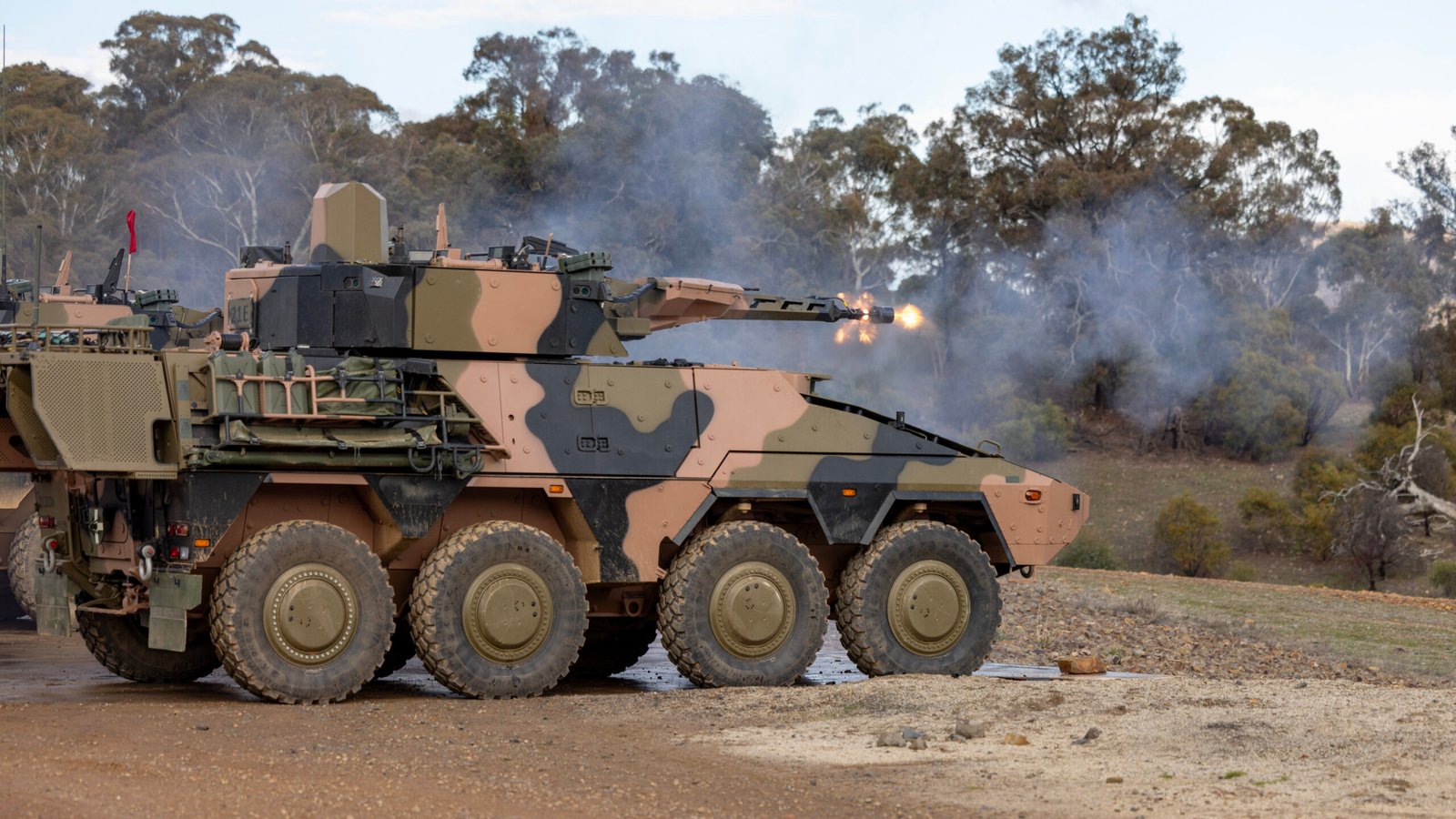
An initial batch of seven Australian-manufactured Boxer combat reconnaissance vehicles (CRV) has been completed at Rheinmetall Defence Australia’s production facility at Redbank, Queensland, with the milestone marked on 27 March.
The Australian Army is to receive 211 Boxers under Project Land 400 Phase 2 inked on 9 August 2018, a figure that includes 25 Boxer Block I vehicles produced in Germany and previously delivered to Australia by May 2021.
That leaves 186 Block II Boxers to be manufactured in Australia. These encompass five variants: reconnaissance; command and control; joint fires and surveillance; repair; and recovery.
Of these, 133 are fitted with a two-man Lance 2.0 turret armed with a MK30-2/ABM 30mm cannon. Some, not all, of these will also feature twin Spike LR2 missiles.
Furthermore, the same Rheinmetall Military Vehicle Centre of Excellence (MILVEHCOE) facility in Australia will produce 103 Boxer Schwerer Waffenträger Infanterie (heavy weapon carriers) for the German Army.
These were procured under a €2.7 billion (US$3.1 billion) contract sealed on 21 March 2024 that included 20 identical Boxers manufactured in Germany. The German vehicles are also based on the Block II with a Lance 2.0 turret and, according to video imagery, at least two German examples were among the seven rolled out from MILVEHCOE on 27 March.
The Department of Defence stated, “The partnership with Rheinmetall Defence Australia underscores growing defence industry collaboration between Australia and Germany to deliver critical capabilities for both of our militaries.”
However, Defence’s statement that “its commitment to deliver capabilities to the Australian Defence Force (ADF) at pace with the first batch of Australian-built Boxer CRVs already rolling off the assembly line” is disingenuous.
Rheinmetall Defence Australia commenced construction of the first CRV Block II in March 2023, and all were to be delivered by 2027 under the original schedule.
Defence has been mute on problems encountered with the Lance 2.0 turret, and in June 2024 the project was elevated to “project of interest” status due to “complexity associated with the parallel delivery of Land 400 Phase 2 and the Boxer heavy weapon carrier export initiative”. Presumably, filling the German order has slowed down delivery to the Australian Army.
However, Defence also admitted to Asian Military Review: “Rheinmetall Defence Australia continues to see impacts from global events, including continuing volatility of the global supply chain. Through close collaboration with RDA, delays to Land 400 Phase 2 interim milestones are being intensively managed to ensure the delivery of this key capability for army.”

The 2nd/14th Light Horse Regiment of the Brisbane-based 7th Brigade was the first unit to receive the Boxer, and the Block I received an initial operating capability in June 2022.
Six Block II Boxers from B Squadron, 2/14 Light Horse Regiment participated in last year’s Exercise Talisman Sabre, and 14 Block IIs had been accepted by the start of 2026.
The 3rd Brigade in Townsville will follow next in fielding the Boxer. Yet its commander, Brigadier Ben McLennan, told AMR that his Boxers will only arrive around 2028-29. He added, “I’ve recently viewed the Block II variant. It’s wholly impressive.”
These delays have forced the Australian Army to retain its ASLAV 8×8 vehicles longer than intended. These entered service in the mid- to late 1990s, and have been declared non-deployable because of their inadequate armour protection levels.
Small quantities of Boxers will also be allocated to the School of Electrical and Mechanical Engineering in Wodonga, Victoria, as well as the School of Armour in Puckapunyal.
Minister for Defence Industry Pat Conroy said, “Rheinmetall Defence Australia, their industry partners and a highly skilled Aussie workforce have partnered to deliver this home-grown capability for our ADF. But this partnership with Rheinmetall also shows how closely Germany and Australia are working together on critical military capabilities.”
German Minister for Defence Boris Pistorius was present at the rollout of the first batch of Boxers, plus he observed the signing of a letter of intent between German warhead manufacturer TDW and the ADF. This would potentially permit warheads for the Kongsberg Naval Strike Missile and Joint Strike Missile to be made and maintained in Australia.
Pistorius also witnessed the Royal Australian Air Force’s MQ-28A Ghost Bat unmanned aerial vehicle at RAAF Base Amberley, with this Boeing aircraft potentially on Germany’s shopping list.
by Gordon Arthur
