

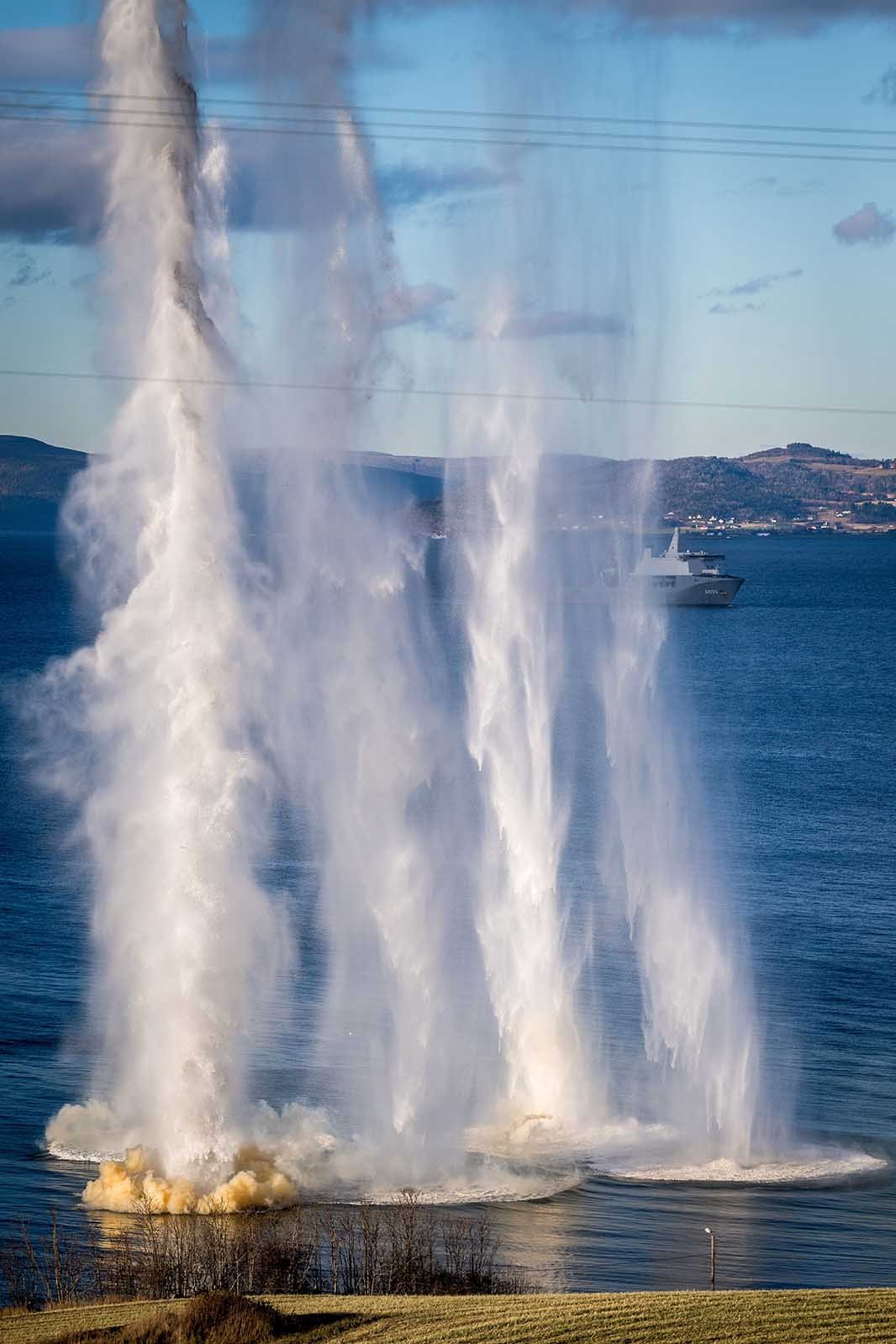
The effective closure of the Strait of Hormuz in the face of various Iranian military capability threats has underlined the return to prominence of mine warfare as both a military-operational and politico-strategic tool. Despite the talk of drones, hypersonic missiles, and other new technologies, and of shifts to ‘hybrid’ force structures and ways of warfare, the humble sea mine continues to shape modern naval operations. Being an asymmetric threat, it is perhaps no surprise, thus, that it does so in a disproportionate way.
At the time of writing, the latest Gulf war stands at a pivotal moment. The Strait of Hormuz is closed to commercial shipping, as Iran plays its cards as it sees necessary in response to the US/Israel attack. Global supplies of key natural resources including oil, liquefied natural gas, helium gas, and fertiliser remain blocked. Both sides have threatened escalation, the US to force the Strait open and Iran to ensure it stays closed.
Iran’s capability to threaten shipping access is multi-layered, including ballistic missiles, cruise missiles, one-way attack uncrewed aerial vehicles (OWA UAVs), fast patrol craft and uncrewed surface vessels, submarines, and mines.
Fighting through such a layered force would require, at the very least, high-end ‘air defenders’ (cruisers, destroyers, and modern frigates) and specialist mine warfare capability including mine-hunting platforms, autonomous and remotely operated underwater vehicles (AUVs, ROVs), and specific personnel expertise.
In naval operations, the mine threat exists in different scales, from minefields laid to deny access to specific waters, to mines deployed in the path of certain ships, to drifting mines and the random risk they pose, and to the ‘non-confirmed/non-denied’ posture of saying mines have been deployed even if they have not.
Today’s risk … and tomorrow’s
In three of the major crises and conflicts shaping Western security interests over the last five years – the Russo-Ukraine war, the Red Sea shipping crisis, and now the latest Gulf conflict – naval mine warfare has played a significant role, impacting from strategic to tactical levels.
In the Russo-Ukraine war, mines have been deployed in large fields to deny access to waters, coastlines, or riverine regions, and as single, drifting threats. A strategic impact has been the risk to shipping exporting Ukrainian grain and other resources to market.
In the Red Sea, for several years the Yemen-based Houthi rebels have mined key ports, islands, and waters to deter adversary landings. In the shipping crisis in 2023-24, risks of floating mines threatened shipping more widely.
In the current Gulf conflict, media reports that a Pakistan-flagged oil tanker navigated the Strait by sailing across the main shipping channels before weaving past the Qeshm, Larak, and Hormuz islands suggested it was using a route identified as safe.
Alternatively, using such a route could have been designed to send a message that there were areas to be avoided.

There are many lessons to be drawn from these conflicts. For NATO navies, some are relevant to future risk perspectives, but some are not. Yet the prominence of mine warfare requirements in NATO’s most recent alliance maritime strategy (AMS), published in October 2025, indicates clearly that mine use is seen as a relevant risk.
Detailing the maritime domain’s role in NATO strategic- and operational-level deterrence and defence in the North Atlantic, the new AMS listed naval mine warfare alongside carrier strike, anti-submarine warfare (ASW), and the use of seaborne autonomous capabilities as central to “[supporting] NATO’s ability to deter, defend, or decisively strike against an aggressor”.
Listing naval mine warfare in a bracket alongside carrier strike and ASW capabilities and operations underlines the strategic-level anti-access/area denial threat now presented to the security of sea lines of communication, maritime choke points, and littoral shore access in the returning state-based competition and conflict at sea.
Such is the significance of this threat, given NATO concerns of Russia seizing NATO Baltic territory, that opposed transits and access through the Eastern Atlantic, the Skagerrak/Kattegat Straits, and across the Baltic Sea is something NATO navies are preparing for. This has been illustrated in at least two NATO exercises in 2026: first, the alliance-wide, strategic-level, ‘Steadfast Dart’, held in February, practiced the delivery of NATO reinforcements into the Baltic through the straits, and ashore into northern Germany; second, the operational-level ‘MCM Baltic’, in March, drilled tactical, procedural, and capability elements to ensure NATO maintains mine warfare readiness in this crucial region.
Theory to practice
The current Gulf war and the closure of Hormuz, in a fight between state protagonists, means the risk is not just theoretical.
The war’s focus on targeting critical energy supply reflects Russia’s Ukraine playbook. In the Gulf’s case, the impact of hitting such supply is exacerbated by the fact it can be turned off more easily than through conducting long-range precision strikes, namely by closing the Strait – including through using mines as a relatively straightforward, affordable, deployable, and massed technology.
The Gulf’s geostrategic disposition as arguably the world’s most significant maritime choke point is shaped by the fact that its entire northern shoreline is Iranian territory, with such territory closed tightly around the Strait itself.
Any response to the closure will need to be multi-domain. Air power will be needed to degrade Iranian missile sites along the coast overlooking the Strait, plus targeting sites further inland. Countering crewed and uncrewed interceptors attacking along the surface will require the ability to strike ashore or target them at sea. Assuming risk nonetheless from shore-based sites, any surface ship conducting escort transits will need to be an ‘air defender’. If there is risk any Iranian submarines remain operational, this risk will need monitoring by underwater sensors: a US Navy (USN) nuclear-powered submarine is known to be in the region; uncrewed underwater vehicles could also provide sensing capability.
Then there is the issue of the mine threat response, again in both politico-strategic and military-operational contexts.

In the former, in mid-March multiple countries signed a statement condemning the closure and reinforcing the need to recognise the international interest in re-opening the Strait. UK Defence Secretary John Healey revealed too that UK military personnel had deployed to US Central Command to contribute to planning for any appropriate options that could provide safe passage.
The BBC reported also that the UK and France were starting to build a coalition of countries willing to help keep the Strait open once conditions allowed. Such effort would require a multinational solution involving crewed and uncrewed platforms to help clear a path, according to unnamed officials cited in the report. The report noted too that while it was possible some mines had been laid, some ships still seemed to be transiting the Strait.
In the latter context, the UK Royal Navy (RN) has provided pre-eminent expertise in this area for some time, with significant capability resident in the Gulf including specialist mine-hunting platforms, support ships, expert personnel, and uncrewed systems.
For many navies, mine warfare was the first capability area into which uncrewed systems were introduced – a move driven by the need to remove the sailor from harm’s way. Within its ‘hybrid navy’ transformation, the RN has already begun shifting its mine counter-measures capability development more firmly towards employing modular constructs based around using uncrewed systems and personnel deployed onboard vessels of opportunity (rather than dedicated platforms).
Yet the war erupted with the RN amidst this transition. It has no specialist crewed platforms remaining in the Gulf, but does have a cadre of personnel and uncrewed systems.
The USN also has three mine warfare-capable Independence-class littoral combat ships homeported in Bahrain. These ships provide a package of capabilities, including helicopters and uncrewed systems. However, a US Naval Institute News report in mid-March said the ships were visiting Malaysia at that time.
Despite the mine threat concern, there lingers though the question of whether it would be in Iranian interests to mine the Strait extensively, given the long-term issues evident in the Black Sea for the safe transit of maritime traffic and trade even once the Russo-Ukraine war is over, due to the extensive mine laying conducted there.
Dr Lee Willet
Click here to read the latest issue of ESD.
