


Let’s take a look at how to get faster in BJJ. Here’s the basic premise in video format, and then we’ll break down this idea a little bit further in the text below…
How To Be Fast
There are different ways to be fast, including choosing the right parents so that you’ve got great genetics, being in shape so you’re not hobbled by exhaustion, and simply training more so that your neural pathways are more deeply grooved and better greased.
But all those things take time, and there’s a simple way to get faster much quicker.
And that’s to choose between fewer options when you have to make a decision in a scramble on the mats.
We’ve known for a long time that reaction time increases as the number of options you have to choose between increases.
(This ultimately culminated in Hick’s Law, which established the logarithmic mathematical relationship between reaction time and degrees of choice.)
Having options is good. Options are great. But options can also work against you, especially if you’re pressed for time.
The ability to scroll through your mental rolodex of techniques depends on whether you’re in a static or dynamic situation.
In a static situation, you have time to think. In a dynamic situation, you only have time to react.
Dynamic Situations: Less is More!
Let’s say I’m shooting on you: you manage to sprawl and avoid the takedown, but now I’m working hard to finish the takedown or sit out and take your back.
This is a dynamic situation. You don’t have the luxury of thought here like you did in a more static position.
You have to move NOW!
Go for a guillotine choke? Fine. Spin to the back? Great! Go for a fancy sacrifice turnover? Wunderbahr!!
In dynamic situations, it matters less what you do so long as you do something right away.
Fractions of a second count here, and if you don’t do something, then your opponent will. Once you’re a step behind in a scramble, it’s really, really tough to catch up.
In these dynamic situations, having ONE good option is better than having 10 pretty decent options. Hick’s law tells us that the fewer options you evaluate, the faster your reaction time will be.
This is especially a problem with those practitioners I call technique collectors: guys who can show you one million finishing options from the front headlock but can’t wrestle their way out of a wet paper bag. Guys who impress you with a dizzying number of variations but can never tap out anyone who isn’t a white belt or blue belt.
They would be much better under pressure if they did less, not more.
Static Situations: More is More!
Now all this being said, there IS a time and place for having lots of options.
First and foremost, it’s good to have options when the situation is relatively stabilised and you have the luxury of time.
Let’s say that you’ve latched onto the Kimura armlock from north-south and your opponent is blocking you by linking his hands together for dear life.
If he’s that focused on defense then you can take some time to think through your options.
It’s time to go through the rolodex of moves!
Maybe it’s better to try and break the Kimura… or go to a leglock entanglement… or fall to a side triangle choke… or take the back… or, or or.
Maybe one of those options really is better than the others in this particular situation, and since you have some time to think about it you can pick the best option.
Another time it’s good to have options is if you’re teaching.
In this case you might want to show a bunch of options because what works for one of the students may not work for another.
Try to contextualise these options if you can: this option tends to work better for people with shorter legs… this other variation works best for bigger people… this is the finish you see most often at a high level.
Options are good; having more options rather than fewer is great. The problem is that every additional option adds more time.
When the chips are down and the scramble is on, less is more.
How to Get Faster with BJJ Games
One way to maximise your training time, get more active reps in, and learn exactly when to pull the trigger is by making your training very specific.
Constraining the options available to you and your opponent and setting very specific goals is the fastest way to get faster, and also the fastest way to get better.
BJJ Games, which I co-produced with Rob Biernacki, is a training methodology to help you with that. First check out this quick trailer for the BJJ Games Instructional.
Keep in mind that Rob has used these exact training methods to get gold in the black belt division in both IBJJF Worlds (Masters division) AND the ADCC Open, so you know they work!
Check out BJJ Games by clicking here, now available in online streaming and app-based formats.
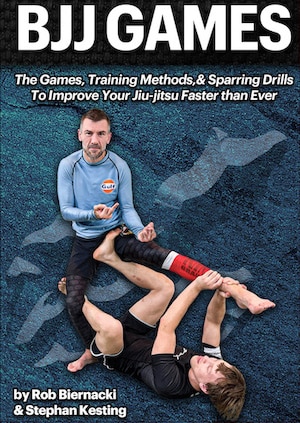
BJJ Games, the bestselling instructional.
