

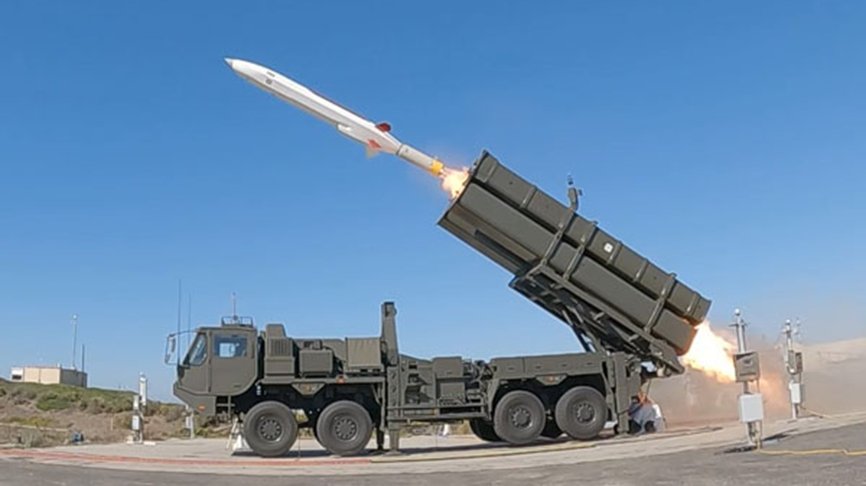
The Japan Self-Defense Force has deployed the first units of its Upgraded Type 12 ground-launched anti-ship missiles to Camp Kengun in Kumamoto Prefecture in southwest Japan.
The first deployment is with the 5th Surface-to-Ship Missile Regiment at Camp Kengun, and a full operational capability is projected by the end of March.
This will be followed by the missile’s fielding to the 8th Surface-to-Ship Missile Regiment in Oita Prefecture, and the 7th Surface-to-Ship Missile Regiment on Okinawa in following years.
The new system is based on the earlier Type 12, but the missile has substantially improved performance and capabilities. The new anti-ship missile has reportedly increased its range to 900-1,000km or more, though the Acquisition, Technology and Logistics Agency (ATLA) has not officially released a figure.
The Upgraded Type 12 can thus potentially reach targets as far away as the Chinese coast. The missile uses a booster at launch, and a turbofan engine for cruise flight.
Mitsubishi Heavy Industries (MHI) redesigned the missile airframe to reduce its radar signature, while satellite and inertial navigation and terrain referencing allow for precise low-level flight. The missile combines radar and imaging terminal guidance that is effective against stationary or moving targets.
Midcourse corrections are also possible through data links. The missile reportedly incorporates manoeuvre options to reduce the effectiveness of ship defence systems, especially in its final approach.
Mounted on an 8×8 tactical truck, the Upgraded Type 12 can take up position, fire and then rapidly displace to a new location, thus reducing the effectiveness of counter-fires.

Deployment of the Upgraded Type 12 is one element in Japan’s “Island Defence” strategy. Another is development and fielding of precision counter-strike capabilities. ATLA’s Hyper Velocity Guided Projectile (HVGP) is part of that capability.
The objective, according to the Institute of International Strategic Studies (IISS), is to engage hostile forces at longer distances, thus holding adversaries at risk beyond Japan’s immediate coastline while defending remote islands and maritime approaches.
Also using a mobile ground launcher, the HVGP combines a ballistic missile to boost its hypersonic glide vehicle payload to high altitudes, allowing the weapon to glide at extremely high speed before striking its target. The IISS suggests the initial HVGP version could have a 500km range.
Through Kawasaki Heavy Industries (KHI), ATLA is also developing its “New Surface-to-Ship Missile”, which may have greater range and incorporate terminal-phase manoeuvres to overcome defensive systems. Prototype subsystems have been completed and are in testing.
When coupled with Japanese efforts to expand its reconnaissance satellite constellation capable of long-range targeting operations, and the creation of an amphibious rapid-response force, these missile developments represent a significant forward shift in Japan’s defensive posture.
by Stephen W. Miller
