

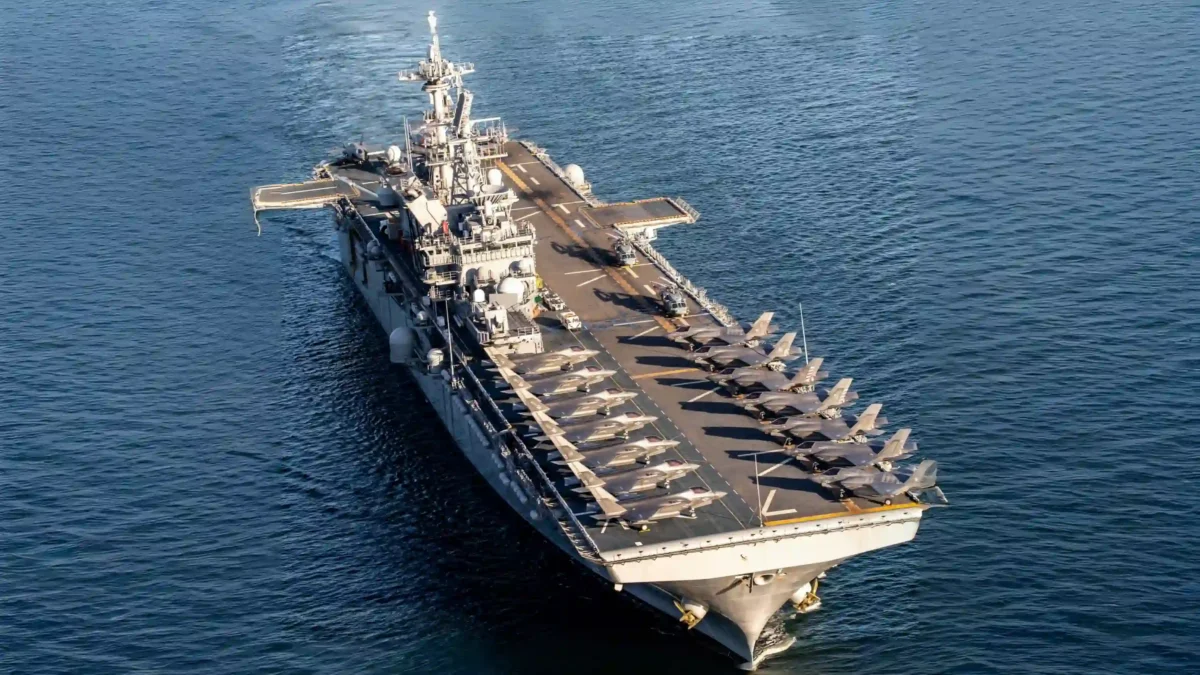
Out on the open ocean, some warships look impressive… and then there are ships that feel almost unreal in scale.
USS Tripoli (LHA‑7) is one of those vessels. At more than 840 feet long and weighing over 44,000 tons, it’s not just a ship, it’s essentially a floating airbase designed to launch Marine aircraft into combat zones thousands of miles from home.
But here’s the twist: the USS Tripoli isn’t technically an aircraft carrier.
Instead, the U.S. Navy classifies it as an amphibious assault ship, part of the powerful America-class amphibious assault ship program. That classification hints at something fascinating about modern naval warfare.
Ships like Tripoli blur the lines between aircraft carriers, troop transports, and expeditionary bases. One day it’s launching stealth jets. The next, it’s delivering Marines and helicopters to a disaster zone.
Commissioned in 2020, USS Tripoli was built with one major idea in mind: aviation dominance for Marine Corps operations. Its enormous flight deck supports cutting-edge aircraft like the F‑35B Lightning II, the Marine Corps’ short-takeoff stealth fighter.
In certain configurations, the ship can operate like a compact strike carrier, a concept naval strategists sometimes call a “Lightning Carrier.”
USS Tripoli represents a shift in naval strategy, a move toward flexible ships that can project power without relying entirely on traditional aircraft carriers. And that flexibility is exactly what makes the ship such a fascinating piece of modern naval engineering.
In this post, we’ll dig deeper into what makes USS Tripoli unique, from its design and aircraft capabilities to the strategic role it plays in the U.S. Navy’s Indo-Pacific operations.
What Is USS Tripoli (LHA-7)?
If you first glance at USS Tripoli (LHA-7), your brain might immediately label it an aircraft carrier. The long, flat flight deck gives that impression. Jets taking off, helicopters landing, crews hustling across the deck, it all looks very carrier-like. But technically speaking, the ship belongs to a different category altogether.

USS Tripoli is an amphibious assault ship, designed to support both aviation operations and Marine Corps amphibious missions. In other words, it’s a hybrid platform. Part airbase. Part troop transport. Part command center for expeditionary warfare. And that versatility is exactly what the modern U.S. Navy wants in an era where conflicts can shift quickly from sea to land.
The ship is the second vessel in the America-class amphibious assault ship series, a new generation of warships designed around aviation power.
Unlike earlier amphibious ships, the first two vessels in the class, Tripoli included, were built without a traditional well deck, the flooded bay used to launch landing craft. Instead, designers expanded aviation facilities to support more aircraft and maintenance operations.
The name “Tripoli” carries its own history, too. The ship honors the U.S. victory during the Battle of Derne in 1805, part of the First Barbary War, one of the earliest overseas conflicts fought by the United States.
Interestingly, this isn’t the first ship to carry the name. USS Tripoli (LHA-7) is actually the third U.S. Navy vessel named Tripoli, continuing a lineage tied to early American naval history.
So when you hear the name USS Tripoli, think beyond a single warship. It represents two centuries of naval tradition, now wrapped inside one of the most advanced amphibious aviation platforms ever built.
Design and Technology Innovations
Spend a few minutes studying USS Tripoli (LHA-7), and something becomes clear pretty quickly: this ship wasn’t designed with yesterday’s wars in mind. Its architecture reflects a different assumption, that airpower, speed, and flexibility will define amphibious operations in the decades ahead.
That thinking shaped nearly every design choice.
The most noticeable change compared with earlier amphibious assault ships is the aviation-centric layout. Tripoli belongs to the America-class amphibious assault ship, and the first two ships in this class were intentionally built without a well deck.
Traditionally, amphibious ships carry landing craft in a flooded internal bay. Removing that feature allowed engineers to expand aviation facilities dramatically.
The payoff? A larger hangar deck, more maintenance shops, and significantly greater aviation fuel storage, all critical for sustained flight operations.

Another important innovation is the ship’s advanced electrical distribution system, often called a zonal electrical architecture. Instead of running power through a few central systems, the ship divides electrical control across multiple zones. If one section of the ship is damaged, other zones can still function, keeping critical systems alive.
Then there’s propulsion. Tripoli uses a hybrid propulsion system, combining gas turbines with auxiliary electric motors. During long-distance cruising, the ship can rely on electric drive for improved fuel efficiency, switching to turbines when higher speed is required.
All these innovations serve one purpose: supporting modern Marine aviation, especially aircraft like the F-35B Lightning II.
In short, USS Tripoli isn’t just another amphibious ship. It’s a purpose-built aviation platform, designed to extend U.S. Marine airpower into places where traditional aircraft carriers might not always be available, or practical.
Key Specifications of USS Tripoli
Numbers don’t tell the whole story of a warship, but they do give you a sense of scale. And when it comes to USS Tripoli (LHA-7), the numbers are… well, pretty staggering.
Stretching roughly 844 feet (257 meters) from bow to stern, USS Tripoli is about the length of three football fields laid end to end.

Fully loaded, the ship displaces more than 44,000 tons, placing it among the largest amphibious assault ships ever built. From a distance, its massive flight deck almost looks like a small island drifting across the ocean.
Under the hood, or technically, beneath the deck, the ship runs on a powerful propulsion system built around two gas turbines and auxiliary electric drive motors. This hybrid arrangement allows Tripoli to cruise efficiently during long deployments while still delivering bursts of speed when needed.
Here’s a quick look at the ship’s core specifications:
| Specification | USS Tripoli (LHA-7) |
| Ship Class | America-class amphibious assault ship |
| Length | 844 ft (257 m) |
| Beam | ~106 ft (32 m) |
| Displacement | ~44,971 tons full load |
| Maximum Speed | 22+ knots |
| Propulsion | 2 gas turbines + electric drive |
| Crew | ~1,200 sailors |
| Marine Capacity | ~1,800 Marines |
One detail that often surprises people: USS Tripoli carries almost as many personnel as a small town. The ship typically hosts about 1,200 Navy sailors, along with up to 1,800 Marines depending on the mission.
And the flight deck? It spans more than nine acres, giving aircraft plenty of room for takeoffs, vertical landings, and maintenance operations. That deck space is essential because Tripoli’s design prioritizes aviation power over traditional amphibious landing craft.
In practical terms, these specs translate into one big advantage: operational flexibility. The ship can sail across oceans, support Marine expeditionary forces, launch advanced aircraft, and sustain operations for weeks at sea, essentially functioning as a self-contained expeditionary base.
Aircraft and Aviation Capabilities
Here’s where USS Tripoli (LHA-7) really separates itself from older amphibious ships: aviation. In fact, the ship was designed almost from the inside out to support aircraft operations.
Engineers gave it larger hangars, expanded aviation fuel storage, and maintenance spaces that look more like what you’d find on a small aircraft carrier than a traditional amphibious assault ship.
And the results? Pretty remarkable.
The flight deck, covering roughly nine acres, can support a wide mix of Marine Corps aircraft. These aircraft handle everything from troop transport and heavy lifting to close air support and stealth strike missions.
Below are some of the primary aircraft that operate from the ship:
| Aircraft | Role |
| F-35B Lightning II | Stealth strike fighter |
| MV-22B Osprey | Tiltrotor troop and cargo transport |
| CH-53K King Stallion | Heavy-lift helicopter |
| AH-1Z Viper | Attack helicopter |
| MH-60 Seahawk | Utility and maritime operations |
The star of the show, though, is the F-35B Lightning II. Unlike conventional fighter jets, the F-35B can perform short takeoffs and vertical landings (STOVL). That means it can launch from ships without the massive catapults used by supercarriers.
Because of this capability, the Navy and Marine Corps developed what’s often called the “Lightning Carrier” concept. In certain mission setups, USS Tripoli can operate around 16–20 F-35B jets, transforming the ship into a compact but potent strike platform.

Think of it like this: instead of relying solely on large aircraft carriers, the Navy can spread airpower across multiple ships. Smaller platforms like Tripoli can still deliver serious punch, while being harder for adversaries to track or target.
So while USS Tripoli isn’t technically an aircraft carrier, it can still launch stealth fighters, support helicopter assaults, and sustain aviation missions for weeks. In modern naval warfare, that kind of flexibility is gold.
Weapons and Defensive Systems
For a ship that looks like a floating runway, USS Tripoli (LHA-7) is surprisingly well-armed. Not in the sense of heavy battleship guns, those days are long gone, but in the way modern warships protect themselves in a world of missiles, drones, and fast attack boats.
Think of the ship’s defenses as layers of protection, each designed to intercept threats at different distances.
First come the missile defense systems, built to stop incoming anti-ship missiles before they get dangerously close. One of the key systems onboard is the RIM‑116 Rolling Airframe Missile, a rapid-reaction missile designed specifically to intercept threats like cruise missiles and hostile aircraft. The system can track and launch within seconds, because in naval combat, seconds matter.

Tripoli also carries the RIM‑162 Evolved Sea Sparrow Missile, which extends the ship’s defensive reach. This missile system forms part of the broader naval air-defense network, working alongside radars and other ships in a task force.
But what if a threat gets through?
That’s where the last line of defense comes in: the famous Phalanx CIWS (Close-In Weapon System). Sailors sometimes nickname it “R2-D2” because of its shape, but its purpose is serious. The system fires up to 4,500 rounds per minute, creating a wall of metal designed to destroy incoming missiles at extremely close range.
Here’s a simplified overview of Tripoli’s defensive suite:
| System | Purpose |
| RIM-116 Rolling Airframe Missile | Short-range missile interception |
| RIM-162 ESSM | Medium-range air defense |
| Phalanx CIWS | Last-ditch anti-missile gun |
| .50-cal machine guns | Defense against small boats |
On top of these weapons, USS Tripoli relies heavily on its escort ships and aircraft for protection. Destroyers, cruisers, and combat air patrols extend the defensive umbrella far beyond the ship itself.
So while the vessel’s primary job is launching Marines and aircraft, it’s far from defenseless. In fact, Tripoli is built to survive, and fight, inside some of the most contested waters on the planet.
Role in Modern Naval Strategy
Naval strategy has changed a lot over the past few decades. Massive carrier strike groups still dominate headlines, but modern planners are increasingly interested in something else: distributed power. Instead of concentrating all airpower on a handful of supercarriers, the idea is to spread capability across multiple platforms.
That’s exactly where USS Tripoli (LHA-7) comes in.

As part of the United States Navy and the United States Marine Corps expeditionary force, Tripoli serves as a mobile base for rapid-response operations. It can launch aircraft, deploy Marines, coordinate amphibious landings, and support humanitarian missions, all from a single ship.
And because it operates aircraft like the F-35B Lightning II, the vessel brings something especially valuable: stealth strike capability without requiring a full-sized aircraft carrier.
This capability has led to the growing use of the “Lightning Carrier” concept, where amphibious assault ships operate a large number of F-35B jets for combat missions. In certain configurations, Tripoli can carry 16 to 20 stealth fighters, effectively transforming it into a compact strike carrier.
Here’s how USS Tripoli contributes strategically:
| Strategic Role | Impact |
| Expeditionary Warfare | Rapid deployment of Marines and equipment |
| Airpower Projection | Launching stealth fighter missions |
| Regional Deterrence | Visible U.S. military presence |
| Crisis Response | Fast humanitarian or evacuation operations |
The ship’s forward presence in the Indo-Pacific, particularly near Sasebo, Japan, also supports the operations of the United States Seventh Fleet. This region has become one of the most strategically significant maritime zones in the world.
Here’s the subtle genius of ships like USS Tripoli: they’re flexible tools. One week they’re conducting amphibious assault exercises. The next week they might deliver disaster relief after a typhoon. And if tensions escalate, the same ship can launch stealth jets within hours.
Not many platforms can switch roles that quickly. Tripoli can, and that versatility is exactly why it matters in modern naval strategy.
