

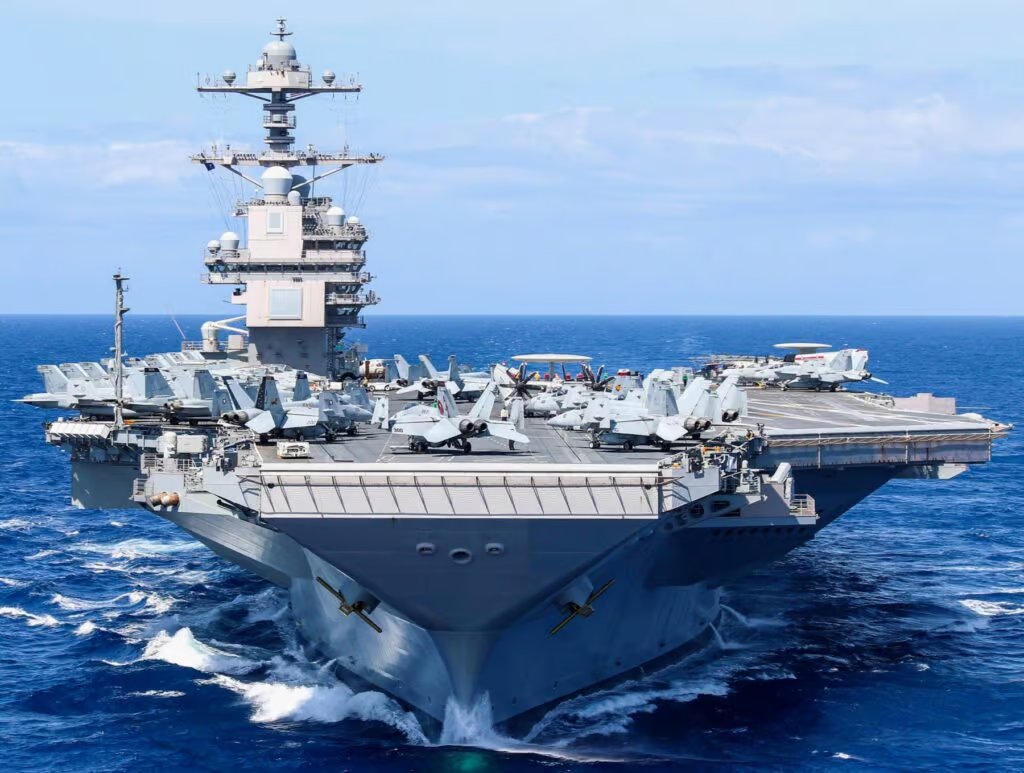

US President Trump sailed his “big, beautiful armada” into the Gulf region to pressure the Iranians into agreeing to end their nuclear arms programme, and they were ready to agree when Israel started its Operation Roaring Lion, which left the United States playing catch-up with its Operation Epic Fury.
The USS Abraham Lincoln aircraft carrier has been in the Arabian Sea since 16 February. The Nimitz-class aircraft carrier is the flagship of the US Navy’s Carrier Strike Group Three (CSG-3), equipped with F-35C Lightning IIs, F/A-18E/F Super Hornets, EA-18G Growlers, E-2D Hawkeyes, and includes three Arleigh Burke-class guided missile destroyers.
The carrier USS Gerald R Ford, with Carrier Strike Group Twelve (CSG-12) consisting of F/A-18E/F Super Hornets, EA-18G Growlers, and E-2D Hawkeyes, departed Souda Bay on Crete and arrived off the Israeli coast on 27 February. A US Navy E-6B Mercury airborne command post was also deployed to the Middle East. The aircraft acts as a command centre and facilitates communication with strategic nuclear submarines.

On February 28, Israel and the United States carried out a large-scale attack on Iranian territory. Washington launched dozens of Tomahawk cruise missiles from US destroyers.
Initial strikes targeted sites connected to Iran’s senior political and military leadership. The Supreme Leader Ali Khamenei was killed when his compound was hit, along with intelligence facilities, units of the Islamic Revolutionary Guard Corps (IRGC), and other security installations.
The United States and Israeli forces attacked Iranian naval vessels and facilities in the Persian Gulf, including Bandar Abbas in Hormozgan Province, which hosts the IRGC Navy Headquarters, the IRGC Navy 1st Naval District, and Artesh Navy Southern Forward Naval Headquarters. A Jamaran-class corvette was the first to be directly hit by US aircraft and missiles at Bandar Abbas, a fate later shared by the Moudge-class frigate Sahand.
On 2 March, an Alvand-class frigate was seen on fire at Bandar Abbas, and US CENTCOM also confirmed the destruction of the Shahid Bagheri, an IRGC Navy drone and helicopter carrier commissioned on 6 February 2025. Converted from a South Korean container ship, the 42,000-ton vessel featured a ski-jump runway. The IRIS Makran, Iran’s first forward base ship converted from a 2010 Japanese-built Aframax tanker, was also set alight. Iran’s first indigenously completed coastal submarine was confirmed sunk on 3 March.


The frigate Dena was torpedoed on 4 March off the coast of Sri Lanka by a Mk-48 ADCAP torpedo launched from a US nuclear-powered submarine. The frigate had been attending an international fleet review in India in February. On the same day, the IRGC’s Shahid Sayyad Shirazi, a Shahid Soleimani-class missile catamaran corvette, was struck.

Defense analysts believe that most of the vessels destroyed during the first week of Operation Epic Fury likely belonged to the IRGC Navy, which maintains a large fleet of fast-attack craft designed to overwhelm larger naval forces through swarm tactics. These platforms include missile boats and high-speed patrol craft, such as the Peykaap missile boats, the Zolfaghar fast-attack craft, the Seraj high-speed boats, and the Ashura-class patrol vessels.
Six days after the start of the strikes launched against Iran, at least 30 naval units have been sunk or destroyed, according to CENTCOM. However, a significant number of small IRGC patrol and attack boats remain, and more importantly, the US has not secured the Strait of Hormuz, one of the world’s major shipping routes through which around a fifth of the world’s oil is transported.
by David Oliver
