

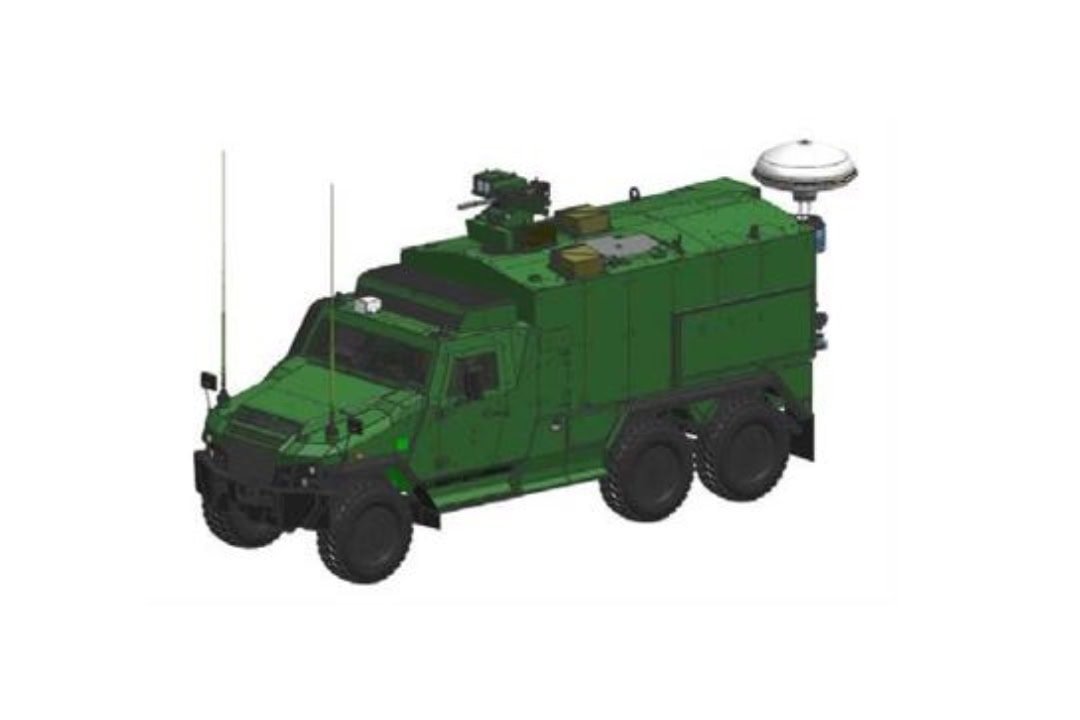

The future of Germany’s MAUS land electronic warfare programme appears to be in jeopardy amidst disquiet in the country’s parliament over the initiative’s direction.
In late January, news emerged that the Budget Committee in Germany’s Bundestag (Parliament) had not approved the purchase of the MAUS (Mobiles Aufklärungsunterstützungssystem/Mobile Reconnaissance Support System) system by the German Ministry of Defence (MOD). The committee is responsible for supervising and overseeing government spending. MAUS is the programme name for a new land Electronic Warfare (EW) capability that will equip the Heer (German Army).
Media reports noted that some parliamentarians had articulated concerns that the MAUS system, which was to have been accommodated on a six-wheel drive vehicle, would be too vulnerable to attack on a future battlefield. A key lesson regarding large land EW systems from the ongoing war in Ukraine is that such systems deployed near the tactical edge are vulnerable to attack by Uninhabited Aerial Vehicles (UAVs) and artillery.
MOD plans had called for the procurement of 40 MAUS systems, plus two prototypes, via an initial $705 million order. MAUS would have replaced existing Heer land EW systems. Armada records indicate that the Heer uses two land manoeuvre force electronic warfare systems mounted onboard the Daimler-Benz TPz Fuchs-1 six-wheel drive armoured personnel carrier. The Hummel (Bumblebee) system, of which the army has circa 40, provides Very/Ultra High Frequency (V/UHF: 30 megahertz/MHz to three gigahertz) jamming. These platforms are understood to be earmarked for a life extension to 2030 in the wake of MAUS’ apparent cancellation. Twelve Hornisse (Hornet) High Frequency (HF: three megahertz to 30MHz) jammers are deployed to target trunk and high tactical/operational level HF radio links. The mission systems of both these platforms were originally developed by AEG-Telefunken. Thales and Hensoldt also supplied key components like power amplifiers and signal processing software.
MAUS defined
Official German government documents seen by Armada shed additional light on the scope of the MAUS programme. Overall, the initiative had called for a full procurement of 90 systems. This would have seen the Hummel and Hornisse systems being replaced and would have added extra capacity to the German Army’s EW force weight.
Rohde & Schwarz was named as MAUS prime contractor with the associated platform to have been the six-wheel drive version of General Dynamics European Land Systems’ Eagle armoured vehicle. The German Army currently uses this Eagle version as its protected ambulance. Other contractors included Procitec and Innosystec. With Rohde & Schwarz providing the overall mission system it was possible that Procitec would furnish dedicated signals intelligence software and with Innosystec providing data analytics.
Expenditure for the programme was to see an initial outlay of $31.3 million in 2026, $64 million in 2027, $32.4 million in 2028, $296 million in 2029, $175 million in 2030 and $107 million in 2031. The documents note that each MAUS platform would have a unit price of $11.3 million with the MAUS mission system having a unit price of $6.6 million. Alongside the 40 production systems and two prototypes, the full order would have included a further 48 production systems, spare parts, tooling and additional, modular, mission systems.
No information is provided in the documents regarding the MAUS mission system. Nonetheless, it is reasonable to assume that this included HF and V/UHF Communications Intelligence (COMINT) and Communications Jamming (COMJAM) systems. What has been revealed in the documentation is that the German MOD had requested full and complete authority over the system’s software. This would mean that the user has the right to modify, edit and enhance the software as they wish without having to obtain prime contractor permission. The official documents added that MAUS systems were to have been deployed with the army’s 911, 912, 931 and 932 electronic warfare battalions.
MAUS trap?
For all intents and purposes, it appears that the MAUS programme in its current form is dead. Questions for the MOD and the Heer now focus on what might replace it. That the Hummel system is undergoing a life extension does buy both organisations some time, albeit only four years’ worth. Options for the MOD and the German Army include taking the MAUS mission system but installing it on a vehicle with better armoured protection. Such a move would increase the system’s unit cost and is thus likely to see the Heer receiving fewer than the 90 platforms it requested in the MAUS programme.
A second option could see the reduction of the MAUS order to two-thirds, or one-half, its original order size. This could free-up funds for the MOD to invest in light, unattended distributed, attritable COMINT/COMJAM systems that can be networked and deployed across a large area. Such Integrated Tactical EW (ITEW) networks can enjoy good survivability as the loss of one or two systems will not necessarily render the wider architecture inoperative. Networks such as these could also employ attritable Uninhabited Aerial and Ground Vehicles (UAVs/UGVs) to provide longer COMINT/COMJAM lines-of-sight thanks to UAV altitudes. Moreover, UAV and UGV use would let the network, to an extent, move with the ebb and flow of battle.
A third option could be to examine a collaborative land EW programme with an allied nation like the United Kingdom. The UK, as Armada has reported in the past, is in desperate need of a new land forces EW system. A common platform and mission system could be decided by both nations, with each country then free to upload its own classified, national threat libraries and jamming waveforms. Such an approach might help reduce the cost of the German order, ensure a comparable number of platforms and still leave cash for the ITEW architectures which have shown their worth in Ukraine.
Four years can be a blink of an eye in defence procurement so both the Heer and the German MOD have hard work ahead regarding the development of MAUS’ successor. Whatever its successor looks like, it will have to win the hearts and minds of the Bundestag budget committee as well as the trust of the troops that will use it.
by Dr. Thomas Withington
