

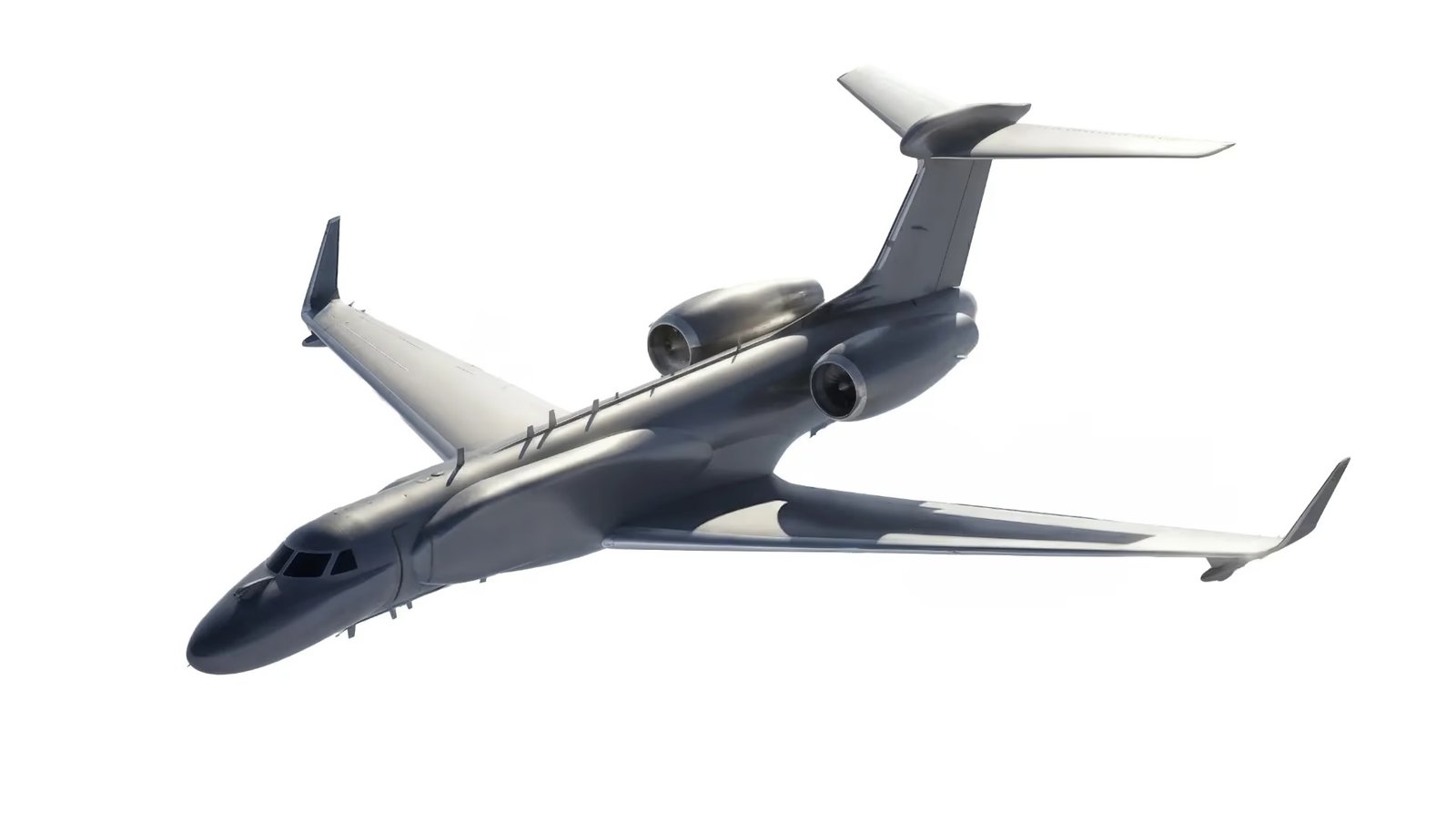
Singapore’s Defence Minister Chan Chun Sing announced during a parliamentary budget session on 27 February that the city state will acquire three Gulfstream G550 Maritime Surveillance Aircraft (G550-MSA).
He said the aircraft will complement four recently ordered Boeing P-8A Poseidon maritime patrol aircraft in safeguarding Singapore’s sea lines of communication, and forming part of its broader maritime security surveillance network.
An accompanying press release said: “The G550-MSA is equipped with radar systems, electro-optical/infrared (EO/IR) cameras, communication and identification systems, which allows the G550-MSA to simultaneously detect, identify and track a range of potential maritime threats.”
No further details have been released. However, an accompanying image of the G550-MSA shows conformal fairings along the fuselage, similar to the four G550 Airborne Early Warning aircraft that the Republic of Singapore Air Force (RSAF) has operated for more than 15 years.
There are two primary integrators of G550 special-mission aircraft in the market: US-based L3Harris and Israel Aerospace Industries (IAI), each offering missionised G550 variants that align with these attributes.
However, L3Harris’ solution is oriented primarily toward the airborne electronic attack role, whereas IAI’s ELI-3150 multi-mission intelligence, surveillance, target acquisition and reconnaissance (ISTAR) product – or a derivative of it – would represent a closer fit.
IAI’s ELI-3150 system, also known as the Multi-mission Airborne Reconnaissance and Surveillance 2 (MARS 2) platform, and more recently the Oron, is described as a wide-area, persistent-surveillance, multi-sensor aircraft that can support operations across air, land and maritime domains.
To carry out its ISTAR mission, the aircraft is equipped with an ELM-2024 active electronically scanned array radar featuring synthetic aperture radar and ground moving target indication modes, alongside a signals intelligence suite, EO/IR targeting pods and advanced data links.
Assuming the RSAF’s G550-MSA is based on the IAI ELI-3150 system – which is also offered on business jets such as the Challenger 650 and Global 6500 – the G550 platform was likely chosen to maintain commonality with Singapore’s G550-AEW fleet. Since they are already operational, the G550 also represents a lower-risk platform.
It is worth noting that Gulfstream ceased production of the G550 in 2021, so airframes for the G550-MSA may have to be pre-owned.
In recent times, Singapore has expressed concerns about freedom of navigation in its regional maritime environment, as well as the security of underwater infrastructure. Addressing these challenges is key to safeguarding its strategic maritime interests.
Singapore has embarked on a major overhaul of its naval capabilities, including the construction of six new Victory-class multirole combat vessels, upgrades to its Formidable-class frigates, two additional Type 218SG submarines (on top of an existing four) and the aforementioned P-8A aircraft.
Alongside the P-8, the G550-MSAs could strengthen maritime domain awareness by delivering advanced surveillance and intelligence-gathering capabilities in missions that do not require the former’s weapons or underwater sensing systems.
The selection of a multi-domain ISTAR aircraft for the maritime environment is not surprising, as the convergence of intelligence, surveillance and reconnaissance (ISR) capabilities across the domains has been a long-standing trend.
Beyond maritime operations, the G550-MSA may also serve as a flexible platform for ISR missions across the land and air domains. As such, the acquisition could provide the RSAF an opportunity to recapitalise its current airborne ISR platforms.
by Roy Choo
