

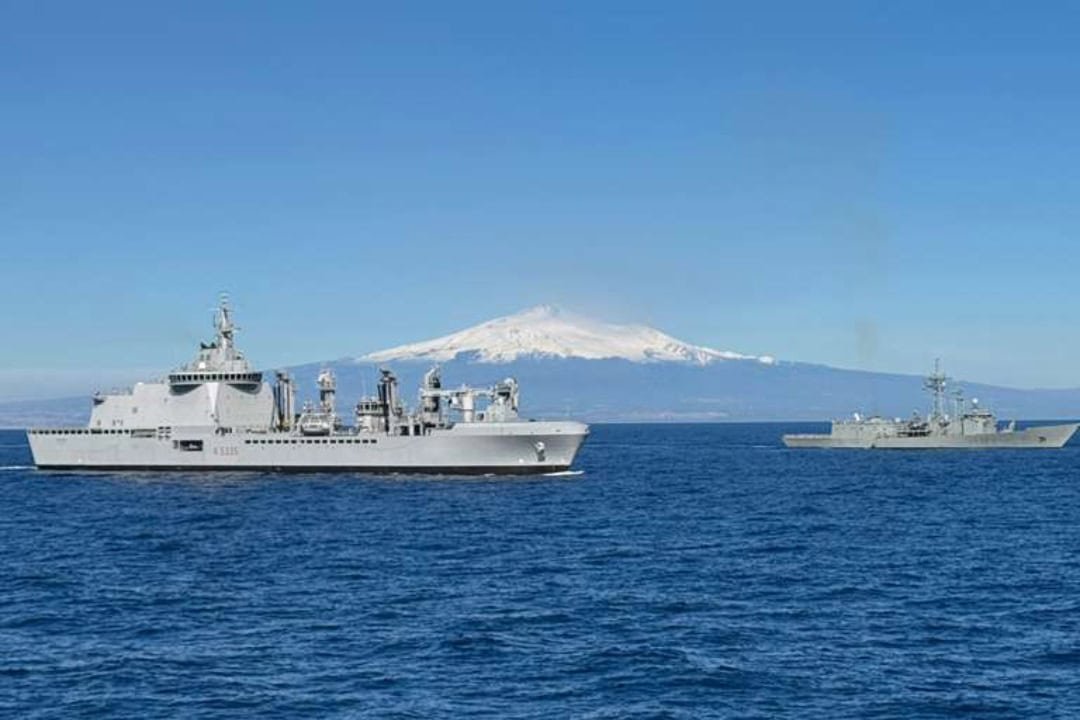

NATO naval activities underway across the geographical and operational task spectrum in the Mediterranean Sea are underlining an enduring alliance presence there, on NATO’s southern flank, even at a time of geostrategic focus on matters to the north (in the Arctic and Baltic, for example).
At the lower end of the operational spectrum, covering maritime security tasking, NATO conducted its first Operation ‘Sea Guardian’ (OSG) Focused Operation for 2026, from 21 January to 9 February. On 23 February, Exercise ‘Dynamic Manta 26’ began; running until 6 March, ‘Manta’ is NATO’s Mediterranean-focused anti-submarine warfare (ASW) exercise. Both activities are run by NATO Allied Maritime Command (MARCOM), based in Northwood, UK.
The OSG activity was led by Türkiye, with the Turkish Naval Forces Command’s Gabya-class frigate TCG Gaziantep serving as flagship. The operation focused on strengthening maritime situational awareness (MSA), deterrence, and co-operation between allied and partner forces, with a particular focus on maritime security information gathering, NATO said in a statement. Notably, the operation’s patrols were supported by Greek, Italian, and Turkish submarines, alongside Greek, Turkish, and United States maritime air assets. Such layers of assets can combine to improve MSA both on and below the surface. For example, the statement noted, “Submarine forces conducted extensive undersea operations, enhancing NATO’s ability to monitor maritime activity and contribute to a comprehensive maritime picture in the Eastern Mediterranean.”
For ‘Dynamic Manta’, submarines, surface ships (with embarked, organic helicopters), and maritime patrol aircraft (MPAs) from 10 NATO countries have come together to demonstrate seamless allied multi-domain operations, interoperability, and operational effectiveness in the delivery of ASW capability. Standing NATO Maritime Group 2 (SNMG2) – NATO’s Mediterranean-based, escort ship-focused standing naval force – is operating at the core of the exercise, as usual. ‘Manta’ is also integrating uncrewed surface vehicle (USV) capability for the first time this year. This development, according to a NATO statement, “[showcased] NATO’s commitment to innovation, and the integration of emerging technologies in support of maritime security”.
“‘Dynamic Manta’ offers an unmatched opportunity for allied submarines, surface forces, and air assets to train together as one team. This exercise enhances our collective ASW capabilities and ensures NATO remains ready to defend allied waters today and in the future,” said USN Rear Admiral Bret Grabbe, Commander, Submarines NATO (COMSUBNATO), in the statement.
The Mediterranean Sea has been a melting pot for maritime activity in recent years, with the worsening security situation in the region before the outbreak of the Russo-Ukrainian war, and then the war itself, prompting significant naval activity, especially in the Eastern Mediterranean. However, Russia’s loss of access to the Black Sea for non-Black Sea Fleet assets (since Türkiye closed the Bosporus/Dardanelles Straits under the terms of the 1935 Montreux Convention when the war broke out) and its loss of basing access in Syria (when the Assad regime collapsed in 2024) make it more challenging for Russia to sustain a naval presence in the Mediterranean – except perhaps for nuclear-powered attack submarines. Yet, as elsewhere across the Euro-Atlantic theatre, the lines between lower- and higher-end maritime tasks have become more blurred since the return of crisis and conflict there. For example, providing maritime security to secure sea lines of communication (SLOCs) is no longer about patrol presence to ensure the free flow of maritime trade, but about conducting ASW and other high-end operational activities to sustain such SLOCs in case of a requirement to secure NATO reinforcement across the North Atlantic from North America.
by Dr. Lee Willett
