

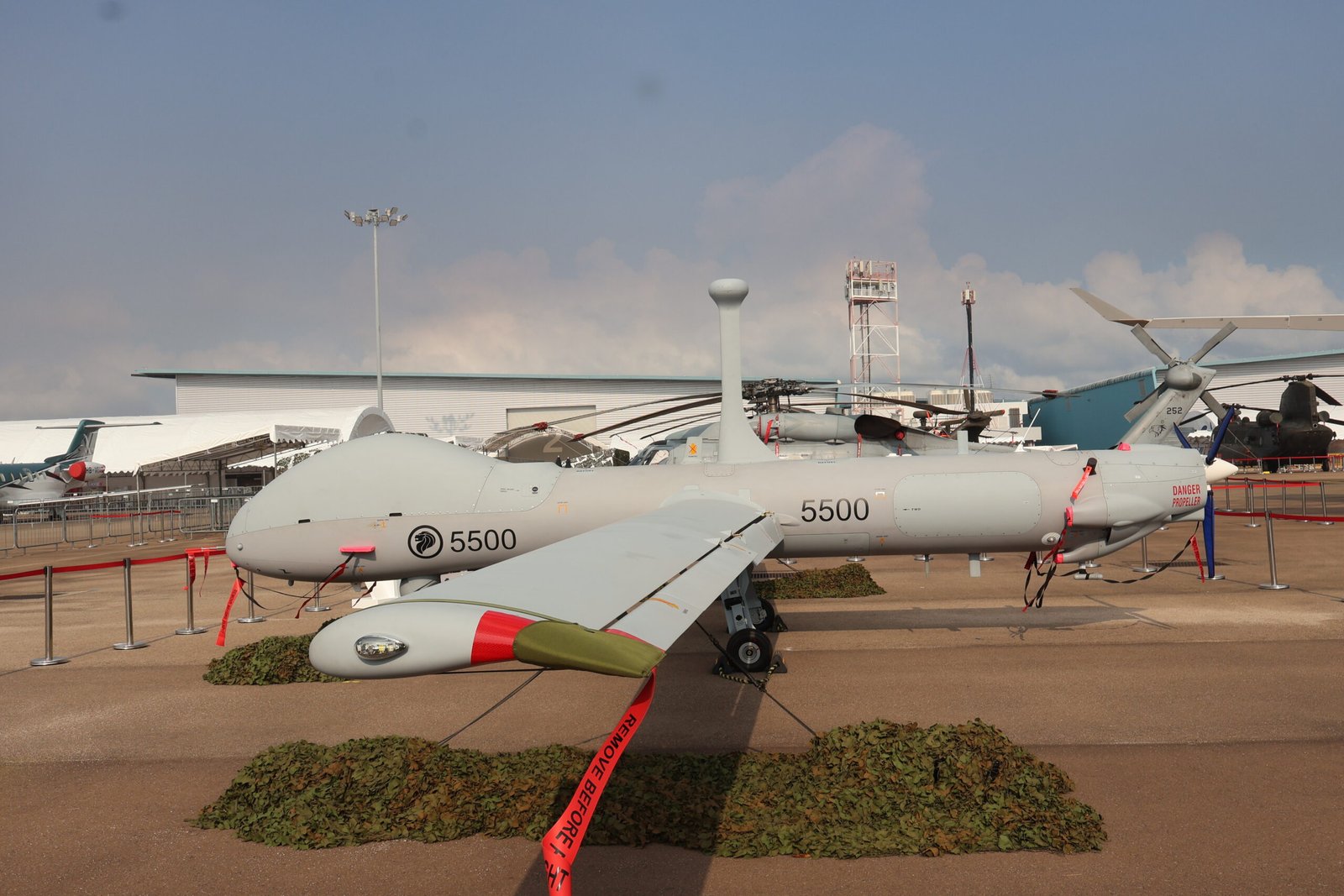
In the static display at the recent Singapore Airshow 2026, the Republic of Singapore Air Force (RSAF) showed examples of most aircraft in its fleet, as usual. New, however, was its recently acquired Elbit Systems Hermes 900 unmanned aerial vehicle (UAV).
The RSAF’s smaller Aeronautics Orbiter 4 UAV was also on display, having been acquired a few years ago but only now becoming fully operational.
Inside the exhibition hall, meanwhile, ST Engineering displayed two surveillance UAVs, the Veloce 15 and Veloce 60 hybrid UAVs. They were first seen at Singapore Airshow 2020, when ST Engineering began seeking customers.
Although the smaller Veloce 15 is in service with the Singapore Army, where it has replaced ST Engineering’s earlier Skyblade III, the company has not had much export success. The Royal Thai Army is the only known foreign operator of the Veloce 15, and no exports have been identified for the larger Veloce 60 so far.
Two more surveillance quadcopters that ST Engineering displayed at Singapore Airshow 2024 under the DroNet label were not on display this time. However, the company did unveil the DrN-600, a larger UAV designed for commercial cargo carriage, and the Artos, a compact quadcopter designed for close-range urban operations.
Interestingly, the RSAF has never bought a domestically designed drone. The service began operating the Elbit Systems Hermes 450 in 2007, and introduced the larger Israel Aerospace Industries (IAI) Heron 1 medium-altitude long-endurance (MALE) UAV in 2012.
The Hermes 900 that has just entered service will replace the 450s, and it was chosen in preference to the IAI Heron Mk II. Powered by a Rotax 914 engine, the Hermes 900 has a maximum range of more than 300km and an endurance of up to 36 hours.

When it decided to supplement its MALE UAVs with a smaller drone, the RSAF could in theory have chosen the Veloce 60. Like the Orbiter 4, the ST Engineering product is a Group 4 UAV with a maximum take-off weight of around 60kg and a top speed of 70kt. Its endurance is up to 14 hours, and the data link range is 100km.
However, the Orbiter 4 has a longer endurance and data link range, according to the RSAF. Aeronautics said that it can carry a range of interchangeable intelligence, surveillance and reconnaissance sensors, even a radar, although the payload capacity is only 12kg. It is shaped for low observability, and has autonomous flight modes.
The RSAF chose a version that is rail-launched and parachute-recovered, although Aeronautics does offer a hybrid vertical-take-off-and-landing (VTOL) version. According to the RSAF, the Orbiter 4 “can operate within a wide range of urban and confined spaces to support security operations such as counterterrorism and peacetime contingencies”.
Like its smaller stablemate, ST Engineering’s Veloce 60 is a VTOL machine. That makes it more suitable for operation from ship decks. Asian Military Review understands it will be employed by the Republic of Singapore Navy (RSN) on its six new destroyer-sized Multi-Role Combat Vessels, the first of which is due in 2028. Until now, the RSN has relied on Insitu ScanEagle UAVs, which are catapult-launched and recovered by a hook.

The RSAF plans to expand the scale and roles of UAVs, and it recently created a Drone Rapid Operational, Integration and Deployment (DROID) unit. It can already cue the army’s Veloce 15s from its Heron 1s via a Mobile Imagery Intelligence Dissemination System (MIDS).
Singapore recently decided to train all military reservists to operate small drones like the Veloce 15. In theory, ST Engineering should be well placed to provide more of them for both domestic and export use.
At this year’s air show in Singapore, ST Engineering’s Chua Jin Kiat, Head of International Defence Business, told journalists that its products were designed for simple operation by relatively inexperienced personnel. The company displayed a lightweight and portable simulator for the Veloce 15 for the first time too.
by Gordon Arthur
