

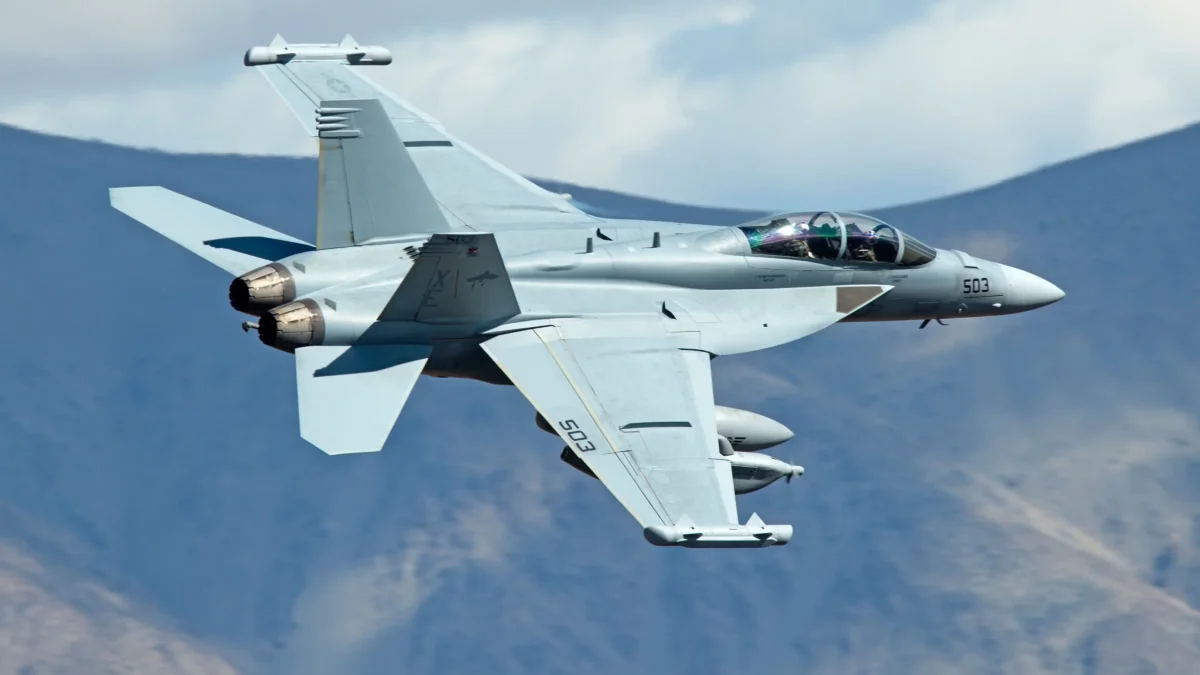
There’s a moment, right before a carrier launch, when everything feels suspended. The jet crouches at the edge of the deck, engines snarling, heat bending the air behind it.
Then, in less than three seconds, 30 tons of machine and fuel explode forward and vanish into open sky. That machine, more often than not, is the F/A-18 Super Hornet. And if modern naval airpower had a backbone, this would be it.
Built by Boeing, the Super Hornet isn’t just another fighter jet. It’s the quiet workhorse of the United States Navy, the aircraft that launches first, stays longest, and comes back ready to do it again tomorrow.
Unlike stealth aircraft designed purely for invisibility, the Boeing Super Hornet thrives on versatility. It can hunt enemy fighters at dawn, strike ground targets by noon, and escort surveillance aircraft by night. Same jet. Different mission. No drama.
Here’s the surprising part: despite its aggressive appearance, the F/A-18E/F Super Hornet wasn’t designed to be flashy. It was designed to be dependable.
Think of it less like a sports car and more like a high-performance pickup truck, fast, tough, adaptable, and capable of operating from some of the harshest environments imaginable: floating airfields in unpredictable oceans.
Today, Super Hornets serve not only the United States but also allied nations like Australia and Kuwait. With the newer Block III Super Hornet upgrades extending its lifespan into the 2040s, this aircraft isn’t fading away, it’s evolving.
So what makes this carrier-based multirole fighter so effective, so trusted, and frankly, so hard to replace? Let’s break it down piece by piece.
What Is the F/A-18 Super Hornet?
The simplest way to understand the F/A-18 Super Hornet is this: it’s the aviation equivalent of a multi-tool. Not the cheap kind, the heavy, steel, field-tested tool that soldiers actually trust.
It was built from the ground up to handle the unpredictable nature of carrier warfare, where every takeoff, landing, and mission profile is shaped by weather, fuel limits, and operational urgency.

The “F/A” in F/A-18 stands for Fighter and Attack, and that dual identity is the aircraft’s defining trait. Unlike specialized jets that focus purely on air combat or ground strikes, the Super Hornet comfortably does both.
It can shoot down enemy aircraft using radar-guided missiles or deliver precision bombs within meters of a target. No refit required. No swapping airframes.
There are two main versions of the Super Hornet, each designed with slightly different strengths:
| Variant | Crew | Primary Advantage |
| F/A-18E | 1 pilot | Lighter, optimized for air combat |
| F/A-18F | 2 crew | Better coordination for complex strike missions |
The second crew member in the F model isn’t just a passenger. They manage sensors, radar, and weapons systems, reducing pilot workload during high-stress combat situations. It’s like having a co-pilot, tactical analyst, and mission commander rolled into one seat.
Compared to the older Hornet it replaced, the Super Hornet is about 25% larger, carries significantly more fuel, and has increased survivability. But here’s the interesting twist, it was also designed to require less maintenance per flight hour. That means more missions, less downtime.
Read also: F-18 Hornet vs Super Hornet: What’s the Difference?
And in naval aviation, availability often matters more than raw speed.
Development and History of F/A-18 Super Hornet
The story of the F/A-18 Super Hornet isn’t just about machines, it’s about solving a very human problem: how to keep naval aviation relevant in a world of evolving threats.
In the late 1980s and early 1990s, the United States Navy faced a challenge. Its fleet of F-14 Tomcats and older attack jets was aging, maintenance costs were skyrocketing, and emerging threats demanded longer-range, more versatile aircraft. Enter the Super Hornet.
Developed by Boeing (after acquiring McDonnell Douglas), the Super Hornet was essentially a “grown-up” version of the original F/A-18 Hornet.
Engineers extended the fuselage, increased wingspan, and enlarged the internal fuel capacity, giving it more endurance without sacrificing agility. Avionics and radar systems were also upgraded, making the jet smarter, more aware, and better connected to other assets in the fleet.
The first flight took place in November 1995, and by the early 2000s, the Super Hornet had entered operational service. It didn’t just replace old jets; it consolidated multiple roles into one platform: fighter, attack, reconnaissance, and even early electronic warfare when paired with the Growler variant.
A subtle but crucial advantage? Maintenance. Compared to the older Hornets and Tomcats, the Super Hornet was easier to service, allowing higher mission readiness rates.
Commanders quickly appreciated its reliability; in carrier operations, an aircraft that can fly when you need it is often more valuable than one with slightly better performance stats on paper.

Today, the Super Hornet continues to evolve. Modern Block III upgrades, including advanced networking, extended range, and reduced radar signature, mean this aircraft isn’t just a relic, it’s a living, adaptable solution for the next generation of naval aviation.
F/A-18 Super Hornet Specifications
If you really want to understand the F/A-18 Super Hornet, don’t just look at how fast it flies. Look at what it carries, how far it goes, and how much punishment it can absorb while still coming home. Because in carrier aviation, survivability and endurance often matter more than bragging-rights speed.
At a glance, the Super Hornet looks compact compared to massive land-based fighters. But that’s deceptive. It’s engineered to maximize performance within the strict size limits of aircraft carrier elevators and hangar decks. Every inch serves a purpose.
Here’s a clear breakdown of the core specifications:
| Specification | F/A-18E/F Super Hornet |
| Length | 18.31 meters (60.1 ft) |
| Wingspan | 13.62 meters (44.8 ft) |
| Height | 4.88 meters (16 ft) |
| Empty Weight | ~14,500 kg (32,000 lbs) |
| Max Takeoff Weight | ~29,937 kg (66,000 lbs) |
| Engines | 2 × GE F414-GE-400 turbofans |
| Total Thrust | 44,000 lbs combined |
| Top Speed | Mach 1.6–1.8 (~1,915 km/h) |
| Combat Radius | ~720 km (450 miles) |
| Service Ceiling | 50,000+ ft |
Those twin engines are the real heartbeat. Each one produces enough thrust to power a commercial airliner-sized object into the sky. Combined, they give the Boeing Super Hornet impressive acceleration, even when fully loaded with weapons and fuel.
Fuel capacity is another hidden advantage. The Super Hornet carries about 14,400 pounds of internal fuel, roughly one-third more than its predecessor. That translates to longer patrol times and greater mission flexibility, especially important over vast ocean distances.
But numbers only tell part of the story. The airframe itself is reinforced to survive the brutal stress of carrier landings, essentially controlled crashes onto a moving runway.
Most aircraft avoid that kind of punishment. The Super Hornet was born for it.
F/A-18 Super Hornet Weapons and Armament
If the F/A-18 Super Hornet were just about speed and agility, it would be impressive, but hardly deadly. What makes it truly formidable is its arsenal.
Think of it less like a plane and more like a Swiss Army knife with wings: modular, adaptable, and capable of deploying the right tool for any aerial or ground threat.

At the core of its firepower is the M61A2 20mm Vulcan cannon, tucked neatly inside the fuselage. It may sound humble compared to missiles, but it fires at a staggering 6,000 rounds per minute, and when a close-range dogfight occurs, that rate of fire can decide life and death.
Beyond the gun, the Super Hornet has 11 external hardpoints that can carry up to 17,750 pounds of ordnance. This allows it to tailor its loadout for any mission, air-to-air, air-to-ground, anti-ship, or suppression of enemy defenses.
| Mission Type | Typical Weapons |
| Air-to-Air | AIM-9 Sidewinder, AIM-120 AMRAAM |
| Precision Strike | JDAM GPS-guided bombs, Paveway laser-guided bombs |
| Anti-Ship | AGM-84 Harpoon missiles |
| Suppression of Enemy Air Defenses (SEAD) | AGM-88 HARM missiles |
| Close Air Support | GBU-series guided bombs |
And here’s a twist many overlook: the F/A-18F two-seat variant often sees the Weapons Systems Officer orchestrating complex attack sequences in real time, effectively turning one jet into two brains in the sky.
There’s also the EA-18G Growler sibling, a Super Hornet variant optimized for electronic warfare. Same airframe, same engines, completely different personality: jamming radar, disrupting communications, and softening enemy defenses before any bombs are dropped.
In short, the Super Hornet isn’t just armed. It’s adaptable, precise, and built to strike across multiple domains with devastating flexibility.
Variants of the F/A-18 Super Hornet
The F/A-18 Super Hornet family isn’t just a single jet, it’s a small fleet of closely related aircraft, each designed to handle different combat challenges while sharing the same rugged, carrier-ready DNA.
Think of it like a sports car line where each model is tuned for a specific track: some for speed, others for endurance, all unmistakably the same make.
The two main variants are the F/A-18E and F/A-18F. The E model is a single-seat jet, lighter and slightly faster, optimized for air-to-air combat and conventional strike missions. Its nimbleness makes it ideal for intercepting threats or engaging in dogfights, while still carrying a substantial payload.
The F model, meanwhile, has two crew members, the pilot and a Weapons Systems Officer (WSO). This extra pair of eyes allows the aircraft to tackle more complex missions, coordinate precision strikes, and manage multiple weapons systems simultaneously.
| Variant | Crew | Strengths | Typical Missions |
| F/A-18E | 1 | Lighter, agile | Air superiority, strike missions |
| F/A-18F | 2 | Enhanced coordination | Complex strikes, SEAD, multi-target missions |
| EA-18G Growler | 2 | Electronic warfare specialist | Radar jamming, SEAD, electronic attack |
Then there’s the EA-18G Growler, a specialized electronic warfare variant. It shares the Super Hornet airframe but trades some of the traditional armament for jamming pods, sensors, and electronic countermeasure systems. It’s designed not just to fight, but to blind enemy defenses and soften the battlefield for other aircraft.

Finally, the evolution of the airframe itself is tracked in “blocks.” Block I and II jets were early production versions, while the Block III Super Hornet features modernized avionics, conformal fuel tanks for extended range, and a reduced radar signature. This evolution ensures the Super Hornet remains competitive well into the 2040s.
Versatility is the family trait, every variant complements the others, making the Super Hornet a true multi-role force on any carrier deck.
F/A-18 Super Hornet Cost and Production
Owning a fighter jet isn’t like buying a car, it’s more like funding a small, very expensive satellite program that also happens to fly and fight.
The F/A-18 Super Hornet sits squarely in that high-stakes category. Each jet comes with a price tag of roughly $57 million per unit, though the final cost can fluctuate depending on weapons, avionics packages, and whether it’s a Block III configuration.

Add in operational support, maintenance, and training, and each aircraft represents a multi-hundred-million-dollar investment over its lifetime.
Production of the Super Hornet began in the late 1990s, as the United States Navy looked to replace aging F-14 Tomcats and older attack aircraft.
Despite its age, production continues today, largely because the jet has evolved through Block III upgrades, keeping it relevant alongside newer 5th-generation fighters like the F-35. Over the years, Boeing has delivered several hundred jets, ensuring that the U.S. fleet maintains both quantity and quality.
| Production Detail | Info |
| First Flight | 1995 |
| Service Entry | Early 2000s |
| Unit Cost | ~$57 million |
| Total Produced | 500+ (all variants) |
| Current Production | Block III continuing into 2020s |
Operators aren’t limited to the U.S. Navy. Australia has integrated Super Hornets into the Royal Australian Air Force, while Kuwait has also acquired them for national defense.
The combination of proven performance, multi-role flexibility, and ongoing upgrades makes the Super Hornet an appealing option for allied nations seeking carrier-compatible, reliable fighter jets.
In short, the Super Hornet isn’t cheap, but its long-term value, mission versatility, and continuous modernization make it an investment the Navy and allies are willing to make, year after year.
F/A-18 Super Hornet Role in Modern Air Combat
The F/A-18 Super Hornet is more than just a jet, it’s a Swiss Army knife for modern naval aviation. On any given day, it can shift roles seamlessly, moving from air-to-air combat to precision strike missions, close air support, or even electronic warfare when paired with its Growler variant. This adaptability is what makes it indispensable aboard aircraft carriers.
Carrier operations are unforgiving. Launch and recovery require split-second precision, and the deck is often pitching in high seas. The Super Hornet’s reinforced airframe, arrestor hook, and landing gear are specifically engineered for this environment.
In practice, this means the aircraft can handle multiple launches and recoveries in a single day without significant wear, a capability critical in wartime scenarios.

Mission types are equally varied. In air superiority mode, the jet’s AIM-120 AMRAAM and AIM-9 Sidewinder missiles give it lethal reach against enemy fighters.
For strike missions, it can deploy JDAM or Paveway guided bombs, engaging targets hundreds of kilometers away. Close air support? Precision-guided munitions allow pilots to support ground forces without risking collateral damage.
Add electronic warfare to the mix, and the Growler variant can disrupt radar and communications, effectively shaping the battlefield before bombs are dropped.
The Super Hornet’s combat effectiveness isn’t just in raw power, it’s in situational awareness. Advanced AESA radar, targeting pods, and integrated communications make the pilot’s job less about guessing and more about making precise decisions quickly.
In naval aviation, where seconds and accuracy count, this combination of speed, firepower, and smart systems turns the Super Hornet into a multi-role force multiplier.
Put simply: in modern air combat, it’s not the flashiest jet that dominates, it’s the one that can do everything the mission demands, and the F/A-18 Super Hornet does exactly that.
