

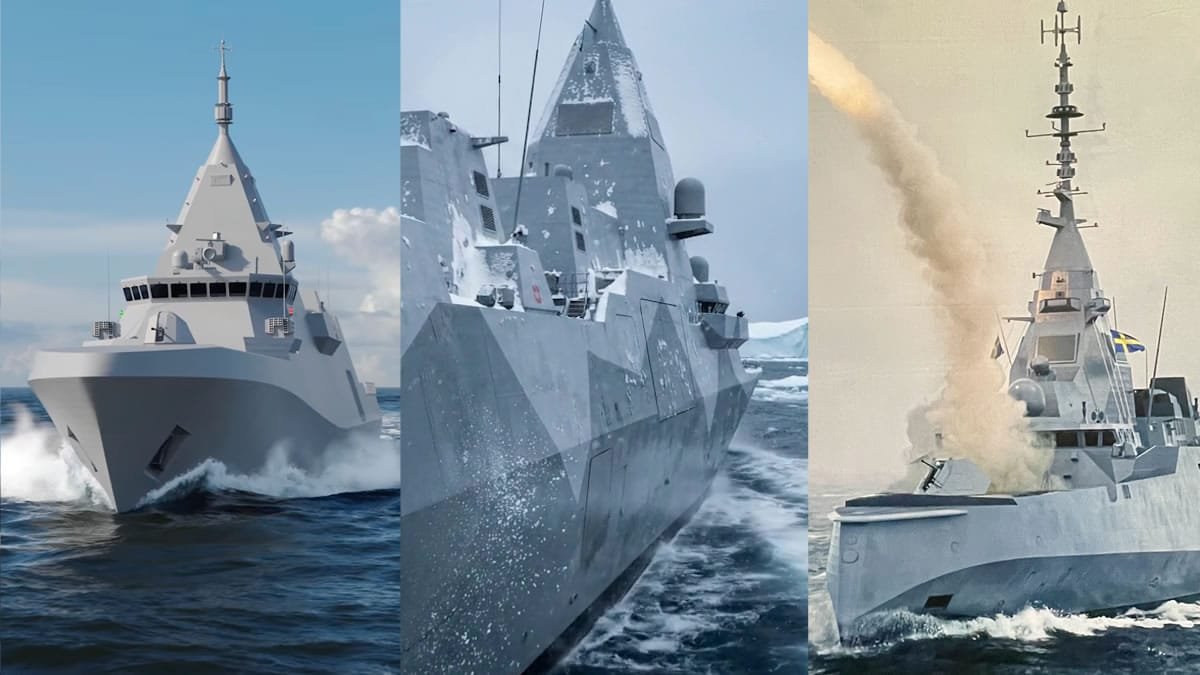
The acquisition of air defence frigates will revive a measure of blue water capability for the Royal Swedish Navy (RSwN) and allow it to better contribute to NATO maritime tasks, the service’s most senior officer has said.
Speaking at the Navy Tech 2026 conference in Gothenburg on 3 February, Chief of the Navy Rear Admiral Johan Norlén said the four new Luleå-class ships, planned to enter service from 2030, reflected a shift in operational mindset “from denying an adversity freedom of action to establishing and sustaining control across the Baltic Sea region”.
Sweden’s Defence Materiel Administration (FMV) has evaluated rival frigate designs offered by Babcock, Naval Group and Navantia, with government expected to announce a final selection decision in the near future. The new ships – to be named HMS Luleå, HMS Norrköping, HMS Trelleborg and HMS Halmstad – are intended to introduce an area air defence capability in the form of MBDA’s Aster 30 family, with both Aster 30 Block 1 and Block 1NT missiles being considered.
The RSwN retired its last frigates in the early 1980s. Since then, its surface fleet has been made up of smaller surface combatants – fast strike craft and latterly corvettes – optimised for operations in Baltic waters. The navy’s five Visby-class corvettes represent the apex of this development path.
“[The] task was not to dominate the sea, it was to deny its use and to limit an opponent’s freedom of action in the Baltic Sea, and by that also creating time for the army to mobilize its forces,” Rear Admiral Norlén told the Navy Tech 2026 audience. “This way of thinking shaped a navy adapted to a demanding environment [of] confined and congested waters, narrow straights and archipelagos, short reaction times [and a] tough underwater environment.
“We learned early that our navy’s size alone would not protect us,” he added. “Survivability mattered more than visibility. Agility mattered more than mass. As a result, we invested in stealth rather than size, in electronic warfare and strict emission control, [and] in deception, dispersion and resilience. Our archipelagos became a central part of how we operated, not obstacles but enablers. They offered concealment and protection. They allowed freedom of movement close to the coast. They shaped a way of fighting that relied on knowledge of the [environment].”
Sweden had originally planned to buy a new class of larger corvettes under the Ytstridsfartyg 2030 (YSF 2030) programme. However, after joining NATO in the wake of Russia’s full-scale invasion of Ukraine, the decision was made to look at larger and more capable frigate-size ships more relevant to the needs of the alliance in and outside the Baltic.
“The acquisition of air defence frigates represents a fundamentally new capability, not only for the Royal Swedish Navy, but for the Swedish Armed Forces and also, I would say for the nation as a whole,”
“It strengthens air defence and control…in our immediate region and beyond. Together with an organic helicopter, the ASW [anti-submarine warfare] role will also be deeply enhanced and enable us to support our allies fully.”Rear Admiral Norlén, Chief of Royal Swedish Navy
He added: “This is new territory, at least in modern times, with these kind of capabilities, and as an ally, we are completing our green and brown water capabilities and are extending one foot or one leg into the blue water capability.”
Having originally funded Saab to complete project definition as prime designate for new surface combatant design, FMV in May last year began an international market survey activity to explore off-the-shelf frigate options. According to Rear Admiral Fredrik Lindén, Director Naval Systems Division at FMV, this switch reflected a new focus on achieving early delivery – with an aim to receive the first two units by the end of 2030 – while also mitigating programme risk.
“We found out that speed was of the essence for delivery,” he told Naval News during an interview at Navy Tech 2026. “So we decided to go out and do market survey to find out what is out there in the market, what is being built, what is in the water, and what works. And that was especially around the capability of the Aster 30 [missile system] as well.”
“There were three [propositions] in the end,”
“That was Navantia in Spain, Naval Group in France, and Babcock in the UK. My task given to me was to evaluate [the proposals with respect to] time, capability and price.”Rear Admiral Fredrik Lindén, Director Naval Systems Division at FMV
While Sweden has sought an off-the-shelf solution to the maximum extent possible, bidders were encouraged to maintain commonality with weapon systems already in, or being introduced to, the RSwN’s inventory. These include the Saab RBS 15 anti-ship missile, Saab Torpedo 47 lightweight torpedo, and BAE Systems’ 57 Mk 3 57 mm medium calibre gun. The MBDA Common Anti-air Modular Missile (the effector for the Sea Ceptor local area anti-air missile system being retrofitted to the five Visby-class corvettes) will provide an inner layer of defence alongside Aster 30.
FMV submitted its joint results from the market survey to the Armed Forces and the Ministry of Defence at the end of January. The Swedish government has previously said that intends to confirm a preferred partner in the early part of 2026.
In parallel to the frigate acquisition, the RSwN is continuing to invest in upgrades for the Visby-class corvettes. The first step of a staged Mid-Life Upgrade (MLU) is the retrofit of MBDA’s Sea Ceptor system.
“We signed the MLU contract [with Saab] last year, and the first corvette is going in [for upgrade with Sea Ceptor] in the summer,” Rear Admiral Lindén said. “We also expect the new RBS 15 missile to be delivered when the boats come out.
“We call that campaign number one,” he continued. “Campaign number two will look at other aspects of the combat system, such as ASW and electronic warfare. [The extent] of that will depend on what money we have, and the time we have to get it done.”
MLU Campaign 2 is planned to start in the early 2030s. According to Rear Admiral Lindén, one aim for this phase would be to achieve a degree of commonality with weapon and sensor equipments being introduced with the new frigates.
Check out Naval News‘ video interview with Rear Admiral Lindén during Navy Tech 2026:
Swedish Luleå-class Frigate contenders
Arrowhead 120 by Babcock

Babcock has developed its new Arrowhead 120 concept in partnership with Saab. This converges earlier YSF 2030 project definition work jointly undertaken by the two companies with the design pedigree of the larger Arrowhead 140 frigate design (variants of which are being procured by Indonesia, Poland and the UK).
At 124 m in length, and displacing 4,650 tons, the Arrowhead 120 design marries a steel hull (built by Babcock at its Rosyth yard) with a lightweight composite superstructure fabricated by Saab Kockums. The combat system solution is based on Saab’s 9LV combat management system, and also features Saab’s Sea Giraffe 4A S-band and Sea Giraffe 1X X-band radars (these being hosted in an lightweight integrated mast structure).
Naval News interviewed Saab about their YSF 2030 proposal during DSEI 2025. You may watch the video at this link.
FDI by Naval Group

Naval Group’s proposal is based on a minimum change variant of the Amiral Ronarc’h-class Frégate de Défense et d’Intervention (FDI) now entering service with the French and Hellenic navies. Arguments in favour of FDI include a ‘hot’ production line at Naval Group’s Lorient yard, compressed build time (Naval Group is postulating a 36-month construction timeline), a de-risked combat system, and strong parent navy support.
While selected Swedish weapons and sensors are introduced to the design, Naval News understands that Naval Group’s own SETIS combat management system, and the Thales SeaFire S-band fixed-face multifunction radar, are both retained in the baseline FDI configuration evaluated by FMV: according to Naval Group, SETIS is the only combat management system to have a proven integration with the Aster 30 missile system.
First-in-class ship Amiral Ronarc’h was in Gothenburg in early February. You may watch our video coverage at this link.
ALFA 4000 by Navantia

Navantia’s ALFA 4000 design is a ‘stretched’ 120 m evolution of the ALFA 3000 corvette previously delivered to the Royal Saudi Naval Forces. Like Naval Group, Navantia is promising an accelerated programme schedule: an initial operational capability in 2030 and all four ships, with trained crews, accepted into service by the end of 2031.
FMV has been presented with the option of either the Saab 9LV or Navantia SCOMBA combat management systems: Navantia states that 9LV would serve to ‘maximise Swedish industrial participation,” while SCOMBA is characterised as a proven solution designed for NATO interoperability and offering a joint upgrade roadmap with the Spanish Navy. The sensor suite, housed in an integrated mast structure, includes Saab’s Sea Giraffe 4A and Sea Giraffe 1X radars. The three competing frigate designs share a number of common characteristics, reflecting the requirements set by the RSwN. These include vertical launch cells for an outload of Aster 30 and CAMM missiles; aviation facilities for the support and operation of an NH90 and MH-60R helicopter; and an ASW ‘sense’ capability based on a combination of hull-mounted and variable depth sonars.
Naval News interviewed Navantia’s head of sales regarding their ALFA 4000 pitch to Sweden, during World Defense Show 2026. You may watch our video coverage at this link.
