

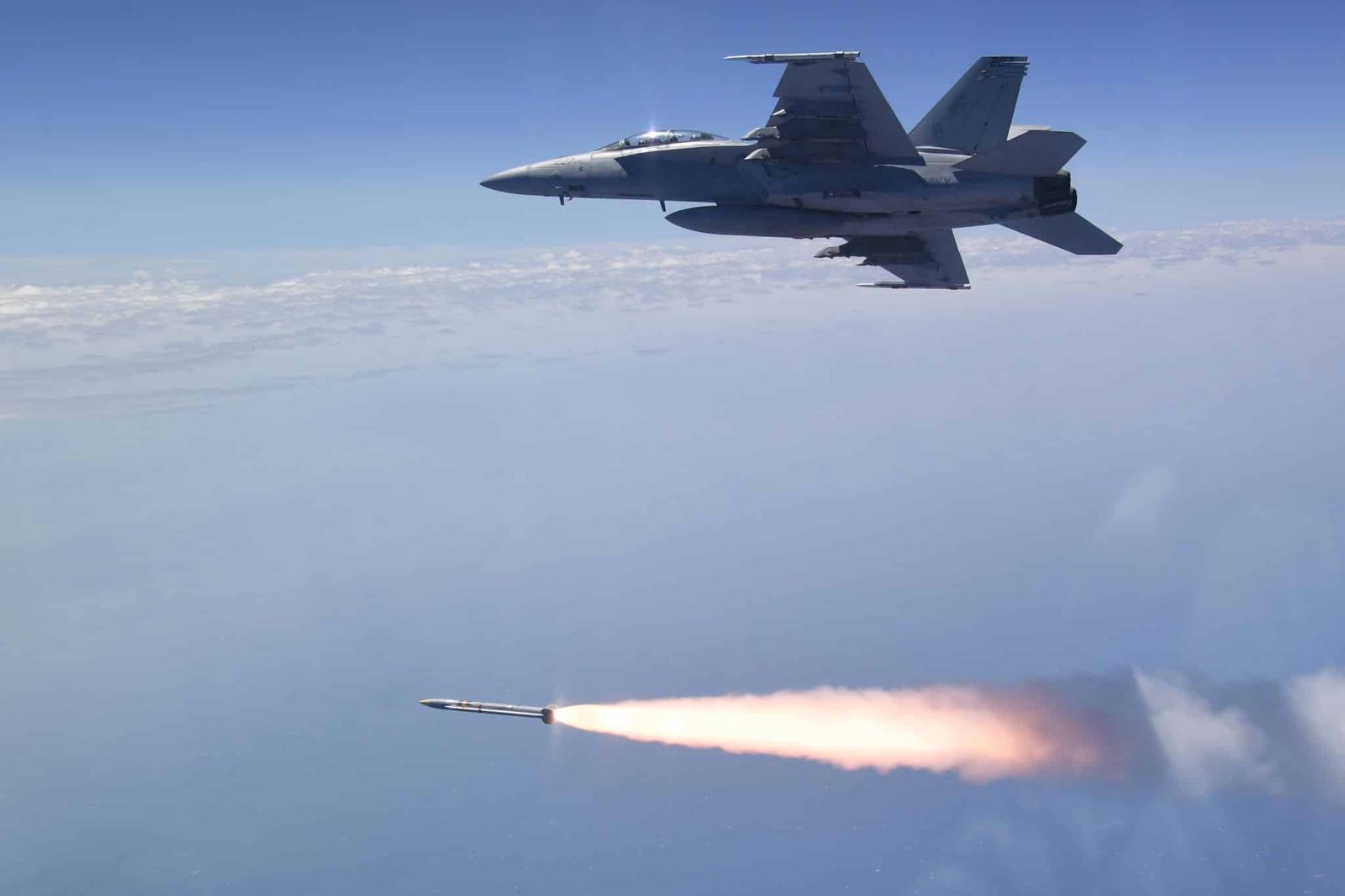
Amidst a push to expand and reform missile production in the United States, the US Navy has published a contract seeking to procure a new type of Anti-Radiation Missile (ARM), dubbed the Advanced Emission Suppression Missile (ASEM).
Dictated in a contract released by NAVAIR, ASEM is detailed to have a longer range than any other radar killing missile in the current inventory of the United States Navy, giving enhanced stand-off capabilities to the US Navy’s Anti-Radiation Missile launching aircraft. Additionally, ASEM will be designed to fired from the Navy’s existing inventory of fixed wing fighters, including the F/A-18E/F, F-35C, and the E/A-18G Growler, the electronic attack variant of the F/A-18E/F.
Initial orders by the US Navy are expected to reach 300 ASEMs each year in 2 years, placing ASEM as the most ordered ARM in the United States, rising above the ~88-160 AGM-88G AARGM-ERs currently procured each fiscal year. The missile might also be destined for export to US allies, as the contract stipulates the exploration of an exportable configuration.
Guidance on the missile will be provided by GPS, Inertial Navigation, and a home on emission mode found within most ARMs, with the seeker head covering a wide swathe of electronic frequencies. Combined with a multitude of guidance methods, ASEM is listed to carry complex Electronic Counter-Counter Measures (ECCM) to defeat forms of decoying such as, “chaff, flares, jamming and anti-ARM techniques.”
ASEM’s stated goals include maintaining a high probability of kill against it’s portfolio of targets, which will include modern air defense and radar systems. Along with the targeting of surface based systems, ASEM is stated to also have the ability to engage air-to-air targets, a feature not widely utilized on specialized Anti-Radar munitions.
Searching for SEAD

ASEM comes as the latest weapon in United States Navy inventory, adding to a lengthy history of using aircraft to hunt or suppress enemy radar and air defense systems, a mission colloquially designated as SEAD (Suppression of Enemy Air Defense). The first operational practice of modern SEAD was carried out during the Vietnam war, cementing the importance of the targeting of enemy emitters with in United States military aviation, despite the lack of operational success.
SEAD munitions, especially ARMs, had massive leaps in capability since the introduction of the first US made ARMs in the AGM-45 Shrike and AGM-78 Standard ARM, improving greatly by the AGM-88A HARM’s usages in the 80s and during Operation Desert Storm in 1991. Coalition forces launched a concerted campaign which incapacitated the Iraqi air defenses, seeing US forces alone expending 661 HARMs against Iraqi targets, often forcing Iraqi radars off the air or outright destroying them.
Since Desert Storm, the AGM-88 family has continually evolved and improved into the current AGM-88E AARGM and AGM-88G AARGM-ER. The AARGM-ER is the latest iteration in US ARMs, a program initialized in 2016 which sought to improve the existing AGM-88E, as well as create a new form factor to fit the radar-hunting missile internally in F-35A/C airframes. AARGM-ER’s range is estimated to be around 160 miles, putting the range estimates for ASEM at least beyond that figure, making it a potent stand-off weapon.
However, the implications of the publication of the ASEM contract towards the fate of the AARGM-ER program is still unknown, especially due to constant delays within the AGM-88G’s production and fielding schedule throughout it’s lifecycle, although funding regarding procurement for 141 missiles was passed in the fiscal year 2026 budget.
