

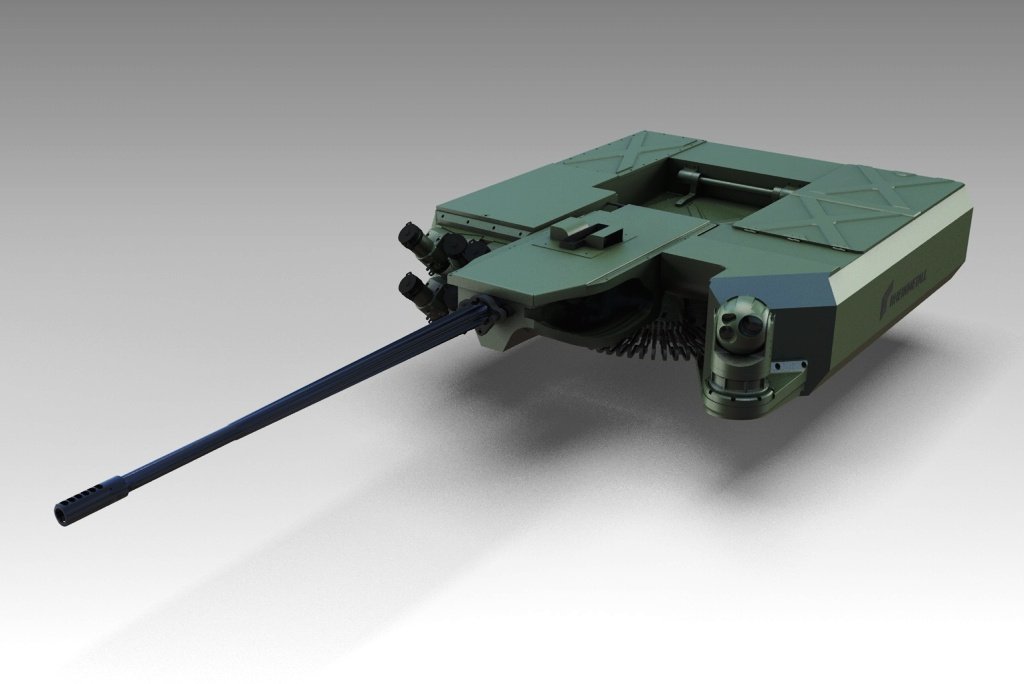
20 February 2026 – Rheinmetall will contribute to the reconnaissance capabilities, combat effectiveness and training of the German Army’s Intelligence and Reconnaissance Corps. General Dynamics European Land Systems (GDELS) is the prime contractor for the next generation ‘Luchs 2’ reconnaissance vehicle of the Bundeswehr, which is due to be delivered from 2029 onwards. GDELS has commissioned Rheinmetall to supply the turret, main armament and corresponding simulators. The contract was signed in Kaiserslautern at the beginning of February 2026. The total order value is in the mid three-digit million-euro range.
“We are grateful for the trust that GDELS and the Bundeswehr have placed in our products and capabilities”, said Timo Haas, Head of the Digital Systems Division. “The Luchs 2 contract package is a significant success for our Bremen site and our colleagues in Rome. At the same time, it sends a strong signal in favour of European defence cooperation”.
The largest share of the Luchs 2 contract package will be fulfilled by Rheinmetall Electronics GmbH in Bremen. At first, 274 CT-025 turrets are to be delivered by 2031, marking the first major order of this newly developed, modular, unmanned turret system. The Luchs 2 will receive a modified version of the CT-025, complying with the specific requirements of the Bundeswehr. The newly developed Rheinmetall turret will serve as a technological base platform for different mission profiles, and combines high operational capabilities with maximum adaptability to operational and logistical requirements.
State-of-the-art sensor technology and digital networking give the turret particular strengths: a stabilised vision system enables precise counter-attacks against ground and air targets, including drones (UAVs). The fully digitalised fire control system with inertial weapon stabilisation, a ballistic computer and GVA/NGVA-compatible interfaces, ensures maximum accuracy, even when the vehicle is in movement.
Furthermore, the Bundeswehr version of the CT-025 features a turret hatch supplemented by ballistic protection, allowing an open protected position while commanding the vehicle in motion. To comply with the maximum weight requirement, the ammunition supply has been adapted according with the mission. Additionally, the height profile has been optimised to ensure compatibility with other platforms.
The CT-025’s open, modular framework enables full integration into the Rheinmetall Battlesuite, the Group’s digital ‘capability store’. This allows functions such as AI-supported target tracking or mission-specific software upgrades to be quickly and flexibly integrated without hardware modifications.
The German Army’s mechanized reconnaissance forces will soon be fighting with the tried-and-tested Oerlikon KBA 25 mm automatic cannon. Manufactured by Rheinmetall Italia S.p.A. in Rome, it is Rheinmetall’s most widely produced weapon in the NATO standard calibre of 25 mm x 137. Manufactured over 6,000 times, it combines a battle-proven design with outstanding reliability. With three firing modes (single shot, rapid single fire /175 rounds per minute and burst fire /600 rounds per minute), dual belt feed and a range of up to 2,500 metres, the CT-025 offers versatile firepower. The Oerlikon KBA 25 mm is a cost-effective, scalable solution offering high effectiveness against a wide range of targets due to the variety of 25 mm x 137 ammunition types available. It can penetrate the armour of most modern armoured personnel carriers.
With a firing rate of 600 rounds per minute – the highest in its category – and thanks to the new 25 mm x 137 proximity fuse ammunition technology, it also provides an effective protection against drones. The dual belt feeder allows two different types of ammunition to be loaded as well as a fast interchange between the two. This turns the KBA 25 mm into a thorough, multi-purpose weapon. Its low recoil enables it to be installed on various platforms, ranging from heavy tracked vehicles to light armoured 4×4 reconnaissance vehicles. It is suitable for both manned and unmanned turrets, as well as anti-aircraft mounts and naval applications. This paves the way for a cross-sectional main weapon for the Bundeswehr, enabling synergies in training, maintenance and logistics.
Modern simulation technology, also supplied by Rheinmetall Electronics, will soon be used to provide comprehensive, mission-oriented, modern training for reconnaissance soldiers. GDELS has commissioned the development and delivery of six combat simulation training devices for vehicle-based reconnaissance troops (AGFS). The reference system is scheduled for delivery in mid-2028 and will later be upgraded to the same standard as the other five devices in the series.
The AGFS is a highly realistic simulator, recreating the battlefield. Its precise replication of key elements, such as vehicle logic, sensor technology and ballistics, enables highly realistic training in line with the ‘train as you fight’ concept. The AGFS is designed to enable networking with other AGFS simulators or other compatible systems. Rheinmetall is developing the AGFS on the same technological basis as the firing and combat simulators already under contract for the Puma infantry fighting vehicle, the heavy weapon carrier and the Schakal wheeled infantry fighting vehicle.
Rheinmetall has also been commissioned in the field of live simulation. The established training device, the AGDUS combat simulator, will be fully integrated into the coming vehicle fleet. The laser-based training tool will enable army reconnaissance troops to train in realistic conditions – from firing exercises to large-scale exercises in the combat training centre in all types of operations. Rheinmetall is thus relying on the installation already proven in the Puma and Lynx programmes, which enables laser-based combat using original display and control elements.
Photo courtesy Rheinmetall
