

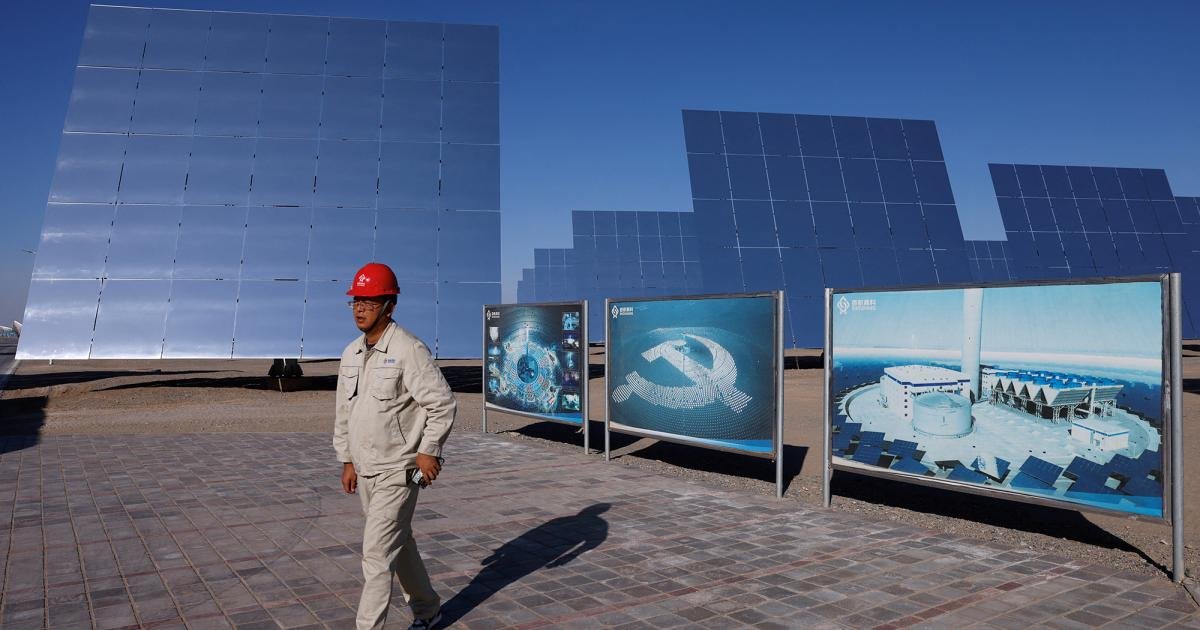
Over the past two decades, China has transformed from a strategically weak energy power, dependent on imports of oil and gas, into the world leader in clean energy. Today, China produces the most wind turbines and solar panels, controls nearly every stage of global battery supply chains, exports electric vehicles at prices Western automakers struggle to match, and builds nuclear reactors at a breakneck pace. Even though none of these technologies were discovered in China and none of these industries originated there, the country has become the market maker and dominant player for each one. In other words, by commanding the systems that electrify modern economies, China is on its way toward achieving energy dominance.
U.S. President Donald Trump does not see it that way. He instead defines energy dominance more narrowly, in terms of fossil fuel production. Steeped in the oil crises of the 1970s and inspired by the U.S. shale revolution in the first decade of this century—which made the country the world’s largest oil and gas producer—the president has focused on increasing oil, natural gas, and coal production at home and in the Western hemisphere, as the U.S. foray into Venezuela this January illustrated. Trump established the National Energy Dominance Council by executive order in February 2025 to expand the domestic fossil fuel industry and parse which clean technologies to stick with and which to drop.
But this is an outdated conception. Global demand for electricity is rising and will likely accelerate as economies electrify transport, industry, and households. Artificial intelligence and machine learning—plus the data centers and advanced manufacturing that drive it—are making modern economies increasingly energy intensive. Military systems, meanwhile, are shifting from fuel-guzzling fighter jets and aircraft carriers to battery-powered drones and undersea vehicles, as well as into data-heavy cyberwarfare. Global demand for oil continues to grow, but it is projected to plateau in the early 2030s as efficiency gains and electrification reshape consumption.
The United States is still mostly self-reliant on its own energy sources. Natural gas remains the backbone of U.S. electricity generation and will supply most of the power to American data centers. But as electricity demand surges, energy dominance will depend less on what lies underground than on the infrastructure that contributes to it—turbines, transmission lines, transformers, and grid interconnections—much of which is now built on Chinese tech. Already, the United States’ electricity infrastructure deficits are inhibiting its race to artificial general intelligence and leaving it surprisingly dependent on Chinese-controlled supply chains, such as grid equipment, solar panels, and storage systems.
Beijing, by contrast, has spent nearly two decades preparing for precisely this landscape. It did so, in large part, by treating energy and electrification as central components of national strength, rather than a standalone industry or a narrow climate issue. It devised a long-sighted strategy that fused manufacturing, technological innovation, and national security. The guiding principle has been consistent: build domestic power and reduce external dependence. China’s dominance in renewables now underpins its growing influence over global electrification, infrastructure, and industrial development, especially in the so-called global South. And it reflects a deeper understanding of where the world will move once AI and machine learning become the predominant elements of economic strength and global competitiveness.
This energy dominance with Chinese characteristics matters to the United States. Not only are many of these technologies and materials critical for global military and economic supremacy, Beijing has already demonstrated its willingness to use its technology and mineral-processing capabilities as leverage over Washington. It also sets the pace, price, and scale of clean energy systems that electrify economies worldwide, and it is diversifying them away from oil. Today, China is indispensable to the global energy economy not because alternatives do not exist, but because few competitors can match it.
Power accrues not only to those who produce energy but to those who build, finance, integrate, and expand energy systems. By that definition, China, not the United States, is most successfully practicing a policy of energy dominance. Washington has the resources, capital, and technology to lead in electrification and energy infrastructure, but by prioritizing fossil fuel exports over broader system development, it is losing the energy competition.
GLOBAL POWERHOUSE
Since Chinese leader Xi Jinping came to power in 2012, he has been committed to reducing China’s reliance on legacy industries and to securing its lead in new energy technologies. This is not climate altruism: as Amy Myers Jaffe argued in Foreign Affairs in 2018, China’s move to clean energy was a strategy of power politics by other means, designed to limit vulnerability to U.S. dominance over oil and gas and the U.S. Navy’s control of sea-lanes surrounding the Middle East. But what started as an attempt to secure China’s economic growth against external shocks has evolved into a formula for economic success—and power over the United States.
Beijing’s success is often chalked up to scale and subsidies. Although this is part of the story—China was able to flood global markets with artificially cheap wind turbines, solar panels, batteries, and electric vehicles—it ignores the strategic coherence and innovations that Beijing adopted along the way. Indeed, China has integrated these industries into a single, tightly coordinated ecosystem capable of setting global standards.
China treats energy as a central component of national strength.
China recognized early on that electrification technologies have a distinct advantage over hydrocarbons, which are geographically dispersed. To capitalize on this, it located manufacturing of raw materials, intermediate components, and finished products in the same places, often within a few hours of one another. This supply chain density lowers costs, accelerates production, and allows Chinese firms to outcompete others on both speed and price. Major data-center developers are now trying to do something similar in the United States by creating vertically integrated energy and infrastructure ecosystems that are physically close to one another.
China’s supply chain density was also the result of deliberate regional coordination, sustained investment in infrastructure, and a willingness to tolerate excess capacity, knowing that a large market lay beyond the country’s borders. Because Beijing treated clean energy manufacturing as a strategic industry, it offered subsidies while also channeling capital into research, industrial parks, grid infrastructure, and workforce development. Innovation was scaled alongside production, allowing new technologies to move rapidly from the laboratory to the factory floor. Firms competed fiercely for scale and efficiency; many failed, and consolidation was ruthless. But the ecosystem as a whole became more competitive.
EXPORTING INFLUENCE
This model transformed domestic deployment into global leverage. China’s massive buildout at home drove domestic costs down, and its export capacity ensured its technologies could reach markets where demand was rising fastest and capital was scarce. Starting a decade ago, China could offer low-cost, fast-deploying clean energy technology at a scale others couldn’t match. A Chinese solar panel costs approximately 30–40 percent less than its Western equivalent; a Chinese electric vehicle is half as much as an American or European model.
This makes Chinese tech particularly attractive for much of the developing world, where governments are seeking affordable, reliable power now, not aspirational pledges with extended timelines. Their need for fast results is particularly acute in the wake of Russia’s 2022 invasion of Ukraine, when global natural gas prices spiked and revealed the folly of relying on fossil fuels. India, Pakistan, and Sri Lanka, to name just a few countries, experienced widespread blackouts that made pivoting to Chinese-manufactured solar panels a logical alternative. And once the panels were in place, the cost and supply of solar energy were domestic and fixed.
Natural gas remains the backbone of U.S. electricity generation.
China has also moved beyond supplying individual components to delivering entire energy systems, complete with generation, transmission, storage, and grid modernization—and often bundled with financing and long-term maintenance. In Kenya, for instance, Chinese firms have built solar farms and grid extensions. In Pakistan, Chinese-produced solar panels generate gigawatts of renewable power. Across Latin America, Chinese companies are modernizing transmission networks. Beijing already owns or operates more than ten percent of Brazil’s electricity infrastructure, with similar stakes expanding elsewhere in the global South. The result is not simply leadership in clean energy but influence over how electrification unfolds worldwide.
China’s energy strategy has been so successful that it formalized this system-level approach with the adoption of the Energy Law in late 2024. Unlike earlier legislation that governed discrete subsectors—coal, oil and gas, nuclear, and renewables—this law treats energy as an integrated strategic domain. Energy security, industrial development, technological innovation, and market structure are now addressed within a unified legal and policy framework. Central authorities coordinate planning, regulate emerging technologies, and align industrial goals with energy-security objectives.
Most notably, the organizing principle for this new system is expansion, not substitution. Although the law includes mandates for the accelerated deployment of solar, wind, nuclear, and hydrogen energy, as well as energy storage, it also affirms the continued centrality of fossil fuels. Coal, oil, and gas are framed not as legacy resources to be displaced but as foundations to be optimized. The law elevates grid expansion and modernization as national planning priorities in order to build capacity and strengthen the resilience of fossil fuel systems. It also recognizes coal’s integral role in system stability and supports oil and gas exploration and production to reduce external vulnerabilities. This coexistence is not a contradiction. By preserving optionality across fuels while expanding capacity, China has built an energy system designed to absorb shocks, support industrial growth, power new technologies, and give it leverage over other countries.
WATT COMES NEXT
The success of China’s energy strategy was visible in 2025. Renewed trade tensions with Beijing, for instance, reminded Washington how dependent American industries were on Chinese-controlled supply chains of critical minerals and energy technologies, and how dangerous those chokepoints could be for U.S. defense systems and advanced manufacturing. The United States still spent that year celebrating its rising oil and gas exports under the banner of “energy dominance.” But the larger global supply drove down crude prices, allowing China to amass substantial fuel reserves at a low cost. In an oversupplied market, Beijing’s diversified import base and accumulated stockpiles cushion it from disruptions, including the potential loss of Venezuelan oil.
As outlined in its most recent five-year plan, Beijing is extending the same state-coordinated industrial strategy that propelled its rise in clean energy manufacturing into emerging sectors such as autonomous vehicles, artificial intelligence, and robotics. The objective is not simply participation but leadership by anchoring next-generation technologies in domestic supply chains and scaling them before global competitors can catch up. The United States will benefit from its role as an oil and gas supplier for decades to come, but China will erode its competitor’s technological edge. U.S. firms still dominate AI models and chip design, but scaling those operations depends on U.S. grids that remain fragmented, aging, and contested. The United States has the resources, capital, and innovative capacity to compete, yet political disagreements have prevented it from adopting a workable strategy. Before it is too late, U.S. energy and critical-mineral policies must be redefined around integration and innovation rather than simply raw extraction. Washington will have far more success embracing opportunities across oil, natural gas, nuclear, renewables, and batteries than by focusing strictly on fossil fuels.
In Pakistan, Chinese-produced solar panels generate gigawatts of renewable power.
Trump’s National Energy Dominance Council, however, has prioritized short-term export influence in hydrocarbons over long-term technological leadership. It is still pushing geothermal, advanced nuclear, and battery innovation, but it has slashed federal backing for large-scale solar and wind deployment, electric vehicle incentives, and grid modernization—the very sectors driving global electrification. By limiting the scale and scope of these industries, the United States risks losing international technological leadership. Energy systems, manufacturing, and artificial intelligence, after all, are converging.
The United States must pair its natural resource endowment with sustained investment in innovation, manufacturing, and global partnerships to restore its technological advantage. The irony of the current moment is that the administration most vocal in its commitment to “energy dominance” has pursued policies that make it less attainable. By defining dominance narrowly around fossil fuels and retreating from the technologies that electrify economies, Washington is ceding the terrain on which twenty-first-century power is being built. Dominance will belong to the country that can supply both the energy that powers economies and the infrastructure that supports them.
Loading…
