

Calisthenics is one of the simplest and most effective ways to build strength, improve body composition, and enhance overall fitness. You do not need machines, heavy barbells, or even a gym membership. Your body is the resistance.
But “simple” does not mean “easy.” Bodyweight training can be extremely demanding. The key is choosing the right foundational exercises and performing them with good technique and intelligent progression.
This article breaks down five basic calisthenics exercises for beginners:
- Push-Ups
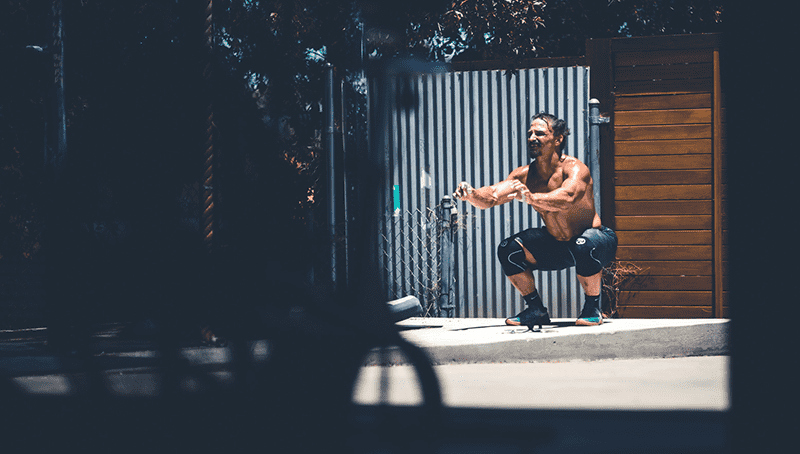
- Bodyweight Squats
- Planks
- Glute Bridges
- Inverted Rows
Each movement is backed by scientific evidence and chosen because it trains major muscle groups, improves functional strength, and builds a base for more advanced skills later on.
Let’s get into it.
Why Calisthenics Works
Before diving into the exercises, it’s important to understand why bodyweight training is effective.
Builds Strength and Muscle
Resistance training — whether with weights or bodyweight — increases muscular strength and size when performed with sufficient intensity and volume. The American College of Sports Medicine (ACSM) states that progressive resistance training leads to significant improvements in muscular strength and hypertrophy in beginners and trained individuals alike (ACSM, 2009).
Research shows that muscle growth can occur across a wide range of loads, as long as sets are taken close to muscular fatigue (Schoenfeld, 2010; Schoenfeld et al., 2017). This is important because it means push-ups, squats, and other bodyweight exercises can build muscle when done properly.
Improves Functional Strength
Calisthenics relies heavily on multi-joint, compound movements. Multi-joint exercises are particularly effective for increasing overall strength and neuromuscular coordination (Kraemer and Ratamess, 2004). These movements mimic everyday actions like pushing, pulling, sitting, and standing.

Training these patterns improves movement efficiency and reduces the risk of injury when performing daily tasks (Behm and Colado, 2012).
Enhances Core Stability and Joint Health
Many bodyweight exercises require the core to stabilize the spine. Core stability training improves balance and dynamic control, which may reduce injury risk and enhance performance (Hibbs et al., 2008).
Because calisthenics often uses closed-chain movements (where hands or feet are fixed to the ground), joint stress can be lower and more evenly distributed compared to some machine-based exercises (Escamilla et al., 2009).
Now let’s look at the five essential beginner movements.
1. Push-Ups
The push-up is one of the most effective upper-body exercises you can do without equipment.
What It Trains
Push-ups primarily target:
- Pectoralis major (chest)
- Triceps brachii
- Anterior deltoids (front shoulders)
- Core muscles for stabilization
Electromyography (EMG) studies show high activation of the pectoralis major and triceps during push-ups, comparable in some cases to bench press variations (Calatayud et al., 2015).
Why Beginners Should Start Here
Push-ups train horizontal pushing strength. This pattern is foundational for pressing movements and essential for overall upper-body development.
Research comparing push-ups with bench press demonstrates that push-ups can produce similar muscle activation when resistance is matched (Calatayud et al., 2015). That means beginners can build meaningful strength without touching a barbell.
How to Perform a Standard Push-Up
- Start in a plank position with hands slightly wider than shoulder-width.
- Keep your body in a straight line from head to heels.
- Lower yourself until your chest nearly touches the floor.
- Push back up while keeping your core tight.
Common mistakes include sagging hips, flared elbows, and partial range of motion.
Beginner Progressions
If full push-ups are too difficult, start with:
- Wall push-ups
- Incline push-ups (hands elevated on a bench or table)
- Knee push-ups
Progression is essential. As strength improves, gradually lower the incline or move toward full push-ups. Progressive overload — gradually increasing training stress — is a core principle of strength development (Kraemer and Ratamess, 2004).
2. Bodyweight Squats
The squat is a fundamental lower-body movement that trains multiple muscle groups simultaneously.

What It Trains
Bodyweight squats primarily target:
- Quadriceps
- Gluteus maximus
- Hamstrings
- Core stabilizers
Squats are one of the most studied exercises in resistance training. They produce high activation of the quadriceps and gluteal muscles (Escamilla et al., 2001).
Why Squats Matter
The ability to sit down and stand up safely is critical for independence and mobility. Lower-body strength is strongly associated with improved functional capacity and reduced fall risk, especially as people age (Peterson et al., 2010).
Even in young adults, increasing lower-body strength improves athletic performance and general movement efficiency.
How to Perform a Bodyweight Squat
- Stand with feet shoulder-width apart.
- Push your hips back and bend your knees.
- Lower until your thighs are at least parallel to the floor.
- Drive through your heels to stand up.
Keep your chest upright and knees tracking over your toes.
Depth and Safety
Research shows that when performed correctly, squats are safe for healthy individuals and do not inherently damage the knees (Escamilla, 2001). Proper alignment and controlled movement are key.
Beginners who lack mobility can use a box or chair as a depth guide.
Progression Options
- Pause squats
- Slow tempo squats
- Single-leg variations (e.g., assisted split squats)
Unilateral training can improve balance and muscular symmetry (Behm and Colado, 2012).
3. Planks
The plank is a simple but powerful core stability exercise.
What It Trains
Planks target:
- Rectus abdominis
- Transverse abdominis
- Obliques
- Erector spinae
Core endurance is associated with improved spinal stability and reduced injury risk (Hibbs et al., 2008).
Why Core Stability Matters
The core transfers force between the upper and lower body. Weak core musculature can impair performance and increase the risk of low back pain (McGill, 2007).
Stabilization-based exercises such as planks are effective for improving trunk endurance and control (Ekstrom et al., 2007).
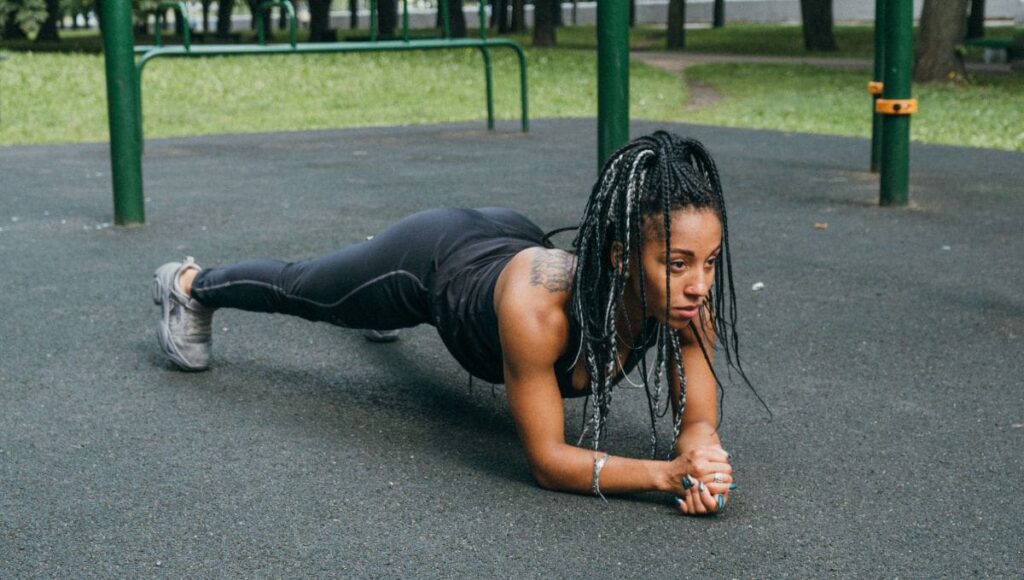
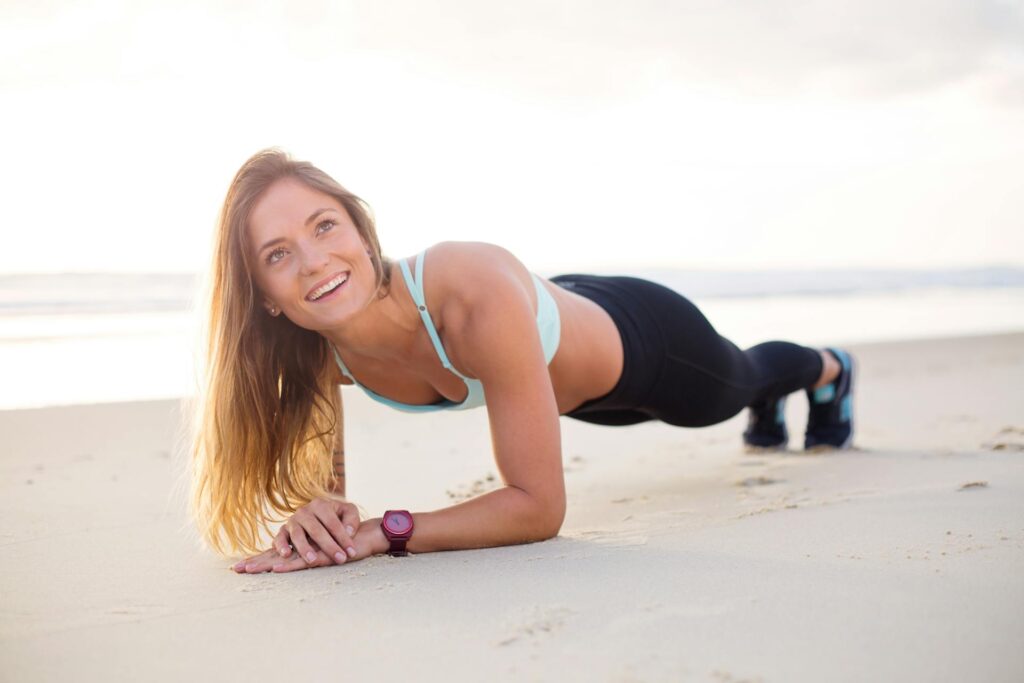
How to Perform a Plank
- Place forearms on the floor under your shoulders.
- Extend your legs behind you.
- Keep your body in a straight line.
- Brace your core and hold.
Avoid letting your hips sag or pike upward.
How Long Should You Hold?
For beginners, start with 10–20 seconds and gradually increase. Core endurance improves with consistent training (Hibbs et al., 2008).
Progression Options
- Side planks
- Plank with shoulder taps
- Extended lever plank
Increasing lever length increases muscular demand without external load.
4. Glute Bridges
The glute bridge is often overlooked, but it is critical for hip strength and posture.
What It Trains
Glute bridges primarily target:
- Gluteus maximus
- Hamstrings
- Core stabilizers
Weak glutes are associated with poor hip mechanics and increased risk of lower-body injuries (Powers, 2010).
Why Hip Strength Is Important
The gluteus maximus is the largest muscle in the body and plays a central role in hip extension. Strong glutes contribute to better running, jumping, and lifting mechanics (Contreras et al., 2015).
Sedentary lifestyles can reduce glute activation, leading to compensation patterns (Powers, 2010).
How to Perform a Glute Bridge
- Lie on your back with knees bent.
- Place feet flat on the floor.
- Drive through your heels and lift your hips.
- Squeeze your glutes at the top.
- Lower under control.
Keep your ribs down and avoid arching your lower back.
Progression Options
- Single-leg glute bridges
- Feet elevated bridges
- Tempo variations
Single-leg exercises increase muscle activation and improve stability demands (Behm and Colado, 2012).
5. Inverted Rows
Push-ups train pushing strength. Inverted rows train pulling strength. Balance between the two is essential.
What It Trains
Inverted rows target:
- Latissimus dorsi
- Rhomboids
- Middle trapezius
- Biceps
Pulling movements are crucial for posture and shoulder health.
Why Pulling Strength Is Critical
Many beginners overemphasize pushing movements and neglect pulling. Muscle imbalances around the shoulder can contribute to dysfunction and pain (Ludewig and Reynolds, 2009).
Rowing exercises improve scapular control and upper-back strength, which support healthy shoulder mechanics.
How to Perform an Inverted Row
- Position yourself under a bar or sturdy surface.
- Grip slightly wider than shoulder-width.
- Keep your body straight.
- Pull your chest toward the bar.
- Lower with control.
The more horizontal your body, the harder the movement.
Progression Options
- Bent-knee rows (easier)
- Straight-leg rows
- Feet elevated rows
Increasing body angle increases resistance.
How to Structure a Beginner Calisthenics Workout
Here is a simple structure:
- Push-Ups: 3 sets of 6–12 reps
- Bodyweight Squats: 3 sets of 10–15 reps
- Inverted Rows: 3 sets of 6–12 reps
- Glute Bridges: 3 sets of 10–15 reps
- Plank: 3 sets of 20–40 seconds
Rest 60–90 seconds between sets.
Frequency
The ACSM recommends training major muscle groups at least two times per week for strength development (ACSM, 2009). Beginners can start with two to three full-body sessions weekly.
Progression Principles
To continue improving:
- Increase repetitions
- Increase time under tension
- Decrease rest periods
- Move to harder variations
Progressive overload is necessary for continued adaptation (Kraemer and Ratamess, 2004).
Common Beginner Mistakes
1. Ignoring Technique
Poor form reduces effectiveness and may increase injury risk. Controlled movement and full range of motion are essential.
2. Doing Too Much Too Soon
Excessive training volume can lead to overuse injuries. Gradual progression is supported by strength training guidelines (ACSM, 2009).
3. Neglecting Recovery
Muscle adaptation occurs during recovery, not during training. Adequate sleep and rest are essential for performance and muscle growth (Schoenfeld, 2010).
Final Thoughts
Calisthenics is not a lesser form of strength training. When programmed correctly, it builds muscle, increases strength, improves joint stability, and enhances functional movement.
These five exercises — push-ups, squats, planks, glute bridges, and inverted rows — cover all major movement patterns:
- Push
- Pull
- Squat
- Hip hinge/extension
- Core stabilization
Master them first. Focus on quality. Progress gradually. Stay consistent.
You do not need complexity. You need fundamentals done well.
Key Takeaways
| Exercise | Primary Muscles | Main Benefit | Beginner Tip |
|---|---|---|---|
| Push-Ups | Chest, triceps, shoulders | Upper-body strength | Start with incline if needed |
| Bodyweight Squats | Quads, glutes | Lower-body strength | Use a chair for depth guidance |
| Planks | Core muscles | Core stability | Begin with short holds |
| Glute Bridges | Glutes, hamstrings | Hip strength | Focus on squeezing glutes |
| Inverted Rows | Back, biceps | Pulling strength and posture | Adjust body angle for difficulty |
References
- American College of Sports Medicine (2009) ‘Progression models in resistance training for healthy adults’, Medicine & Science in Sports & Exercise, 41(3), pp. 687–708.
- Behm, D.G. and Colado, J.C. (2012) ‘The effectiveness of resistance training using unstable surfaces and devices for rehabilitation’, International Journal of Sports Physical Therapy, 7(2), pp. 226–241.
- Calatayud, J., Borreani, S., Colado, J.C., Martin, F., Rogers, M.E. and Behm, D.G. (2015) ‘Bench press and push-up at comparable levels of muscle activity’, Journal of Strength and Conditioning Research, 29(1), pp. 246–253.
- Contreras, B., Vigotsky, A.D., Schoenfeld, B.J., Beardsley, C. and Cronin, J. (2015) ‘A comparison of gluteus maximus, biceps femoris, and vastus lateralis electromyographic activity in the back squat and barbell hip thrust’, Journal of Applied Biomechanics, 31(6), pp. 452–458.
- Ekstrom, R.A., Donatelli, R.A. and Carp, K.C. (2007) ‘Electromyographic analysis of core trunk, hip, and thigh muscles during 9 rehabilitation exercises’, Journal of Orthopaedic & Sports Physical Therapy, 37(12), pp. 754–762.
- Escamilla, R.F. (2001) ‘Knee biomechanics of the dynamic squat exercise’, Medicine & Science in Sports & Exercise, 33(1), pp. 127–141.
- Escamilla, R.F., Fleisig, G.S., Zheng, N., Barrentine, S.W., Wilk, K.E. and Andrews, J.R. (2001) ‘Biomechanics of the knee during closed kinetic chain and open kinetic chain exercises’, Medicine & Science in Sports & Exercise, 30(4), pp. 556–569.
- Hibbs, A.E., Thompson, K.G., French, D., Wrigley, A. and Spears, I. (2008) ‘Optimizing performance by improving core stability and core strength’, Sports Medicine, 38(12), pp. 995–1008.
- Kraemer, W.J. and Ratamess, N.A. (2004) ‘Fundamentals of resistance training: progression and exercise prescription’, Medicine & Science in Sports & Exercise, 36(4), pp. 674–688.
