

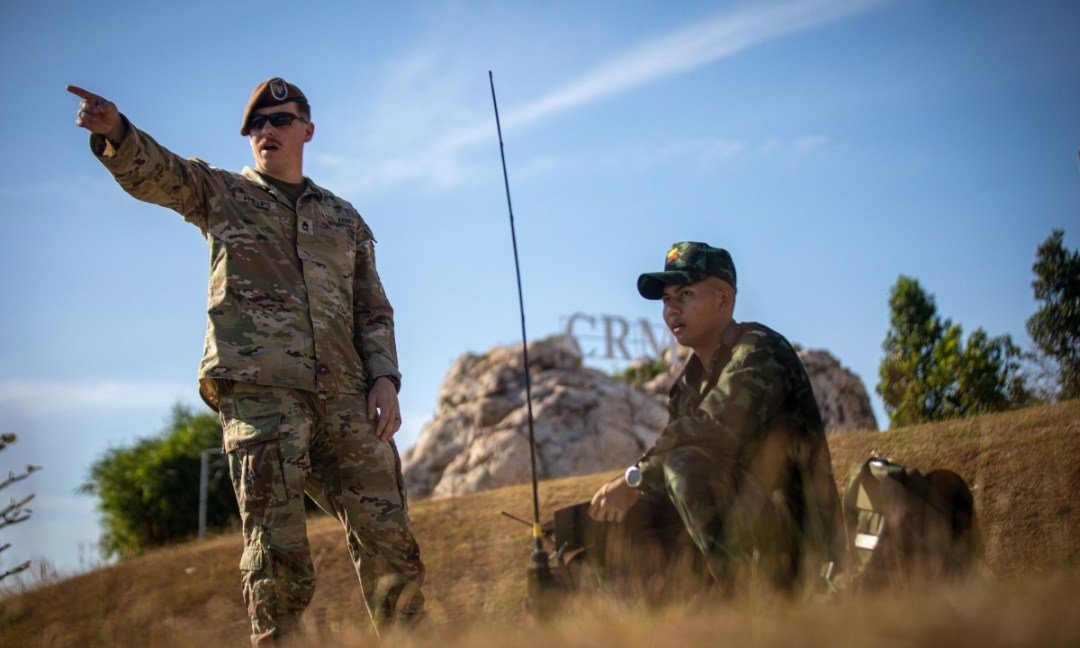
Leaders for years have been talking about an unpredictable future, the persistence of change, and the need for adaptability to deal with uncertainty and respond to the unexpected. Today is no exception. The Army Transformation Initiative outlines a vision to convert the Army for future warfare and reorganize force structures. In the aggregate, these understandable decisions require tough choices. Latest restructuring documents call for new command structures, the removal of outdated equipment, new physical fitness standards, and robust policy changes aimed to streamline procurement and overhaul innovation—all essentially simultaneously and at breakneck speed. The tough choices forced by these objectives now also include changes in advising and how the Army conducts security force assistance. Among the organizations to fall victim are the Army’s security forces assistance brigades (SFABs).
The Army’s decision to deactivate its SFABs and advisor training institutions to better align resources and provide commanders with units that are focused on warfighting and lethality is a sudden, albeit predictable change in view of the recently released US National Security Strategy and National Defense Strategy. SFABs will now be a billpayer for this rapid transformation, with its units divested or reclassed to better align with current objectives. But, while security force assistance is no longer a core Army function for now, that does not mean that the advising lessons SFABs learned and the institutional capabilities they housed must be allowed to atrophy. Both those lessons and those capabilities can—and should—help the United States achieve its goals in this new age of change.
We’ve Been Here Before
“I have today ordered to Viet-Nam the Air Mobile Division and certain other forces which will raise our fighting strength from 75,000 to 125,000 men almost immediately,” President Lyndon B. Johnson announced in a televised address on July 28, 1965. “These steps, like our actions in the past, are carefully measured to do what must be done to bring an end to aggression and a peaceful settlement. We do not want an expanding struggle with consequences that no one can perceive, nor will we bluster or bully or flaunt our power, but we will not surrender and we will not retreat.”
Johnson’s comments marked a pivotal moment in US defense policy; it was a notice to the American people that the early-war advisory focus with its comparatively light footprint in Vietnam was at an end and a shift to direct US participation in major combat operations would now emerge.
Prior to this moment, the US presence in Vietnam had been relegated to a support role. However, following the defeat of French forces at Dien Bien Phu and the emergence of the “domino theory” as a key driver US policy, the United States adopted a more active approach in Vietnam. As officials determined how to organize US forces in Vietnam, advisors would be placed in main headquarters, assigned to divisions, and integrated into the training system to assist with building host-nation capability. Advisors would also be working at the local level assisting with combat operations and act as a continuity for Special Forces rotating in and out of Vietnam and other irregular defense groups. To manage the growing advisory mission the Military Assistance Command, Vietnam (MACV) was established in 1962. Lessons learned during this time revolved around several themes: addressing gaps in cultural understanding, enhancing understanding of counterinsurgency theory, promoting civic actions, and fostering country orientation. Advisors equipped with this knowledge were able to improve US situational awareness, inform policymaking decisions, and provide local insights to enhance US and its South Vietnamese partners’ operations. As those partner forces faltered against their growing North Vietnamese Army and Viet Cong adversaries, President Johnson eventually committed US ground troops and transitioned to full-scale combat operations. As a result, manning, resourcing, and funding prioritized US combat units. By 1966, “The buildup [had] eclipsed what had previously been an advisor ‘show.’” In essence, “The advisory effort had, at least in practice, been relegated to a secondary role.” Despite MACV’s best efforts to train advisors, it only skimmed the surface in addressing vast cultural and military challenges given the change in strategy.
By the 1970s, the United States saw a renewed interest in advising that supported four components of Vietnamization—a strategy to shift reasonability to Vietnam and exit the theater. It was in these final years of wartime transition that the functions and knowledge MACV developed were again utilized and valued. MACV responsibility again shifted to supporting South Vietnamese forces as the US footprint was reduced. Improving combat capability and capacity was MACV’s primary task, an objective intended to enable a US exit from the region while sustaining US support for its strategic goals.
Decades later, the transition from combat to advising would drive the genesis of the SFABs and associated advising institutions, as well. This latest era of US security force assistance took its initial form in 2006 with the publication of the Quadrennial Defense Review. “U.S. forces have been engaged in many countries, fighting terrorists and helping partners to police and govern their nations,” the review noted. “To succeed in such operations, the United States must often take an indirect approach, building up and working with others.” For the next decade, however, this indirect approach would largely be taken absent a dedicated infrastructure to develop advising capacity. SFABs were then originally conceived in 2017 to transition ad hoc advisor sourcing to formalized advisor missions in Afghanistan, a break from the legacy military transition teams in Iraq and Afghanistan that lacked the specialized training of security assistance and cultural competency required to effectively integrate with and train foreign partners. As specialized units designed to assess, support, liaise, and advise partners, the new SFABs thereby alleviated conventional combat units for other priorities, improved Army readiness, and permitted a dedicated mission to build conventional partner capacity in support of security force assistance requirements.
SFABs aligned with geographic combatant commands, advisors became regionally focused, and as the US footprint in Iraq and Afghanistan decreased—but the necessity for advisors remained—commanders used advisors to identify operational gaps that impacted foreign partner readiness in all combatant commands in preparation for the shift toward large-scale combat operations and a new era of strategic competition that would inevitably set the stage for any future conflict. However, while all SFABs largely had the same capabilities, their employment and utility greatly differed across combatant commands and regions as leaders were forced to adapt to the changing character of warfare. The mission of the SFABs, as it relates to large-scale combat operations and competition, therefore initiated debate among Army leaders and across combatant commands, leading to this moment today.
Like with the shift from advising to direct combat operations in Vietnam in the early 1960s, this Army’s reorganization toward preparing for large-scale combat operations now signals Army transformation intentions and a posture shift to various stakeholders, allies, and adversaries. Yet, US military history demonstrates that even when advising structures contract or dissolve, the underlying competencies of rapport-building, influence, and sustaining access remain indispensable for successful conflict outcomes and winning America’s wars. This transition requires foresight, prioritization, and innovation to ensure that the gains and competencies the United States has developed over the last twenty years with its allies and partners remain intact and utilized. Failure to do so risks jeopardizing defense objectives in strategically relevant regions and burden-sharing efforts to set conditions for lasting peace and stability.
The Path Forward: Leveraging Distributed Advising Competencies
A dwindling presence of US forces globally is certain to present challenges: an Africa continent more vulnerable to Russian and Chinese meddling and exploitation; accelerated Russian efforts to further destabilize Europe; and terrorist networks in the Middle East with more maneuver space to strengthen ties with one another, further impacting US interests for peace and economic development. However, a means to address these persistent threats is to capitalize on the work former SFAB units accomplished with allies and partners worldwide, and more importantly to transfer adviser skills and knowledge to other units and organizations to sustain or further build US influence across regions wherever they present.
Along the competition continuum, the importance of individual competencies (cultural fluency, social dynamics, and building rapport among foreign military and government leadership) will remain vital to ensuring US military success in any theater. A peace through strength approach requires local understanding to sustain the partnerships that permit preferred access. A testament to this fact was MACV’s need to leverage the advising capacity developed in its early years once again in the 1970s, when it sought to understand and identify defense gaps to ultimately facilitate an exit strategy by positioning advisors in headquarters and training facilities in South Vietnam. Despite the transition from a mainly advisory mission to a direct combat role and then back to an approach that once again leveraged advising capability, the need for high performers to serve as advisors was there throughout, and offers an instructive lesson today: During large-scale combat operations, the acquisition and employment of cultural knowledge enables the United States to build inroads with foreign partners.
There is also an operational element that, when perfected, can establish tangible advantages like greater interoperability with partners—as was the case when SFAB advisors helped a foreign corps headquarters coordinate with the US forces in the Warfighter 24-5 exercise. Daily interaction with partner forces ensured access and enhanced multinational interoperability. Just as advisors fully leveraged foreign partners’ capabilities through intelligence collection, drone operations, and strengthening the communication architecture in this exercise, the United States could effectively employ foreign formations in training environments and strengthen multinational operations where interoperability with the joint force is essential. This will be especially important if the United States and its allies find themselves needing to respond to an emerging crisis or conflict. Organizational presence facilitates the movement of materiel, information, and units to respond accurately and efficiently. Whether in the Indo-Pacific region or the Western Hemisphere, this knowledge is vital to both establishing and expanding a US military presence and countering non–Western Hemisphere rivals in the region. During crisis or phases under the threshold of armed conflict, rapport and trust mitigate insurgency resurgence and provide alternatives to counter messaging. Access enables influence operations and host-nation capacity-building, and breeds US legitimacy across various demographics.
Keep the Past Alive
In 1958, Eugene Burdick and William Lederer’s The Ugly American was published. The novel offered a proof of concept for what effective US advising and influence can look like. Among other characters, it followed Major James “Tex” Wolchek—serving as a US advisor in a local village in a fictional Southeast Asian country—and his efforts to counter adversaries’ disinformation and sustain access and credibility at the local level. By taking stock of local customs and fostering cooperative relationships, he undermines anti-American propaganda. With SFABs gone and the Military Advisor Training Academy likely to close, the US military may find it challenging to retain the individual skills—those that real-world advisors share with Wolcheck—without the proper training and emphasis aligned with tactical and operational objectives.
To get ahead of this scenario, the joint force can still seek innovative approaches of sustaining these skills and knowledge to ensure the United States maintains a competitive edge across vital regions. One way to do this is to incorporate cultural training, foreign partner engagement, and negotiation skills into predeployment training and exercises for rotational units. By doing so, interactions foreign partners have with the joint force can build on the work done by SFABs. Empowering noncommissioned officers and junior officers with these skills—and more importantly, trusting them to execute these functions in every interaction—signals the military’s trust in our tactical leaders. Enabling junior officers and noncommissioned officers to be stewards of important relationships also highlights to our partners the importance the United States holds on cultural and societal fluency as a means of building trust and warfighter competencies.
Additionally, focusing on relationship building helps to effectively counter the ugly American complex that adversaries often message to stymie US influence. Where time and resources permit, additional instruction on rapport building could be a recurring element of soldier development.
The Army’s current transition away from advisor units and institutions may paradoxically invite a fresh look at how the US military conducts security cooperation at echelon. A recent article argues that the deliberate downsizing of SFABs is plagued with consequences that may negatively impact security assistance capabilities. Perhaps, then, a smaller cadre of dedicated advisors or other functional areas held at the corps or theater level can still be utilized, and in fact, provide opportunities for a greater and more persistent presence and simultaneously improve the understanding of security force assistance for senior leaders. Advisor skills are indispensable across the competition continuum, and dedicated personnel could help sustain US efforts across that continuum even if the advising infrastructure is being removed.
Finally, as with every change, the joint force must not be ignorant of history and should seek to incorporate the many advising lessons US military organizations, from MACV to the SFABs have learned. Failing to adequately immortalize these hard-won lessons risks potential growing pains in future conflicts that equate to unnecessary loss of life, time, and treasure. In Vietnam, by 1970, the failure of seek-and-destroy warfare triggered a renewed interest in advising, chiefly in key billets that supported combat units and training institutions, as a means to winning the war. But this came at a cost of 54,493 US service members killed in action between 1965 and 1970. Advisor lessons learned can be preserved and deployed through doctrine, specialized advisor training centers such as the Security Force Assistance and Stability Integration Directorate, and the sustainment of integration between special operations forces and civil affairs partners. Such efforts could also lead to better interagency collaboration with the Department of State and joint services. This would not only create a broader network of informed soldiers, but also reduce unnecessary misunderstandings between the State and Defense Departments, which arise all too often when military personnel wade into the greater whole-of-government approach to security cooperation.
The Units Will Go, but the Capability Must Not
The Army’s decision to deactivate SFABs follows a predictable path of shedding advising capability as the US military’s institutional focus shifts toward kinetic warfighting. While this change may be uncomfortable, with dedicated units no longer conducting security force assistance at scale, it is not without precedent. However, even as the SFABs vanish, the United States cannot afford to abandon the core advising competencies that history shows are instrumental in war. Even in the warfighting-focused organizations that are now prioritized across the Army, advisor skills and functions—namely building and maintaining rapport, influence, and access with foreign partners—are a strategic asset that remain vital to achieving US military goals of peace and stability. The professional advisors may go, but the capability and its functions must not.
Lieutenant Colonel Jacob Myers is a US Army foreign area officer with a focus on European security. He currently serves as a security cooperation instructor at the Army’s Military Advisor Training Academy.
The views expressed are those of the author and do not reflect the official position of the United States Military Academy, Department of the Army, or Department of Defense.
Image credit: Spc. Aleksander Fomin, US Army
