

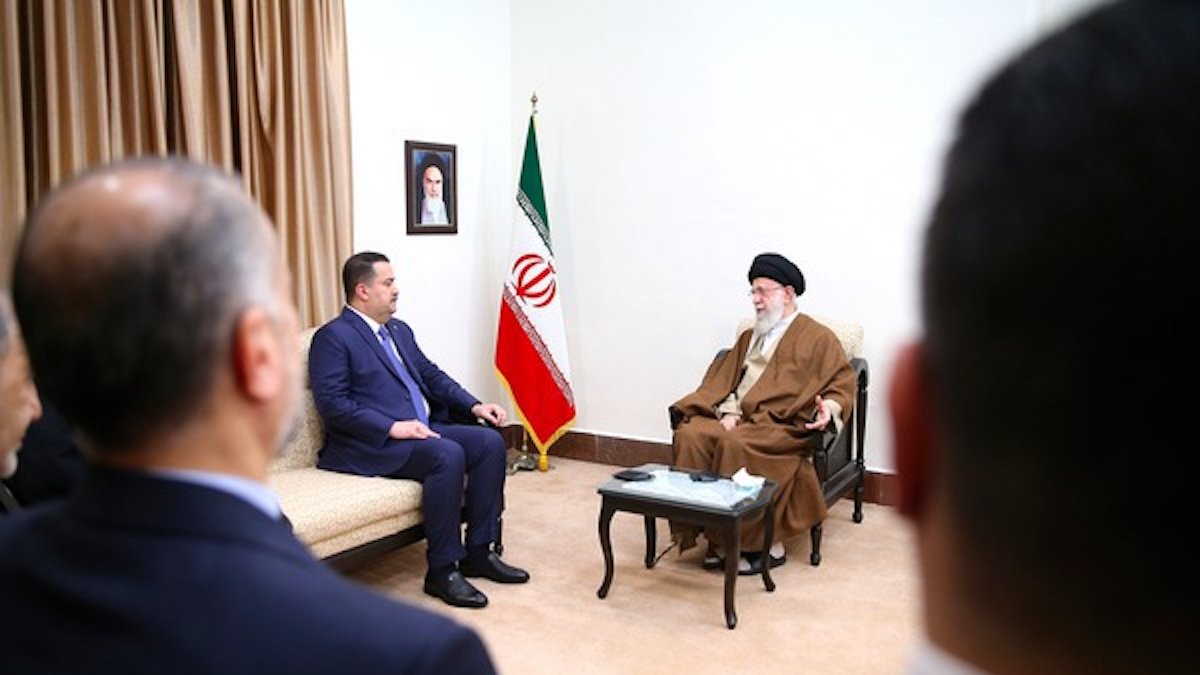
What happens when the proxy network loses its patron but not its guns? We might be about to find out.
Negotiations between the United States and Iran proceed, but the fact that the president has ordered a second aircraft carrier to the Persian Gulf is a clear sign that force is not off the table. It is therefore important to consider the secondary consequences any regime change in Tehran would have in Iraq.
Given the extent of Iranian influence throughout Iraq’s formal and informal institutions, a change in Tehran will immediately reverberate in Iraq. However, it could also create an opportunity for Iraq to address a long-standing security conundrum and emerge a stronger state no longer beholden to Iran. Central to this are Iraq’s Popular Mobilization Forces, a network of mostly Shiite militias in Iraq that were mobilized in 2014 to help fight the Islamic State after the Iraqi army collapsed in parts of the country. Although they were later formally incorporated into the Iraqi state and receive government funding, many of their most powerful factions maintain close ties to Iran and operate with significant independence from Baghdad.
With the U.S. military mission in Iraq on a glide path to end this year, reducing Iran’s influence in Iraq by disarming these militias could give Iraq an opportunity to exercise sovereignty and determine its own fate in a way it has not had since the fall of Saddam Hussein in 2003.
Regime change in Iran could engender several scenarios for Baghdad, mostly ranging from bad to worse. One scenario could be an abrupt collapse of the regime in Iran, resulting in an influx of Iranian Quds forces and regime leadership into Iraq, all seeking safety from a suddenly inhospitable Iran and overwhelming Iraq’s capacity to handle the crisis. A more likely scenario would see the Iraqi government remain passive, allowing the situation to develop and hoping any spillover is limited, thereby sparing it from having to make any hard decisions. Indecision has become an art form among Iraqi officials, with the prevailing preference to “hold the stick by the middle,” an Iraqi expression meaning to play the middle ground for as long as possible. There is a long shot scenario, however, wherein the government of Iraq and the Iraqi people — with limited but focused support from outside players — recognize a change in Tehran as an opportunity to finally disentangle itself from de facto Iranian state capture. To accomplish this, they will first need to face two serious security challenges: preventing instability in Iran from jumping the fire break into Iraq and containing internal instability that could erupt within their own borders.
The Fire Break Challenge
If regime change in Tehran takes the form of a chaotic and expeditious collapse, it is not difficult to envision many Iranian regime officials — to include members of the Islamic Revolutionary Guard Corps — crossing the border to seek refuge in Iraq. Securing its border with Iran will be no small feat for Iraqi forces given the border’s length, the number of informal crossings, and existing close ties between the regime and certain segments of Iraqi society. Adding to this challenge is the fact that among those fleeing Iran would be hundreds of Iraqi Shiite militia who have reportedly poured into Iran over the southern border near Basra to assist the regime in putting down protests. Additionally, the Iraqi government will need to continue to dedicate resources, even if reduced, along the western border with Syria, which is facing a renewed threat from the Islamic State — a threat taken very seriously in Iraq. Despite these challenges, Iraqi border forces, supported by police and security forces, have the manpower, training, and equipment to secure the nation’s borders. Seeing firsthand how the Iraqi security apparatus pursued Islamic State extremists in Anbar and the strides they made in joint operations and targeting, we know it is well within their capability to tighten defenses along multiple borders.
While Cooling Internal Volatility…
Tensions within and between different sectarian groups permeate Iraqi society, and this is especially true when it comes to Iran’s influence in the country. While the majority of Iraqis simply want to recalibrate and normalize relations with Iran — and with all of its neighbors for that matter — there are Iraqis who deeply resent Iran’s control over the country and yet are too weak to do anything about it except seethe. Other Iraqis — a minority, we would argue — are deeply aligned religiously, politically, and economically with the Islamic regime. A change in Tehran will bring these tensions to the forefront and likely spark civil unrest, protests, and violence in Iraq. How big a fire that spark creates will depend on several factors, the most determinant of which will likely be the guidance issued by Grand Ayatollah al Sistani and other influential Shiite clerics to their followers. But when and how the Iraqi government responds will also matter. Recent experience shows a growing competence in handling sectarian violence. For example, when inter-Shiite political conflict related to elections erupted in Baghdad in the summer of 2022, the Iraqi security forces effectively prevented escalation with Sadrist factions. They demonstrated that there are well-trained security professionals who can handle large-scale security crises and manage internal threats. As with the challenge of securing the border, Iraqi security institutions should have sufficient experience to maintain order and prevent large-scale escalation during a domestic crisis response.
Ultimately, how quickly and effectively the Iraqi government responds to these two security challenges — the one external, the other internal — will impact not only near-term stability but could have longer-term implications as well. If the Iraqi Government can address these two immediate challenges in a way that engenders confidence and support from the majority of Iraqis, it could potentially set the conditions for progress on a more intractable issue plaguing Iraq: the demobilization and reintegration of the Popular Mobilization Forces.
…To Help Address the Challenge of the Popular Mobilization Forces
While an in-depth discussion of the Popular Mobilization Forces is beyond the scope of this piece (there are numerous excellent articles on the topic), they broadly consist of dozens of predominantly Shiite militias who answered the call of the Iraqi government and religious authorities to support the Iraqi military in 2014 in its fight against the Islamic State. These militias, which receive a large portion of their budget from the government, played an important role in the fight against the Islamic State and are held in high regard by most Iraqis for having answered the nation’s call at a desperate time. However, within the Popular Mobilization Forces, there is a subset of militia that have deep and direct ties to Tehran. They serve as Iran’s proxy force in Iraq, impeding the emergence of any truly independent and sovereign Iraqi state. Six of these militias are designated as Foreign Terrorist Organizations by the U.S. State Department. Two of them, Kataib Hizballah and Harakat al-Nujaba, profess no loyalty to the Iraqi state whatsoever. They subscribe to the Iranian Wilayat al-Faqih governing construct and look instead to Ayatollah Ali Khamenei as their supreme leader. These groups and their unyielding allegiance to Iran should be removed for Iraq to be truly independent.
Previous Iraqi governments have attempted with varying degrees of seriousness to demobilize the Popular Mobilization Forces, and in recent months we have seen real progress with many militias — even certain Iranian-aligned groups — indicating a willingness to disarm. Unsurprisingly, the principal obstacles remain Kataib Hizballah and Harakat al-Nujaba, whose leaders stoutly refuse to disarm. The reason is clear: It is not in Iran’s interest to relinquish the control and leverage these militia groups give Iran over what happens in Iraq. A Jan. 6 unannounced visit by the Iranian Quds Force Commanding General Esmail Qaani to Baghdad to meet with Iranian Aligned Militia Group leadership speaks to the closeness of the relationship.
This power dynamic, which has long favored Iran, could change abruptly if the regime in Tehran is weakened or removed. With such a change, conditions could finally be right for disarming the Popular Mobilization Forces, and Iraq should be ready to capitalize on any such moment. To be successful, the Government of Iraq will have to negotiate with the Popular Mobilization Forces and be prepared to offer incentives, including immunity from prosecution and financial compensation. Fortunately, this type of bargaining is an area in which Iraqis excel. As indicated, with the exception of Kataib Hizballah and Harakat al-Nujaba, most groups within the Popular Mobilization Forces have already demonstrated good faith in finding a path to fully disarm and subordinate themselves to the state. However, the only way to deal with the most extreme elements of Iranian-aligned militia groups will likely be through the application of precise but overwhelming violence. Iraqi security forces need to be ready for a fight, and make it known that they are prepared to engage and win decisively in any showdown with hardline holdouts.
The Crucial Ingredient: Political Leadership
Critical to successfully navigating the above challenges is strong, non-sectarian, Iraqi-centric leadership. This is important across all Iraqi institutions, but especially in the political domain. Sunni, Shiite, and Kurdish leaders will have to do something they have rarely done throughout the history of modern Iraq: elevate the needs and interests of the nation over competing sectarian interests and certainly over opportunities for personal gains.
By far the most important political position in Iraq is the post of prime minister. It is the prime minister who wields constitutional authority as commander in chief of the Armed Forces, directs the Iraqi National Intelligence Service, and appoints key ministers, including the interior minister. In this context, the ongoing government formation process in Iraq today could not be more consequential. To navigate all of the challenges described above, Iraq will need a strong, decisive leader: one willing to work shoulder to shoulder with Sunni, Kurdish, and other Iraqi leaders and make hard — likely unpopular — decisions in the name of Iraqi cohesion. Recycling previous Iraqi prime ministers with a proven track record of corruption and manipulating the levers of power for personal and sectarian gain is not a path to success.
What Could Iraq’s Supporters Do?
Outside actors could play an important role in helping Iraq navigate any transition in Iran and gain control of its future. Providing ongoing public support for Iraq, as many countries are doing, should continue. Ultimately, navigating this regional turbulence responsibly will be an Iraqi problem to solve, and the government of Iraq needs to understand that the international community will expect it to do so. At the same time, outside nations — particularly those in the region — should refrain from unilaterally advancing what they perceive as their own interests in Iraq.
Countries that currently provide security assistance in the form of training, advising, and providing security assistance should continue to do so. Given the importance of border security, Iraqi security partners should consider repurposing the assistance they currently provide towards strengthening the borders. The Government of Iraq and the Iraqi military will certainly ask for an extensive laundry list of military equipment and technology, claiming that without it, they will be unable to prevent the country’s collapse. Partner countries should not take the bait. The Iraqis have all the materiel and training they need to overcome the obstacles they will face. However, Western partners should be prepared to intensify their political, economic, humanitarian, and diplomatic support to Iraq during any period of crisis. Together, such efforts send a meaningful signal to Iraqis that the international community remains committed to a strong and stable Iraq and could help buoy the next prime minister.
As for the United States, the administration should recognize the immediate and powerful aftershock any change in Tehran would have in Baghdad. As it sets the theater defensively and offensively and develops options related to Iran, the administration should also consider Iraq in its strategy. Failing to do so could undermine the accomplishment of its objectives in Iran and increase regional instability. Fortunately, the administration would not need to significantly change course in Iraq. The drawdown of U.S. forces can continue as well as calling for the demobilization and disarmament of the Popular Mobilization Forces. Within the first 72 hours of any meaningful change in Tehran, Washington can help in discrete but meaningful ways. First, it should increase the quantity and quality of the intelligence and military support it provides to trusted Iraqi partners to help them understand what is going on in Iran and develop a strategy to mitigate the risk of spillage into Iraq. Second, given its presence in northeast Syria and positive relations with the Syrian government, the United States should pressure the Syrians to secure their side of the border and coordinate closely with their Iraqi counterparts. Finally, the United States should use its political and diplomatic influence to dissuade regional and neighboring countries from trying to exploit a preoccupied and vulnerable Iraq. Turkey, the Gulf states, and Israel could each play a constructive or disruptive role as Iraq contends with a litany of challenges. It will be best for all if the Iraqi security forces have the time and space they need to demonstrate to the Iraqi people and regional partners that they can handle Iraqi security.
Conclusion
By the end of this year, the U.S. military presence in Iraq will effectively be over, and with it a substantial portion of American influence in Iraq. If the Iranian regime falls, the two countries that have played an outsized role in Iraqi political, security, and economic life for decades will have exited the scene. If and when that day comes, Iraq will have a unique opportunity to exercise its own national sovereignty and determine its own fate in a way it has not since even the fall of Saddam. The challenges of navigating a potential collapse in Iran will be formidable, and it remains to be seen whether Iraq will be able to rise to the occasion. Will the next Iraqi prime minister lead in a way that unites and not divides the nation? Will the Iraqi security forces be able to contend with multiple external and internal crises? How will Iraqi sectarian, ethnic, and religious leaders support the nation? What role will outside nations play? What is clear, however, is that any change in Tehran will have a direct and immediate impact on Baghdad and the broader region. Given the enormous expenditure of American blood in Iraq over the last 23 years, it is important for the United States to recognize this reality and to incorporate Iraqi stability as it determines its Iran strategy.
Maj. Gen. (ret.) Keith Phillips served multiple tours in the Middle East, including as the senior defense official/defense attaché in Iraq from 2021 to 2022. He completed his career in the Army in January 2026.
Stewart Welch is a retired Air Force officer and Olmsted scholar who served in multiple tours as a Middle East regional affairs specialist. He served with Phillips during a tour in Baghdad from 2022 to 2023 as the air attaché and chief of attaché operations at the U.S. embassy.
Image: رودکی via Wikimedia Commons
