

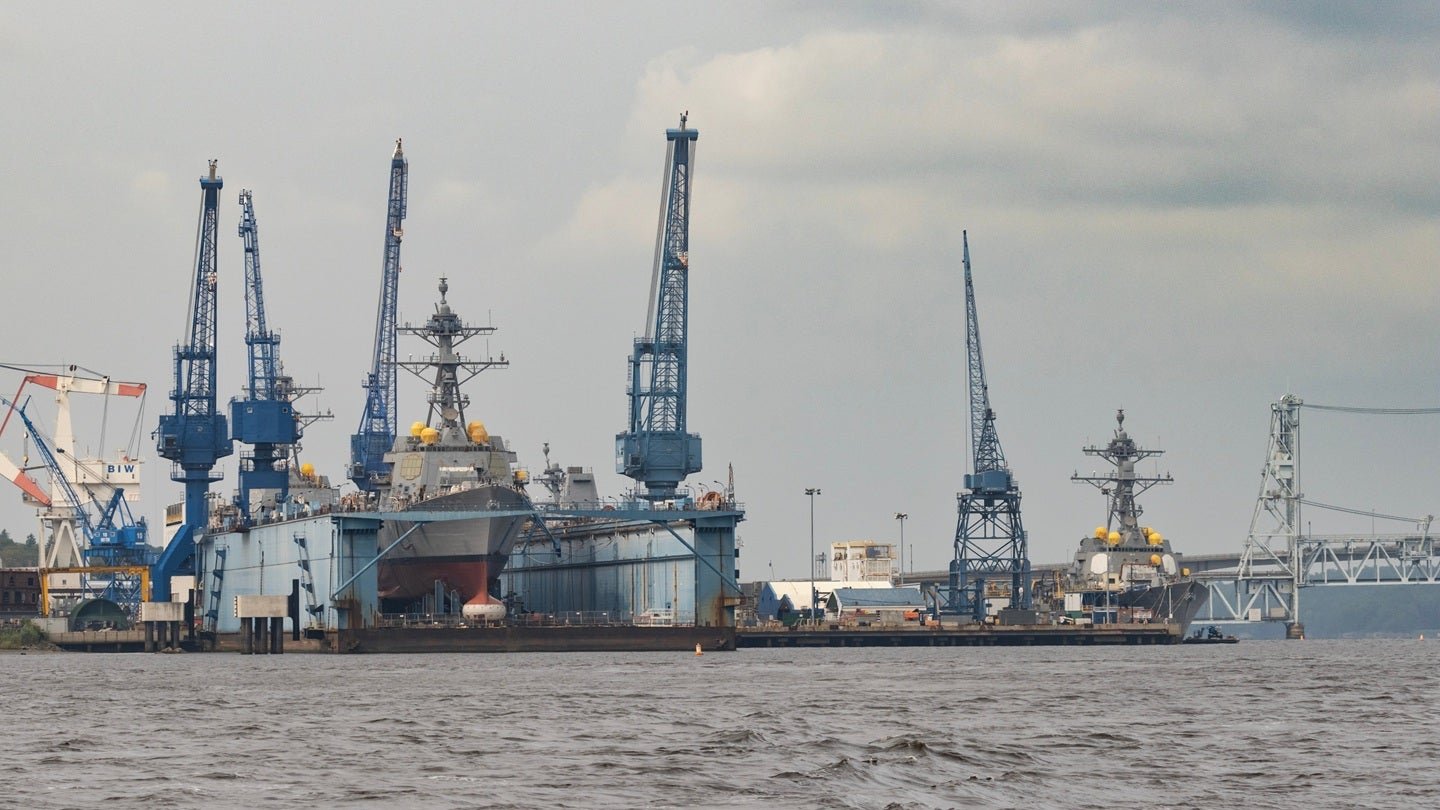
- The US is trying to find ways to counter a growing numerical disparity with its peer competitor in China
- The return of President Donald Trump has seen complex programmes cancelled in favour of simpler alternatives
- The launch of a Maritime Action Plan is intended to provide a viable naval reserve and sealift force
A poll of readers of the Naval Technology news site has found that more than two-thirds consider that United States President Donald Trump’s shipbuilding strategy is not the right course of direction for the US Navy.
The poll, conducted by intelligence firm GlobalData, offered answers broken down into two positive and two negative options: No, it is not the right schedule or direction for industry; No, and the primary focus should be on uncrewed systems; Yes; and Yes, concentrated large firepower in a small number of platforms is the right approach.
Of more than 250 respondents, 67% (171) answered in the negative, indicating that the current US strategy to naval shipbuilding was not the right approach.
From those that answered with a ‘no’, 131 said the US approach was “not the right schedule or direction for industry”, while 40 said the primary focus should be on the development of uncrewed systems.
Of the 83 positive results, 30 said that the current US approach should concentrate firepower in a small number of platforms, while 53 offered the basic ‘Yes’ response.

In February this year, the White House published a new strategy dubbed ‘America’s Maritime Action Plan’, which detailed the state of the country’s shipbuilding sector.
According to the paper, of 66 shipyards, just eight were described as being “active shipbuilding yards”, with 11 able to provide “build positions”, 22 repair yards with drydocking, and 25 topside repair yards.
As a result, the US “does not have the capacity necessary to scale up the domestic shipbuilding industry to the rate required to meet national priorities”.
Among plans in the proposed Maritime Action Plan, which included aspirations for commercial shipbuilding, a Presidential Order directed the Department of Defense to conduct a review and issue guidance on the mobilisation of a “robust inactive reservice fleet” in order to ensure “we have adequate assured access to sealift capacity whenever needed for military operations”.
US struggling to keep pace with China
The US Navy is struggling to keep track of its nearest peer competitor, China, whose People’s Liberation Army Navy (PLAN) is threatening to bridge the qualitative gap, just as it surpassed the US’ quantitative advantage some years ago.
In addition, the return to the White House of President Donald Trump has seen key programmes such as the Constellation-class frigate cancelled in favour of a less sophisticated, but eminently more achievable, FF(X) platform based on the Coast Guard’s Legend-class cutters.
However, while simplicity appeared to win the day in axeing a troubled progamme running over budget and far beyond the timeline, complexity has been added with the planned introduction of the Trump-class battleships.
US shipyards have also struggled to meet the demand in recent years, both in terms of shipbuilding as well as maintenance programmes, resulting in President Trump looking overseas to facilities in countries like South Korea to aid US shipbuilding plans.
The US is also planning to introduce a range of uncrewed naval vessels to provide additional mass, acting potentially as sensor nodes or strike platforms as part of a distributed force, primarily in the Indo-Pacific region.
According to analysis conducted by the US Congressional Research Service in 2025, according to existing plans the number of US Navy warships would increase from 295 to 390 by 2054.
However, before increasing the fleet would become smaller in the near term, falling to 283 ships in 2027.
China’s PLAN operates in excess of 370 warships, and is adding new aircraft carriers and drone assault vessels into its battleforce.

