

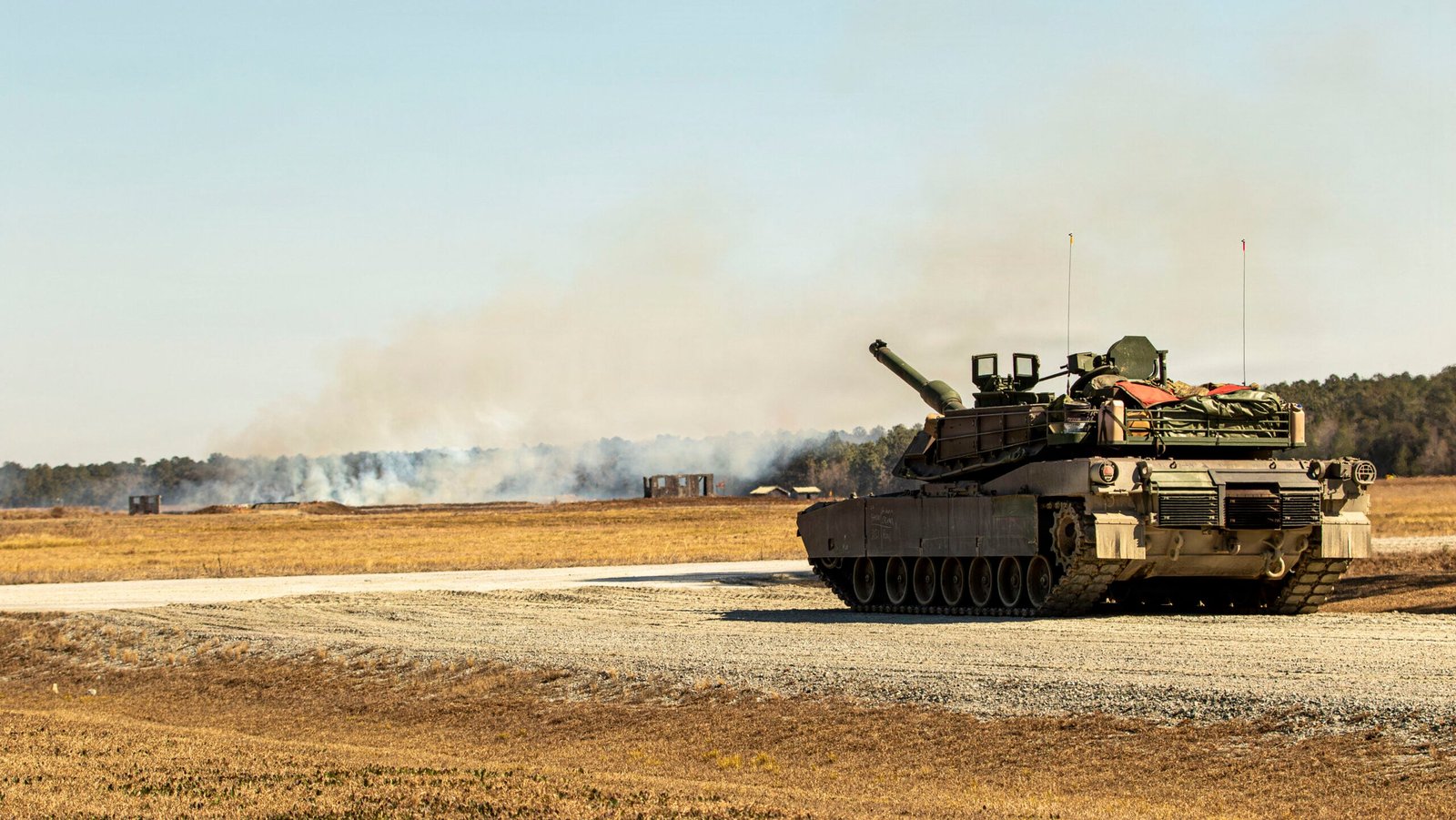
The US Army is about to lose millions of dollars in training value for reasons that have nothing to do with funding shortfalls or maintenance discipline. As armored brigades prepare for National Training Center rotations this year, a significant portion of their Abrams tank fleets remain non-mission capable, waiting for parts.
The Army has the technical ability to manufacture many of these parts quickly using advanced manufacturing techniques. But they’re not. And this is solely due to current policies that make it nearly impossible to justify buying those parts at the “wrong” price.
National Training Center rotations are the apex of collective training for armored units. They are the events where brigades validate readiness and expose weaknesses before deployment. Yet many units now enter “the box” with equipment readiness well below the Army’s 90 percent target.
A common driver is vehicles sitting non-mission capable while waiting on spare parts managed through the Defense Logistics Agency (DLA), often with delivery timelines measured in months. These delays are often not caused by technical complexity; In many cases, tanks are sidelined by simple components like hoses, brackets, or washers. The underlying issue is that these parts are produced by sole-source vendors whose business models are optimized for large batch production, not small, urgent orders. When demand is low and quantities are small, the supply system struggles to respond quickly.
Every broken tank represents more than a maintenance statistic. It represents a crew that cannot train, a gunnery iteration that cannot be executed, and a readiness window that does not reopen once the calendar moves on. Time, not money, becomes the binding constraint.
What makes this situation especially frustrating is that the Army already has an alternative. Army Tank-Automotive & Armaments Command (TACOM) has identified nearly 1,700 parts that can be produced using advanced manufacturing techniques, including more than one hundred Abrams-specific components. Many of these parts could be fabricated and delivered in days rather than months.
This is not a speculative effort: TACOM has already assessed the engineering, qualification, quality assurance, and cybersecurity work required to transition these parts into routine production. The total non-recurring cost to engineer and qualify the entire catalog is less than $100 million.
That figure matters. Spread across nearly 1,700 parts, most of this cost represents a one-time investment. Once completed, those parts can be produced repeatedly at relatively low marginal cost. In other words, the most expensive part of adopting advanced manufacturing at scale is already largely understood and bounded. Yet TACOM’s ability to use this capability remains constrained by how DLA funds and prices spare parts.
Under current policy, TACOM can produce a limited number of parts under temporary repair authorities. Those parts, however, must eventually be replaced by “permanent” components purchased through DLA, who maintains contracts with original equipment manufacturers. Because the funding mechanism used to manage the supply system (the Army Working Capital Fund) requires full-cost recovery, and because small-batch advanced manufacturing includes upfront engineering and qualification costs, the fully burdened cost of these parts nearly always exceeds the catalog price offered by OEMs.
The comparison is further distorted by the catalog prices themselves. Many low-demand parts have not been purchased in years. Their listed prices reflect outdated assumptions about labor, materials, and industrial capacity. Inflation and supply chain disruptions have made many of these prices effectively fictional. Yet they remain the baseline against which advanced manufacturing is judged.
The result is predictable: the supply system cannot justify purchasing a higher-cost part today, even when doing so would immediately restore vehicle availability and preserve training readiness. The cheaper part remains cheaper only on paper. Operationally, it is often the most expensive option available.
Commercial industries confronted this problem long ago. Airlines do not evaluate replacement components based solely on unit price. They weigh the cost of the part against the revenue lost from a grounded aircraft. Power utilities accept higher equipment costs to avoid outages that impose far greater economic and human consequences. The Army faces an analogous trade. Advanced manufacturing does not simply produce parts at higher unit cost. It preserves the ability to train during scarce windows when readiness is actually generated. Once those windows are missed, the value is lost permanently.
Thankfully, congress has begun to acknowledge this reality. Section 1842 of the Fiscal Year 2026 National Defense Authorization Act directs the Department of Defense to identify critical readiness items suitable for advanced manufacturing and to assess non-recurring engineering costs. What Congress has not provided is a method to compare those costs against the readiness lost while waiting.
The Army does not define a fixed number of training days required to achieve top-tier readiness. In practice, however, meaningful platform training occurs on a limited number of days each year. For armored units, this number is often around 50 training and gunnery days. The DoD already calculates what is at stake. Fully burdened personnel cost estimates, which include pay, benefits, training, and institutional overhead, are routinely used in force design and cost analysis.
Using these standard models, the annual fully burdened cost of a four-person Abrams crew exceeds $500,000. When that investment is concentrated into roughly 50 meaningful training days, the implied readiness production value is on the order of $10,000 per crew per day. This leads to a practical decision metric: call it the Value of a Lost Training Day. If the readiness value preserved by restoring a vehicle exceeds the incremental cost of producing the required part, purchasing that part immediately is the rational choice.
Consider the Army’s Abrams fleet of what open-source reporting puts at around 2,300 tanks. The Army’s Weapon System 360 application shows that roughly 6 percent of tanks are currently non-mission capable due to delayed parts deliveries. Digging deeper, 40 of those tanks could be returned to full mission capability using parts already identified by TACOM as suitable for advanced manufacturing.
If advanced manufacturing restored those 40 tanks, the readiness impact would be immediate. Forty tanks multiplied by fifty training days yields 2,000 additional Abrams training days per year. At $10,000 per crew per day, that represents $20 million in preserved training value in a single year. By comparison, the catalog price of the parts required to restore those tanks is less than $20,000. Even if advanced manufacturing increased part costs by an order of magnitude of ten times, the readiness value preserved would still dwarf the additional expense. Who wouldn’t trade $200,000 in costs to preserve $20 million in value?
This problem does not require new legislation or revolutionary reform. The authority already exists. What is needed is a shift in how the DoD evaluates cost.
The Army and DLA should approve advanced manufactured parts when the expected readiness value exceeds the incremental production cost, absorbing those costs into overall working capital fund rates or explicitly asking Congress to appropriate the upfront costs. This is not creative accounting. It is honest accounting, which acknowledges the value of training time the Army already pays for but does not currently price.
Additive manufacturing will not solve every sustainment problem. But when applied to critical, low-volume, long-lead parts, it offers a clear opportunity to convert time into readiness. Until the Army explicitly values that trade, it will continue to make sourcing decisions that look economical on paper while eroding combat preparedness.
Col. Michael R. Mai is the Military Deputy, G-8, and Chief of the Army Working Capital Fund at Army Materiel Command. He oversees budgeting and execution of more than $13 billion in annual working capital fund resources supporting Army sustainment and advanced manufacturing. The views expressed are his own.
