

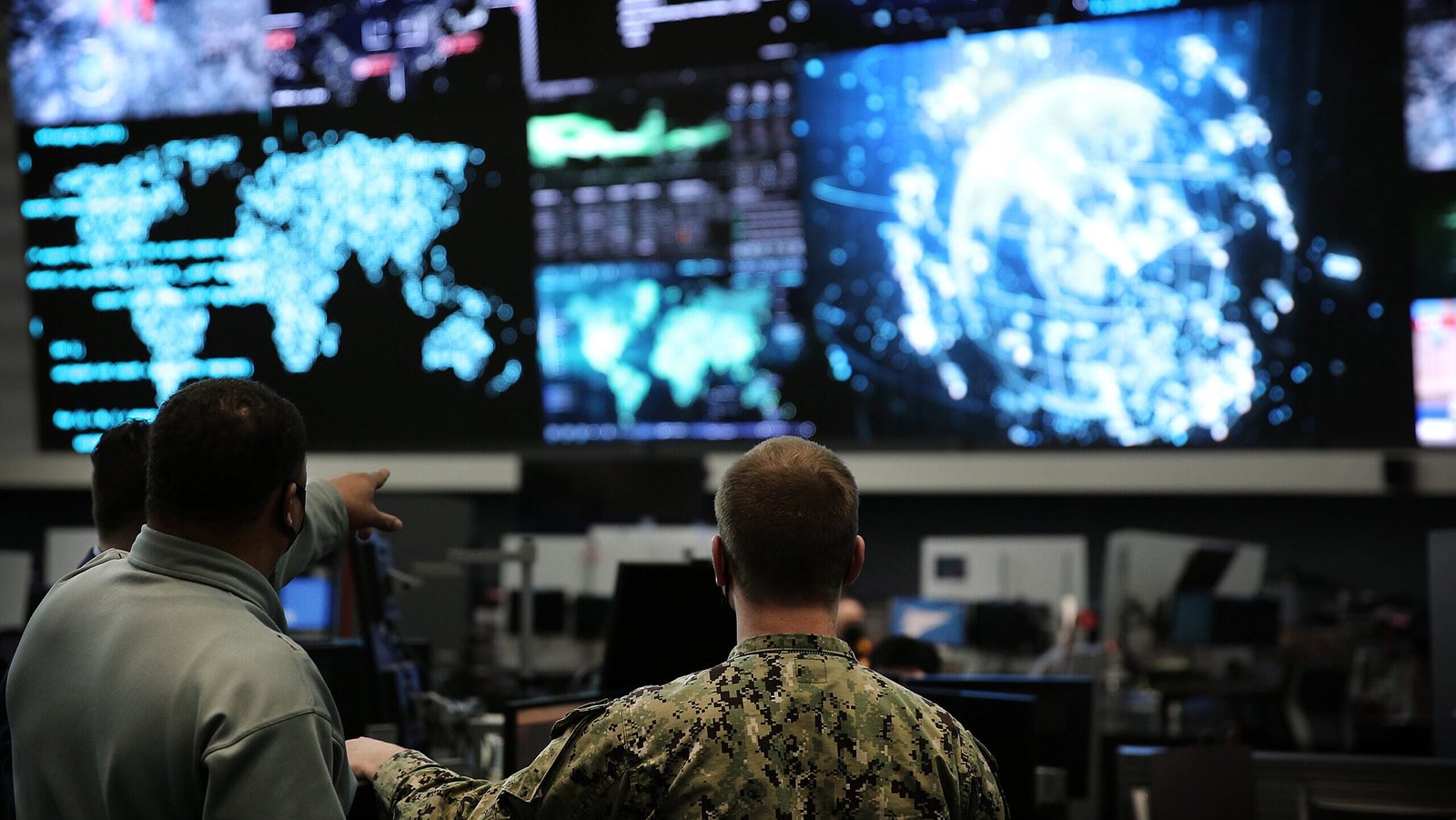
SAN DIEGO — A little-known joint center for integrating cyber operations proved instrumental during the operation to capture Venezuelan leader Nicolás Maduro, a top Navy cyber official said this week.
The Joint Integrated Fire Center (JIFC) acts as a combined air operations center that coordinates all the aircraft in an area of operations, Vice Adm. Hedi Berg, commander of 10th Fleet/Fleet Cyber Command, said at the annual WEST conference. The organization encompasses all the headquarters elements and teams for cyber operations — as well as space counterparts, intelligence community and interagency — to help build out an understanding of cyber fires and work with kinetic and maneuver forces to layer those in at the timing and tempo of the commander.
But the way the JIFC was used during Operation Absolute Resolve “validated” the construct, thanks to “very precision layered fires that also supported maneuver,” she said in public comments during the WEST 2026 conference in San Diego.
“It was large and complex and precise and it validated much of what we had talked about, but it also talked about the absolute criticality, the absolute criticality of the precise delivery of cyber and space fires integrated in with SIGINT,” Berg told conference attendees during a presentation. “And in fact, the Chairman of the Joint Chiefs of Staff said, ‘we will never execute operations as we had previously, we will always see cyber, space and SIGINT at the forefront of how we execute operations.’”
The New York Times reported that CYBERCOM took action to turn the lights out in Venezuela, interfered with air defense radars, and disrupted hand-held radios signifying fuller integration into operations.
There are various types of cyber organizations and forces conducting operations around the globe. For example:
- Joint Force Headquarters-Cyber: These entities are commanded by the heads of the service cyber components and are assigned particular combatant commands to provide planning, targeting, intelligence, synchronization, and command and control of cyber capabilities. They command combat mission teams, that conduct cyber operations on behalf of combatant commands mostly in the offensive sphere, and combat support teams, that provide intelligence, mission planning and other necessary support work for combat mission team.
- Cyber National Mission Force: a sub-unified command under CYBERCOM charged with defending the nation from significant cyber threats. These are high-end cyber warriors made up of 39 joint teams organized into task forces aligned against specific nation state threat actors.
- DOD Cyber Defense Command: Formerly Joint Force Headquarters-DOD Information Networks, it is responsible for conducting defensive cyber operations on the network across the globe.
The concept of a JIFC was created about three years ago and stemmed from an unnamed tier one exercise, Berg, the Navy’s top cyber warrior who took command late last year, said in an interview with Breaking Defense on the sidelines of the conference.
A spokesperson later told Breaking Defense that the JIFC used for the Venezuela op was modeled off one managed by Fleet Cyber for Indo-Pacific Command. Under the Joint Force Headquarters-Cyber, Fleet Cyber heads cyber operations for INDOPACOM, SOUTHCOM and US Forces Korea.
The JIFC is not a standing body like the Cyber Operations-Integrated Planning Elements that are essentially forward extensions of the JFHQ-Cs in the combatant command staff to help plan cyber effects. Rather, it is stood up for an exercise or a named operation or for planning purposes if an operation is likely to take place.
Berg noted that the JIFC provides a single place for the customer to go for requirements and pull in capabilities from all three of the above groups. This is critical as there could be several forces operating in a particular area. For example, Berg is responsible for cyber operations in SOUTHCOM with combat mission teams. There could also be CNMF teams operating against certain actors there as well as cyber support to SOCOM activity from JFHQ-C Marines or defensive activity from DCDC.
All those cyber forces “had to come through the JIFC, which allowed us to really understand and really it was helpful for the customer too. They had one place to go for requirements. They had one place to go for what do you got in the toolkit, as we dig in the bag, and we could do this,” she told Breaking Defense. “That allowed us to, again, through the execution, to understand better about the layering and how we might want to continue to adjust how we layer those fires, and then how we do that execution.”
Berg called it a “game changing” capability that has significantly evolved since it’s inception, noting, “There’s no, like, stray voltage out there that that you got to clean up on aisle six. We’ve got a construct that enables all that integration,” she told conference attendees.
However, there is still work to do to improve the integration and coordination. For example, while the JIFC has proven effective, it is still complicated and depends on the quality of the people to integrate it. Similarly, it is not a standing body that can direct, but rather an integration and synchronization organization. Thus, they need to continue to develop relationships over time.
They are also working to pull more of the defensive operations in as well.
“I don’t think we quite have it right yet to represent the full ecosystem, whereas it’s good at offensive fires, I really need to bring in the entirety of the defensive ecosystem, to include secure, operate and defend,” she said. “When an adversary is targeting us, how do I not just build out the resilience and whatever protective measures that we have to put into place for a fleet to continue to operate, but then also, how do I design targeting packages to be able to target that particular adversary and their infrastructure to take out and continue their attacks? Instead of just building our wall higher to defend against arrows, how are we also rapidly going after the archers and going after the arrow factory?”
What Can Cyber Do For You
Berg said it’s imperative in 2026 they accelerate the integration of space and cyber into other domains. The JIFC was the result of an exercise where there were two key things missing: integration with supported commands and the understanding of what cyber can do for those commands.
“Educating the customer base is another one that will allow us to, I think, better employ,” she said. “A lot of times they’ll understand, ‘Hey, I heard there’s a capability that does x’ as opposed to ‘I need y done,’ and that allows us to be able to think through, ‘Okay, if you want y done, here’s a way that we could accomplish it.’”
Berg noted that each combatant command is integrating these effects at a different pace and understanding their speed as well as how letting them know how cyber can support is paramount.
For example, she explained cyber tools can be employed in a more nuanced way than traditional capabilities.
“Whether it is a warning shot that you can execute in a less visible way, or it is the opportunity to execute a cyber fire that then can act as a deterrent, because it doesn’t demand the same level of response as a kinetic fire,” she said.
Berg pointed to how at the kickoff of the Russia-Ukraine conflict, Russia took action in cyberspace that affected tens of thousands of European users, but did not trigger NATO’s Article V collective defense response that would likely be the result of a kinetic fire.
“This is a much more nuanced tool for, again, escalation dynamics that we haven’t quite been able to master yet,” she said.
