

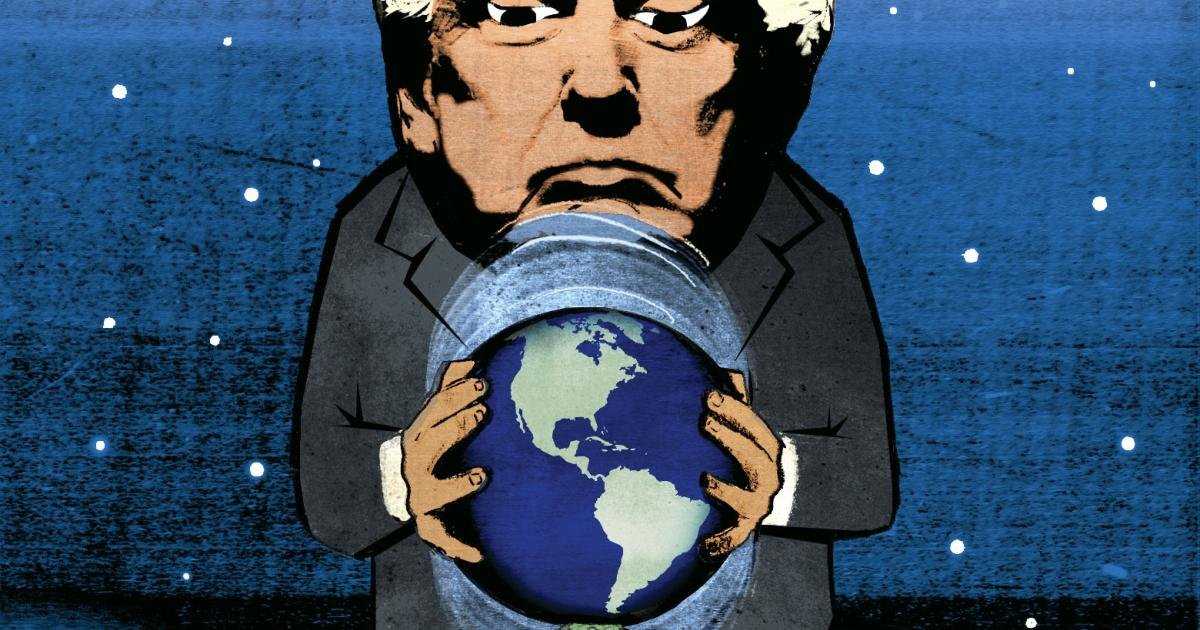
Analysts have long struggled to characterize U.S. President Donald Trump’s foreign policy. Because Trump pointedly rejects liberal-internationalist sensibilities, many have associated him with some form of realism, understood as the pursuit of the national interest defined entirely in terms of power. During his first term, after his 2017 National Security Strategy invoked “great-power competition,” the foreign policy community treated the phrase as the decoder ring by which they could rationalize his maneuvers. More recently, many have claimed that, to the contrary, Trump clearly favors a world in which great powers collude to carve up the world into spheres of influence. Throughout, the only constant interpretation has been that Trump has a “transactional” approach to international politics—the “art of the deal” as grand strategy.
But these assessments all rest on a category error. They begin from the premise that the Trump administration’s primary goal is, as its 2025 National Security Strategy insists, to advance the United States’ “core national interests.” Indeed, U.S. debates about foreign policy, national security, and grand strategy take it for granted that leaders design policy to serve the public good—even if those leaders’ view of the public interest is flawed—rather than to enrich themselves or inflate their personal glory. This is why so many foreign policy analyses argue that the “United States” or “Washington” ought to adopt a particular policy. They assume that the United States has interests that transcend party and that officials occupy their positions as a public trust.
The Trump administration, however, has destroyed this premise. Especially in his second term, Trump has instead wielded U.S. foreign policy principally to increase his own wealth, bolster his status, and personally benefit a small circle of his family members, friends, and loyalists. U.S. foreign policy is now largely subordinate to the private interests of the president and his retainers. These interests may, from time to time, align with some plausible understanding of the public good. Much more often, however, the Trump administration invokes U.S. national interests to deflect from its self-dealing by eroding the distinction between its private interests and those of the American people.
Many news reports on how Trump’s foreign dealmaking will line his supporters’ pockets still treat such arrangements as side payments, not as the main purpose of his statecraft. But if the administration’s foreign policy were not fundamentally kleptocratic, it would not be systematically attempting to subvert the independence of—or simply disable—the institutions that have long made U.S. foreign policy, including the National Security Council, the State Department, and the Defense Department. This de-institutionalization will almost surely undermine U.S. policymaking for at least a decade. It would not be relying on a practice that could be called “transactional bundling,” which intentionally collapses conflict resolution, economic bargains, and arrangements that benefit Trump cronies into grandiose megadeals that are hard or impossible to scrutinize. And it would not have systematically dismantled decades of bipartisan efforts to combat international corruption.
It is tempting to view Trump’s corrupt dealings as less important than his administration’s embrace of far-right ideology. After all, the reactionary right does have a vision of the national interest, albeit a fascistic and destructive one. But under Trump, kleptocracy and ideology are inextricably intertwined. And that makes it more likely that kleptocratic governance—in both domestic and foreign policy—will endure even after he leaves office.
ROGUE WAVE
The political scientists Stephen Hanson and Jeffrey Kopstein argue that Trumpism is part of a global “patrimonial wave,” one that has also swept through countries such as Hungary, Israel, Russia, and Turkey. In all these countries—albeit with varying degrees of success—leaders have sought to rewire modern, bureaucratic, and often democratic states into extensions of their personal authority or that of their political parties. These “neopatrimonial” regimes retain the appearance of impartial procedures and the trappings of a professional bureaucracy. But their leaders appoint cronies to specialized policy positions, subvert the independence of the civil service, and repurpose the gears of administration to reward supporters and punish rivals.
In a neopatrimonial system, corruption can be a means to an end—a way to maintain loyalty, build coalitions, and consolidate power. But Trump’s disposition is not merely patrimonial; it is kleptocratic. In kleptocracies, corruption is the end; the point of holding and keeping office is to enrich a ruler and his inner circle. Regulation, law enforcement, public procurement, and even diplomacy all become means of self-dealing—of extracting resources, controlling streams of income, and diverting wealth to family, friends, and allies.
American political history is replete with examples of corruption. But over time, the United States constructed robust protections against outright kleptocracy, especially at the national level, including independent courts and legislative oversight. The landmark 1883 Pendleton Act limited the spoils system by instituting a meritocratic civil service. Over time, additional reforms—such as strict rules for government procurement, financial disclosure requirements, and the creation of inspectors general—further reduced opportunities for graft.
Trump wants to disable the government’s foreign policy apparatus.
The United States did not establish a modern, unified Foreign Service until 1924, when it required that applicants pass a comprehensive exam. Over time, this professionalized Foreign Service expanded its infrastructure for training officers in foreign languages and technical matters. As senior officials passed along their knowledge and expertise to junior ones, the United States accumulated unrivaled diplomatic capital.
The United States nonetheless remained an outlier among other consolidated democracies: American presidents routinely appointed wealthy political donors to ambassadorial posts and staffed more leadership positions with political appointees. Still, for decades before Trump’s second term, Washington relied on a highly institutionalized foreign policy apparatus, in part to try to ensure that U.S. strategy abroad reflected national interests. Although the president enjoyed wide latitude to define those interests, he could not simply dictate them. Presidents exceeded the limits of their authority, of course, but both Republican and Democratic lawmakers considered it their duty to guard congressional prerogatives against the encroachments of an imperial presidency.
Foreign policy was developed by a variety of bureaucratic agencies, such as the State Department, the Defense Department, the CIA, and the National Nuclear Security Administration. All these agencies were staffed primarily by professional civil servants and military personnel. The agencies’ output drew on the expertise of career officials who specialized in topics or specific countries or regions. Experts deliberated in a system coordinated by the National Security Council. Although it could be cumbersome, this arrangement had many benefits, such as maintaining the policy continuity across administrations that allowed the United States to credibly commit to long-term treaties. It also empowered nonpartisan civil servants to raise concerns about whether proposed deals serve the public good, ask questions about their feasibility or legality, or blow the whistle on unethical conduct.
Trump officials claim they want to root out a “deep state” intent on sabotaging the president’s policy initiatives. But in truth, the administration wants more than a merely pliant staff. It wants to disable the government’s foreign policy apparatus entirely. This fact was made most evident by the complete dismantling of the U.S. Agency for International Development, which for decades oversaw and ran Washington’s foreign aid programs. But the effort has been broader. In 2025, within the State Department, over 1,350 career employees and foreign service officers were dismissed in the name of fighting bloat. The administration has shrunk the National Security Council even more aggressively. It gave Secretary of State Marco Rubio control of the institution rather than having it operate independently. In July, Politico reported that “fewer than 100 people” were working at the NSC, down from around 350 during President Joe Biden’s tenure, and that the NSC was hosting far fewer interagency meetings. In late December, the State Department announced a mass recall of U.S. ambassadors, all of whom were career Foreign Service officers, falsely depicting this move as normal procedure.
PACKAGE BOMBS
Such maneuvers have made room for a foreign policy run by a handful of the president’s friends and backers. Consider Trump’s de facto top diplomat, Steve Witkoff. Most presidents tap a longtime foreign policy professional or high-level politician to serve as their chief envoy (usually, the secretary of state). Trump chose Witkoff, a New York real estate baron with no government or diplomatic experience. What he did have was years of personal friendship with Trump, and for this president, that was credential enough. Trump dispatched Witkoff to negotiate with the United Arab Emirates (UAE), Iran, Hamas and Israel, and Russia and Ukraine—often by himself.
Trump’s other main envoys are also personal connections. He often sends his son-in-law Jared Kushner on diplomatic trips. He appointed Massad Boulos, his daughter Tiffany’s father-in-law, as senior adviser for Arab and African Affairs, senior adviser to the president on Arab and Middle Eastern Affairs, and senior adviser for Africa all at once, tasking him with brokering peace between the Democratic Republic of the Congo and Rwandan-backed rebels. These envoys are given nebulous titles and mandates that do not trigger the kind of financial disclosure requirements typically demanded of senior officials—statements that reveal their personal investments, business interests, and potential conflicts of interest. Without such disclosures, it is difficult to know whether the December 2025 deal Boulos helped broker—involving a bilateral strategic partnership agreement between Washington and Kinshasa that grants U.S. firms preferential access to Congolese critical minerals—created conflicts of interest for him, Trump, or other administration insiders. Boulos said that the deal would not be “private or secretive in any way.” But at the signing ceremony, Trump openly celebrated a potential windfall, promising that “everybody’s going to make a lot of money.”
Such deals more closely resemble interpersonal arrangements than binding agreements among sovereign states. They are often deliberately vague—some aspects are announced publicly while others are unveiled later or obscured altogether. They are also typically bundled transactions, wrapping a variety of demands, investments, business bargains, private side payments, and defense agreements into a single package.
Foreign policy, of course, has always been transactional: states make concessions in return for benefits, and previous U.S. presidents sought investment pledges and economic commitments alongside diplomatic agreements. But these arrangements were negotiated through established institutional channels with built-in legal oversight and a clear separation between the national interest and the negotiators’ personal business affairs. In Trump’s distinct method, the touting of enormous total dollar amounts overwhelms scrutiny of the specifics, as does the practice of rolling together different kinds of deals rather than disclosing them separately, making it much harder to know whether any one of them came about after a company offered a Trump insider a cut of the profits. Trump officials describe all the components as windfalls that will benefit the American worker, even as profits are channeled toward courtiers or firms that have backed the president. The resulting packages are designed not merely to enable corruption but to systematically obscure it.
The transactional bundles that the administration announced following Trump’s May 2025 tour of the Middle East illustrate this pattern. The administration trumpeted a Saudi commitment to invest $600 billion in the U.S. economy, although the investments on the White House’s fact sheet fell short of this figure and some initiatives began under Biden. By November, that investment total was ratcheted up to $1 trillion. Although large arms sales—such as the sale of F-35s, which Riyadh had long coveted and which Washington had previously blocked on national security grounds—are clearly part of the exchange, the bargain’s full scope remains murky. The White House similarly heralded an arrangement with Qatar that aggregated a $96 billion order by Qatar Airways for Boeing aircraft (the largest order of wide-body Boeing planes in history), $42 billion in defense deals involving companies such as Raytheon and General Atomics, and a $38 billion modernization of the Qatari air base that hosts U.S. forces.
Bundled with these arrangements are deals that obviously benefit Trump and his family personally. Last May, U.S. Secretary of Defense Pete Hegseth revealed that Qatar had gifted a Boeing luxury jet to Trump, which will cost American taxpayers an estimated $1 billion to retrofit and which Trump intends to keep after he leaves office. The Trumps are part of brand-leasing agreements and a luxury golf resort connected to Qatari Diar, a real estate company backed by the country’s sovereign wealth fund. Alongside Washington’s official UAE deals, the Trump Organization has expanded its footprint in the sheikhdom through new real estate megaprojects; in April 2025, Trump’s son Eric announced plans for an 80-story Trump Tower in Dubai.
Trump’s deals not only enable corruption but systematically obscure it.
Witkoff’s deals similarly appear to blend national and personal interests. He shepherded an agreement to lift U.S. restrictions on the export of high-end semiconductors to a technology firm chaired by Sheikh Tahnoon bin Zayed Al Nahyan, the UAE’s national security adviser. U.S. officials had previously blocked such a sale, believing it would help China get its hands on the technology. At around the same time, MGX, an investment firm chaired by Tahnoon, bought $2 billion worth of stablecoin, a form of cryptocurrency, from World Liberty Financial, whose co-founders include Witkoff, his two sons, Trump, and Trump’s three sons. (The White House said that Witkoff did not directly participate in brokering the chips deal. “Steve Witkoff has never used his government position to benefit World Liberty Financial,” the company said in a statement.) This arrangement formed part of a three-way deal in which MGX invested the stablecoin in Binance, a cryptocurrency firm whose founder, Changpeng Zhao, was serving a prison sentence in the United States for violating U.S. anti-money-laundering regulations.
Trump’s approach even turns conflict resolution into an opportunity for rent extraction. Extensive reporting in The Wall Street Journal strongly suggests that both Witkoff and Kushner—who have helped lead negotiations over the war in Ukraine—are interested in the business opportunities that could emerge from a grand U.S. bargain with Russia, such as accessing $300 billion in frozen Russian central bank assets for joint U.S.-Russian projects in space exploration, arctic mineral deals, and energy development.
Even if neither Kushner nor Witkoff is intentionally mixing his personal business with negotiations that could permanently alter the foundations of U.S. and European security, the fact that they are leading such negotiations creates a permissive environment for political allies to profit. The businessman Ronald Lauder, a personal friend of Trump, has pushed the U.S. president to acquire the Danish territory of Greenland and, during Trump’s first term, offered to serve as a “secret envoy” to Denmark, according to The New Yorker. In December, the Danish newspaper Politiken reported that Lauder has invested in a Greenlandic mineral water company co-owned by a local official. (Lauder did not reply to a request for comment the newspaper sent him via associates.) And in January, Ukraine awarded the mining rights to one of its largest lithium deposits to a consortium that includes Lauder. “By cultivating ties with investors connected to [Trump] and his administration, Kyiv is positioning itself favorably with the American leader just as it seeks its backing in peace talks with Russia,” The New York Times noted in a report about the deal. (Lauder did not respond to the Times’ request for comment.)
CONTROLLED DEMOLITION
Those whose support for the Trump administration outweighs their distaste for public corruption find ways to excuse its attacks on the rule of law. They spin fables about a heroic disrupter, a crusader rooting out the corruption of the deep state and its freeloading civil servants. Trump’s own rhetoric also numbs the public: in his business affairs as well as his political life, Trump himself has long equated complying with rules as “getting ripped off,” reframing self-dealing and tax evasion as savvy bargaining.
But the Trump team’s kleptocratic approach to foreign policy has in fact unraveled Washington’s critical, albeit incomplete, efforts to counter the metastasizing problem of global corruption. Over the last three decades, policies designed to spur growth by facilitating capital mobility have enabled kleptocrats and oligarchs to launder money and park it offshore. That wealth then became a vector for malign foreign influence in the public policy and electoral politics of consolidated democracies. Substantial reporting suggests that Russian money contributed to the success of the 2016 Brexit referendum, whose outcome undermined the United Kingdom’s prosperity. In 2022, the U.S. Justice Department indicted the Russian oligarch Andrey Muraviev for illegally funneling $1 million through U.S. proxies to influence the 2018 midterm elections.
Such challenges demanded the creation of tools such as the 2012 Magnitsky Act, which authorized asset freezes and travel bans on foreign officials credibly accused of large-scale corruption. During Trump’s own first term, Washington made countering corruption a key part of its criticism of China’s Belt and Road Initiative. Despite opposition from Trump, Congress kept up its anticorruption efforts by passing the 2017 Countering America’s Adversaries Through Sanctions Act (which bolstered Washington’s ability to target and sanction corrupt officials in Iran, North Korea, and Russia) with a veto-proof majority. The 2020 Uyghur Human Rights Policy Act imposed sanctions on entities involved in human rights abuses and permitted freezing the assets of sanctioned Chinese officials. The 2021 Corporate Transparency Act required anonymous shell companies to identify their beneficial owners.

The Biden administration made it a national security priority to combat the “strategic corruption” pursued by China and Russia, using a phrase coined in these pages in 2020 by the former George W. Bush administration officials Eric Edelman, Philip Zelikow, and their co-authors. It backed alternative initiatives such as the India–Middle East–Europe Economic Corridor, which emphasized standardized procurement procedures and sought to avoid the debt-trap dynamics of Chinese infrastructure lending. In March 2022, shortly after Russia’s invasion of Ukraine, the U.S. Department of Justice formed an interagency “KleptoCapture” task force to find and seize the U.S.-based assets of Russian oligarchs; the U.S. government also coordinated global efforts to freeze their international assets.
In his second term, however, Trump has decisively reversed this trajectory. In February 2025, the administration stopped enforcing the Foreign Corrupt Practices Act, the United States’ signature antibribery law. Although the administration claimed that problematic implementation of the act had harmed “American economic competitiveness,” the move freed U.S. companies to engage in bribery abroad without fear of federal prosecution. Then in March, Trump’s Treasury Department hollowed out the Corporate Transparency Act by suspending its enforcement for U.S. businesses.
The White House also gutted oversight of cryptocurrency, an industry that reaps significant profits from facilitating money laundering. In February 2025, the Securities and Exchange Commission dropped or settled many of its ongoing actions against cryptocurrency entities. Then, in April, the administration disbanded the Department of Justice’s National Cryptocurrency Enforcement Team and ordered its Market Integrity and Major Frauds Unit to cease investigating the sector.
Trump has used his pardon power to dismantle U.S. anticorruption norms even more brazenly. Recipients include people directly involved in activities that the administration hypes as existential threats to the U.S. public, such as drug trafficking. Ross Ulbricht, the operator of Silk Road, the dark web marketplace that served as a hub for the sale of illegal drugs, and former Honduran President Juan Orlando Hernández, who had been convicted for large-scale drug smuggling into the United States, were both granted pardons. Last October, Trump pardoned Zhao, the Binance founder; when Zhao pleaded guilty in 2023, the Department of Justice released a statement by Treasury Secretary Janet Yellen that Binance had “allowed money to flow to terrorists, cybercriminals, and child abusers through its platform.”
BROTHERHOOD OF THIEVES
One of the best reasons to staff bureaucracies with professionals—and to choose knowledgeable people to hammer out peace agreements—is to ensure precise language with actionable implications and to build the kind of intergovernmental infrastructure that is necessary for successful implementation. Rushed and vague agreements tend to fail. Indeed, the June 2025 cease-fire agreement in Congo that left Trump gloating did not halt advances by the M23 rebel forces, which continued to seize key Congolese cities. In October, Trump was eager to take credit for the “peace accord” inked by Cambodia and Thailand. But this agreement was merely a joint declaration that left important border demarcation issues unresolved and monitoring mechanisms underspecified; unsurprisingly, a few weeks later, cross-border clashes resumed.
The Trump administration’s bundled transactions resemble the arrangements China has pursued with countries all over the world—deals that Trump aggressively criticized during his first term. These combine government investments with private deals for Chinese companies. And often, the bundles are less publicly supplemented with further side deals for Chinese elites and their local political clients—as when Beijing agreed to inflate the cost of its infrastructure projects in Malaysia in order to funnel money to the country’s corrupt and collapsing sovereign wealth fund.
But despite its significant contributions to global corruption, China has not turned its back on the rules-based international order altogether. Beijing continues to closely engage with both older multilateral institutions and its own burgeoning alternative ecosystem of organizations. China also continues to place some value in technocratic governance and expert oversight, investing substantial resources into higher education and research and development—a stance that made it the leader of the world’s clean energy transition.
Corruption abroad feeds corruption
at home.
The Trump administration, by contrast, is actively trying to undermine any sense of order at all with its extrajudicial killings in international waters and its tariff regimes’ flouting of U.S. treaty obligations. It is doing its best to sabotage many of the advantages—including a rock-solid alliance network, an effective and respected foreign assistance program, and an association with good governance—that it once expected to help it prevail in a rivalry with China. If the kleptocratic instincts Trump and his circle act on were the only problem, then his exit from the stage in early 2029 might be a source of comfort. But the de-institutionalization of U.S. foreign policy will likely undermine U.S. policymaking for at least a decade.
Kleptocracy’s fusion with far-right extremism will also make corruption more enduring. This union, in the United States, now transcends a mere alliance between Trump and right-wing provocateurs. Those most likely to pick up Trump’s torch—people such as Vice President JD Vance and Homeland Security Adviser Stephen Miller—do have a vision of the national interest, an ethnonationalist one premised on the restoration of “traditional” race, class, and gender hierarchies. They are also committed to entrenching oligarchic concentrations of wealth and expropriating rents from purportedly inferior countries.
The partnership between kleptocratic foreign policy and right-wing extremism is no surprise. Most people dislike political corruption, so kleptocrats need scapegoats to justify stealing from the public. Ethnic, racial, and sexual minorities serve as convenient others to blame. True reactionary ideologues, for their part, are generally happy to serve as a kleptocrat’s political “shock troops” in exchange for a powerful ally in their war against their true enemies: liberals, moderates, and pluralistic democracy. Because they are fundamentally utopians, right-wing extremists tend not to worry about shredding institutions and political arrangements.

All this makes it easier for kleptocrats abroad to prey on the United States, a phenomenon that is unlikely to stop when Trump leaves the White House. Already, the transformation of U.S. foreign policy into an instrument of corruption is creating a vicious, self-reinforcing cycle. Instead of trying to curtail foreign corruption, Washington is encouraging it. In turn, corruption abroad feeds corruption at home.
This is why the countries of the European Union, along with other key members of the post–World War II U.S. alliance system, need to treat the Trump regime as a grave and immediate danger to their own political systems. They need to move much faster to fix the gaps in their own regulatory systems that facilitate international corruption. They need to stop using offshore wealth from oligarchs, kleptocrats, and rentier regimes to subsidize their own underinvestment. Rule-of-law democracies cannot afford to back down in the face of U.S. threats of retaliation. The Trump administration clearly prefers other neopatrimonial regimes to European democracies, and figures such as Vance are moving to boost European right-wing parties that enjoy the support of kleptocratic wealth.
Given that Congress is unlikely to use its powers to end these practices, the damage to the security and prosperity of the American public will continue to accelerate. But there is one thing foreign policy observers can do: stop obfuscating the reality of Trump’s foreign policy by calling it realism, great-power competition, or mere transactionalism. Trump’s foreign policy constitutes an existential threat not only to the possibility that a constitutional republic can be rebuilt in the United States but also to the survival of democracies abroad. Each effort to normalize Trump’s foreign policy, each assessment of its “grand strategy” that sidelines its explicit and implicit logic, only exacerbates the danger.
Loading…
