

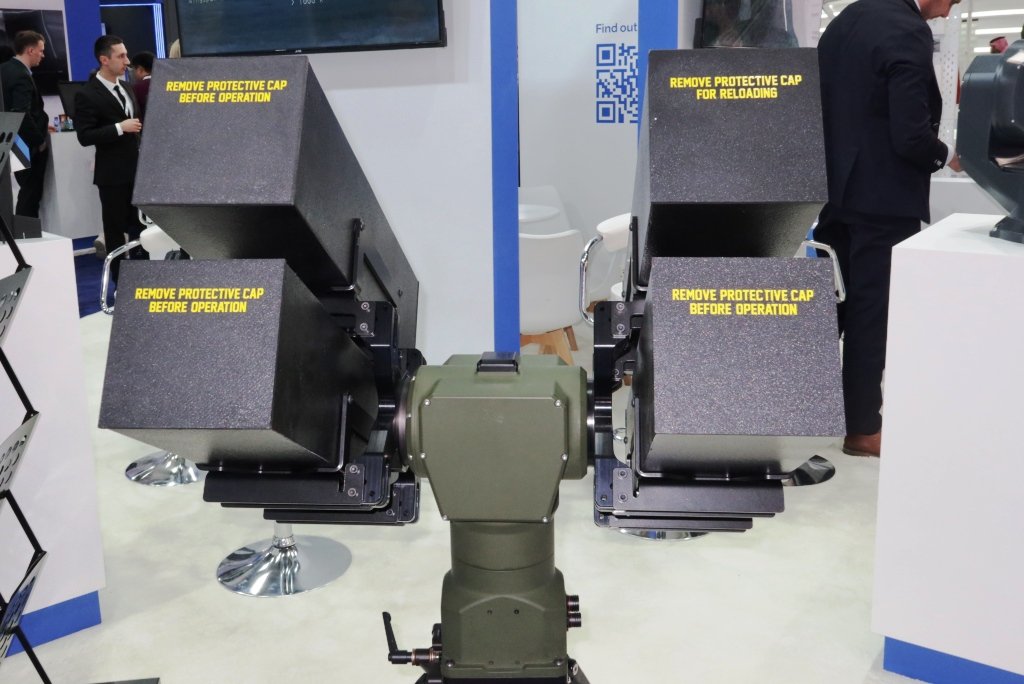
Countering the UAS threat was one of the leitmotif of the World Defense Show, mass production and affordability being among the main issues. Frankenburg Technologies of Estonia showcased its Mark I ultra short-range air defence missile which is about to be mass produced in the ground-based version, while new developments are underway
Based in Tallinn, Estonia, Frankenburg Technologies is busy in developing missile systems capable to neutralise current major threats, namely UAVs, that can be easily mass-produced, at a cost which is comparable, or possibly lower, than that of the enemy effector.
Its first product is the Mark I, a small missile with a mass at launch under 2 kg, a length 660 mm and a 60 mm diameter, which is capable to reach an incoming drone at ranges up to 2 km and 1.500 metres altitude. It is powered by a solid-fuel rocket motor and carries a 0.5 kg high explosive-fragmentation warhead fitted with a proximity fuse with self-destruct capability. A fire-and-forget missile, its guidance is provided by an electro-optic seeker with day and low-light capability.
Before launch data obtained from ground based sensors, such as radars or electro-optical systems, are fed into the launch system which aims the missile towards the intended target. Primary targets are long range attack drones, the benchmark threat being currently the Shahed, or reconnaissance and low-flying drones, such as Orlan, Zala and Supercam, to name those in use by Russian forces in Ukraine. It can also deal with loitering munitions as well as with first person view systems.
No details were provided about the Mark I maximum speed, Frankenburg Technologies saying that the missile is effective against slow-flying threats, with speed of 150-200 km/h, usually propeller driven, as well as against jet engine powered drones flying in the 400-650 km/h envelope.
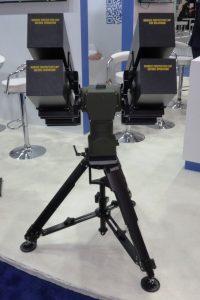
At WDS the system was exhibited in a tripod-mounted version with a pan-tilt head carrying two missiles per side, but EDR On-Line understands that modularity will allow different layouts to be developed.
Although the system price was not unveiled, it was made clear that it is well below that of a Shahed, which is estimated at around 50.000 US$, the average price for a Class 2-3 UAV.
A first evolution of the Mark I will come when the radiofrequency seeker currently under development will become available, providing the missile with a full day/night all weather capability. This will be integrated into the missile thanks to its modular design, which also enables on-site assembly, and facilitates production.
While Frankenburg Technologies headquarter is based on Estonia, the company operates also in Latvia, Lithuania, Ukraine, Denmark, Poland and the United Kingdom. Currently the company workforce is around 70 individuals, but plans are to double that figure by year end.
The development of the Mark I started 15 months ago, in late 2024; development and trials are now mostly finished, the company planning to start production in May, while first shipments are scheduled for July.
A major development is underway in Tallin; Frankenburg Technologies is working on an air-to-air version of its missile, the design including a two-missile launcher. According to information obtained during WDS, the twin-rail plus missiles will have a mass under 8 kg, which will allow installing it on small drones, turning them into hunter-type assets. EDR On-Line understood that the air-to-air version is at TRL6, and that the company intends demonstrating the prototype in a fully representative environment in March 2026.
Photos by P. Valpolini
