

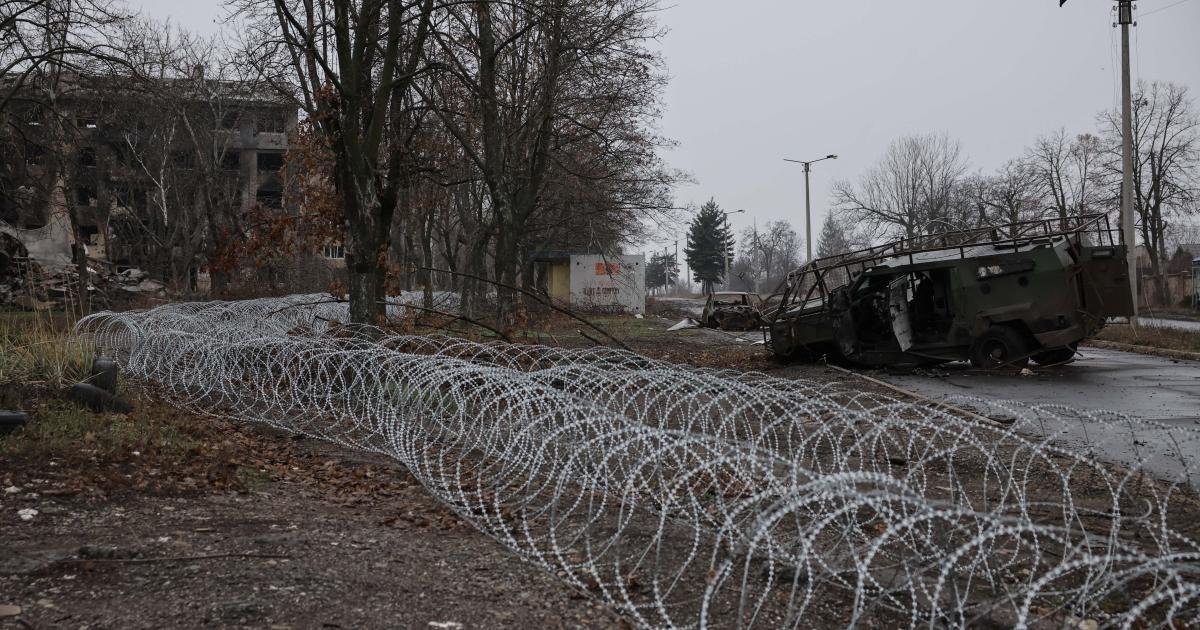
In the four years since Russian President Vladimir Putin launched his “special military operation,” Ukraine and its foreign supporters have consistently framed their objectives in the language of territorial integrity. During the first year of fighting, Western officials explicitly called for the restoration of Ukrainian sovereignty over all its internationally recognized territory, including Crimea and the part of the Donbas that Russia has controlled since 2014. This theory of victory, which was always implausible, collapsed after the failure of Ukraine’s 2023 counteroffensive. Since then, Ukrainian President Volodymyr Zelensky and most Western leaders have reluctantly conceded that Russia will maintain de facto control over much of the territory that it has conquered. Nevertheless, they continue to categorically reject de jure, or formal, recognition of Ukraine’s altered borders.
The refusal to formally recognize Russia’s territorial control rests on a set of claims about the nature of international relations and the fate of the Ukrainian nation. Opponents of de jure recognition argue that the territorial integrity of countries is a pillar of the postwar order and that this principle cannot be compromised without threatening the stability of the entire international system. Territorial concessions, the thinking goes, will embolden aggressors (whether Russia or others). They also hold that legal cession of territory is tantamount to Ukrainian capitulation, while a policy of nonrecognition preserves the possibility of Ukraine eventually reclaiming lost territory. Each of these arguments is flawed on its own terms. More broadly, reflexive opposition to de jure recognition obscures the ways in which formal acceptance of Russia’s gains on the ground could increase Ukraine’s security, facilitate postwar reconstruction, and contribute to international stability.
As part of a durable peace settlement, it is in the interests of Ukraine, Europe, and the United States to draw a new international border roughly coinciding with the final line of control. Such an arrangement would require both Ukraine and Russia to adjust their constitutional claims to correspond to the territory they actually occupy. While Ukraine would cede territory within its internationally recognized 1991 boundaries, Russia would have to accept a legal border short of the territory it has unilaterally annexed. A deal would also allow for limited, mutually agreed-on adjustments to the line of control, as well as a window of time during which residents in the affected territories could freely relocate to the jurisdiction of their choice. Ideally, the new border would be recognized—and politically guaranteed—by Russia’s partners in BRICS and Ukraine’s principal international supporters.
FALSE PREMISES
The assumption that international order rests on a strong and consistently enforced norm against territorial conquest does not withstand historical scrutiny. Borders have changed repeatedly since 1945, often as a result of conquest. As the political scientist Dan Altman documents in a 2020 study, the rate of successful territorial conquest occurred at a higher rate for much of the postwar era than in the 1930s and 1940s. There is no shortage of examples. Israel seized the Golan Heights during the 1967 Six-Day War. A decade later, North Vietnam conquered South Vietnam and Indonesia wrested control of Timor Leste. Not all of these conquests were formally recognized, but the international system absorbed these changes without unraveling, suggesting that the norm of territorial integrity is more aspirational than essential and that it has always been subordinated to power realities.
In the present case, Ukrainian territorial integrity has already been violated. Russia has constitutionally annexed Crimea, Luhansk, Donetsk, Kherson, and Zaporizhzhia. It currently controls the first two regions completely, along with considerable portions of the other three. It is true that Russia retreated from parts of these regions under Ukrainian pressure in the fall of 2022. Still, the balance of forces has shifted significantly since then, with Moscow now possessing advantages in both manpower and materiel that Ukraine is struggling to counter as Western support wanes. As the war drags on, Russia is more likely to gain ground than to lose it. The West’s nonrecognition of Russian territorial expansion will not reverse the reality of Ukrainian territorial losses.
Nor would a policy of nonrecognition meaningfully constrain Russian behavior or deter aggressors elsewhere. International refusal to recognize Russia’s control of Crimea did not stop Putin from invading Ukraine in February 2022. More broadly, actions in one part of the world are not strongly connected to other states’ calculations farther afield. The decision to risk direct military action is driven by perceived costs, capabilities, and strategic interests, not legal precedent. Tellingly, even as Western and Ukrainian officials have vigorously opposed formal changes of Ukrainian territory, concerns about potential aggression in regions such as the Middle East and East Asia have remained pronounced. In any case, Russia’s experience in Ukraine—four years of grinding war producing gains far short of what the Kremlin had hoped to achieve—hardly offers a compelling model for would-be revisionists.
Meanwhile, the objection that de jure recognition would amount to Ukrainian capitulation leaves little room for victory. If the war’s stakes are defined in territorial terms, then Ukraine has already lost. Yet this is not the only way to frame Ukrainian and Western objectives. Immediately after Russia’s full-scale invasion, the priority for Ukraine and its international backers was the preservation of the country’s independence and sovereignty. By this standard, Ukraine has already succeeded. Moreover, it has established close economic, political, and strategic links with the European Union. Such ties have delivered the longtime demands of Ukraine’s Euromaidan protesters, who in 2013–14 sought acknowledgment of their “European choice.” Formally recognizing the existence of a new international border with Russia does not jeopardize these achievements. In fact, Ukraine might have a better chance of further integrating with the West if it relinquishes legal claim to territory it does not control in the east.
Finally, Ukraine’s ability to reclaim control over its 1991 territory does not depend on whether the new border is legally recognized or accepted de facto. A renegotiation is always possible if and when the distribution of power changes. For half a century, the West refused to recognize the Soviet Union’s 1940 annexation of Estonia, Latvia, and Lithuania—a policy that produced no results—while acknowledging the Soviet status of the other 12 republics. In the end, all 15 republics gained independence peacefully. Ultimately, the main obstacle to the restoration of Ukraine’s 1991 territory is Russia’s refusal to relinquish its territorial claims and its capacity to enforce them, not the politics of recognition in Kyiv and other European capitals.
THE SUREST PATH
Not only are the arguments against de jure recognition unfounded, but the case against formally adjusting the border overlooks the benefits that could follow. Multiple studies have found that, compared with other kinds of interstate disagreements, territorial disputes have a greater probability of escalating to armed conflict. Consider South Asia, where Afghanistan, China, India, and Pakistan have all clashed over contested territory. Even ostensibly “frozen” conflicts, such as the one between North and South Korea, remain heavily militarized and primed for escalation.
Conversely, de jure recognition may help curtail the likelihood of future conflict. Europe’s peaceful postwar order, for instance, began with a substantial redrawing of international borders following the violence of World War II. Post-Soviet Central Asia provides a more recent example. Like South Asia, this region was riven by complex territorial disputes and frequent border conflicts. Since 2017, a series of border settlements involving Kyrgyzstan, Tajikistan, and Uzbekistan have contributed to increased stability and economic growth throughout the area.
In the specific case of Russia and Ukraine, formal recognition of a new international border would likely bring immediate security benefits. A clearly defined dividing line would make it simpler to determine responsibility for a resumption of hostilities. This would facilitate so-called snapback sanctions on Russia and renewed military support to Ukraine in case of unprovoked military action by Moscow, strengthening deterrence. Furthermore, a mutually recognized border might enable both sides to accept reciprocal troop withdrawals, lowering the likelihood of inadvertent escalation. In the event that conflict does break out, the aggressor’s foreign partners would be less likely to support the invasion if they had explicitly recognized a new border. Finally, formal recognition would help deprive nationalist forces in both countries of a key argument for resuming fighting and seeking further territorial changes.
Beyond the security arena, an internationally recognized Russian-Ukrainian border could ease Ukraine’s path toward further Western integration and facilitate postwar reconstruction. Ukraine’s accession to the European Union will be difficult under any circumstances, but it will be far more complicated if the country’s eastern boundary remains undefined, unstable, and heavily militarized. Border settlement could also improve Ukraine’s postwar economic prospects. Legal certainty over borders would make the country more attractive for large-scale private investment, which will be essential for reconstruction. Persistent ambiguity, by contrast, would deter capital and lock Ukraine into a permanent high-risk environment.
It may be tempting to maintain the illusion of Ukraine’s territorial integrity, but any peace deal that preserves a mismatch between de jure claims and de facto control will hinder reconstruction efforts and increase the likelihood of renewed conflict. After four years of a grinding war, the surest path to an enduring peace is a deal in which both Ukraine and Russia recognize the reality on the ground and renounce legal claim to territory that they do not control.
Loading…
