

WEST 2026 — The Navy is seeking to shake up its traditional carrier strike group model, with new plans for tailored forces that aim to provide the service greater flexibility, according to the Navy’s top officer.
Building upon previous efforts to interchange destroyers from various carrier strike groups in the Red Sea against the Houthis, the Navy wants to augment these strike groups with scalable and customized forces as part of a broader campaign to provide combatant commanders new formation options to tackle specific missions.
Chief of Naval Operations Adm. Daryl Caudle’s tailored force initiative is embedded in his new “Fighting Instructions” guidance released on Monday that outlines how the Navy plans to organize, train, equip, and fight.
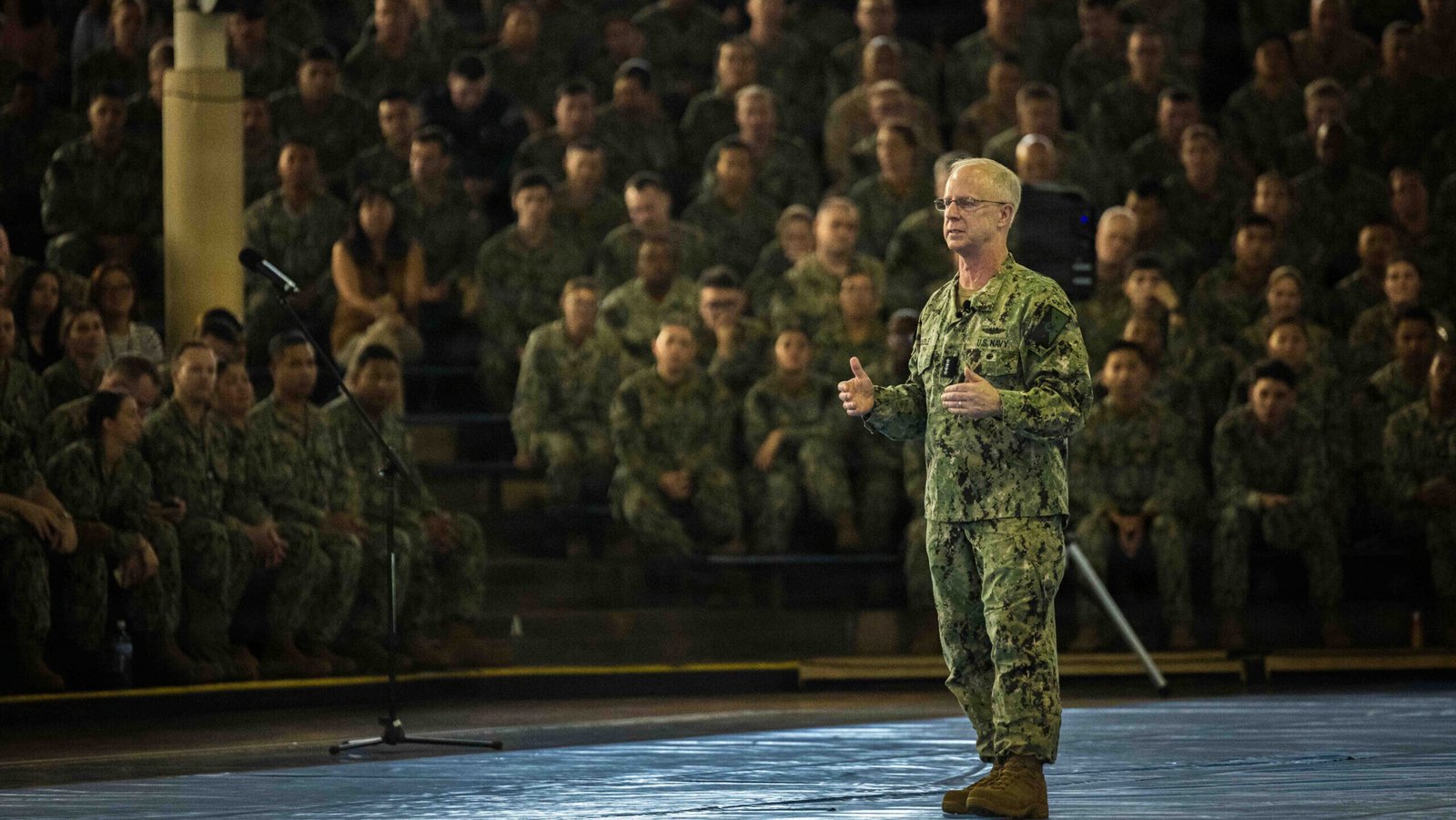
“This idea that the Navy can do something more than this all or nothing approach is really at the core of the premise, that I can be in a conversation with a commander, a combatant commander, who needs naval forces to do a specific thing for them and so having some optionality there, and to be able to flow the right amount of force,” Caudle told reporters on Tuesday during the WEST 2026 conference in San Diego.
Caudle also said that these forces could be utilized outside of their normal deployment cycle — better optimizing the Navy’s assets. That’s a departure from the status quo, where assets of a strike group typically deploy together.
Caudle, who previously served as the commander of US Fleet Forces Command, oversaw efforts to insert new destroyers to the Gerald R. Ford carrier strike group to the eastern Mediterranean Sea at the onset of conflict between Israel and Hamas in 2023. In that case, the destroyers The Sullivans and Delbert D. Black joined the Ford’s strike group, relieving the original destroyers that deployed with the carrier.
Caudle said that those deployments influenced how the Navy is seeking to expand its approach to tailored forces, and is integrating those lessons back into the new “Fighting Instructions” guidance.
“We did learn a lot from these loops that we did, if you will, of pushing forces there into the Mediterranean for some of the things we did in the Red Sea and the Mediterranean, and those are just being factored right back in,” Caudle said.
Additionally, the “Fighting Instructions” outlines Caudle’s plans for a “hedge strategy” that seeks to capitalize on unmanned systems, including unmanned surface vessels (USVs) and unmanned underwater vessels (UUVs). Caudle previewed this strategy at the Apex Defense conference in January, where he said that it would utilize smaller forces specifically designed to address certain missions that don’t require a full strike group, such as clearing mines from a maritime chokehold like the Strait of Hormuz.
“If I had a lot of strike groups, I could place these things all over the world,” Caudle said in January. “But we don’t have enough, [and] as you think about these various missions around the world — whether it be choke point defense or protection, sea lines of communication, anti-submarine warfare, ISR, maritime domain awareness — I just, quite frankly, don’t need a strike group to do all those.”
