


Resistance bands are often seen as a lightweight alternative to dumbbells and barbells, but science tells a very different story. When used correctly, bands can provide sufficient mechanical tension, high levels of muscle activation, and joint-friendly loading that supports long-term hypertrophy.
For the triceps in particular, bands are exceptionally effective because they maintain tension throughout the entire range of motion, including the often-neglected lockout phase where the triceps are most active.
This article breaks down the three best banded triceps exercises for maximal arm growth, explaining exactly why they work from a physiological standpoint, how to perform them correctly, and how to program them for size. Every claim is backed by peer-reviewed research, and everything is explained in clear, practical language.

By the end, you will understand how to use bands not just as a substitute for weights, but as a powerful hypertrophy tool in their own right.
Understanding Triceps Hypertrophy
Triceps Anatomy and Function
The triceps brachii makes up roughly two-thirds of total upper arm muscle mass, which means meaningful arm growth depends far more on triceps development than biceps size. The muscle has three heads:
The long head originates from the infraglenoid tubercle of the scapula and crosses the shoulder joint.
The lateral head originates from the posterior humerus.
The medial head originates from the distal posterior humerus.
All three heads insert into the olecranon process of the ulna and function primarily to extend the elbow. The long head also assists with shoulder extension and stabilization.
Electromyography (EMG) studies show that different triceps heads are emphasized depending on shoulder position, elbow angle, and resistance curve. Exercises that place the shoulder in flexion increase long head activation, while movements that emphasize lockout strongly recruit the lateral and medial heads (Madsen & McLaughlin, 1984; Saeterbakken et al., 2017).
What Actually Drives Muscle Growth
Muscle hypertrophy is driven by three main mechanisms:
Mechanical tension
Metabolic stress
Muscle damage
Among these, mechanical tension is the most important factor for long-term hypertrophy (Schoenfeld, 2010). This tension must be applied to muscle fibers while they are actively producing force, particularly through a challenging range of motion.
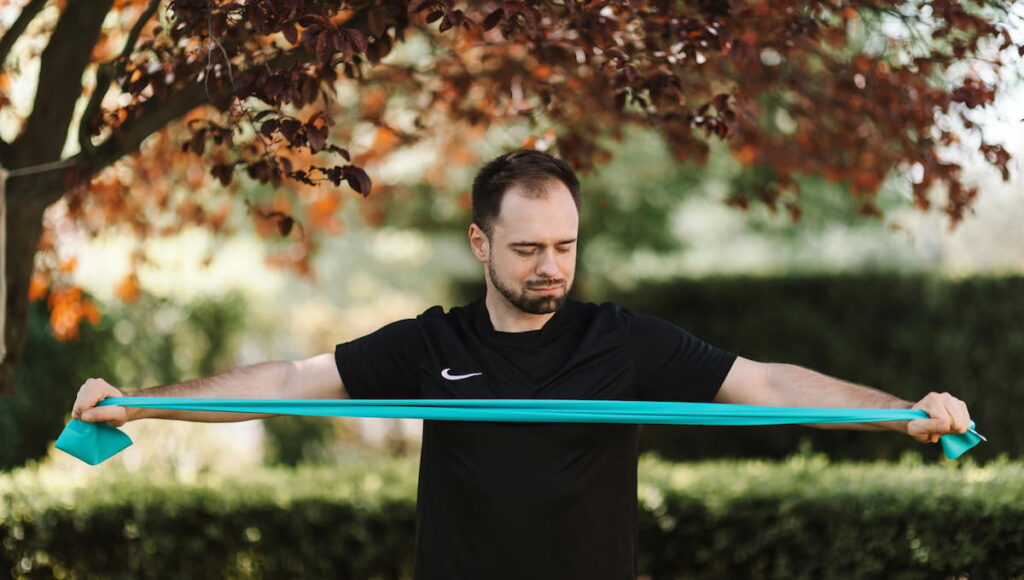
Resistance bands excel here because their tension increases as they stretch. This creates:
High peak tension near full extension
Constant resistance with no “dead zones”
Greater time under tension
Research comparing elastic resistance to free weights shows similar increases in muscle thickness and strength when volume and effort are equated (Martins et al., 2013; Calatayud et al., 2015). In other words, bands can grow muscle just as effectively as traditional weights.
Why Bands Are Ideal for Triceps Training
The triceps are strongest near full elbow extension, where free weights often provide the least resistance due to leverage. Bands do the opposite. As the elbows approach lockout, band tension is at its highest, perfectly matching the triceps’ strength curve.
Studies on accommodating resistance show that variable resistance increases muscle activation and force output at joint angles where muscles are strongest (Andersen et al., 2016). This is one reason bands are particularly effective for triceps hypertrophy.
Bands also reduce joint stress at the bottom of movements, which can allow higher training frequency and volume without overuse injuries. This is critical for arm growth, which responds well to frequent stimulation (Schoenfeld et al., 2016).
Exercise 1: Banded Overhead Triceps Extension
Why This Exercise Works
The banded overhead triceps extension is the most effective banded movement for targeting the long head of the triceps. Because the shoulder is in flexion, the long head is placed under stretch, which significantly increases its activation.
Research shows that training muscles at longer lengths produces greater hypertrophy than training them only at shorter lengths (Maeo et al., 2021). For the triceps, this makes overhead movements essential for complete development.
Elastic resistance further enhances this effect by increasing tension as the elbows extend, creating high mechanical tension through the entire movement.
EMG research confirms higher long head activation during overhead triceps extensions compared to pushdowns (Saeterbakken et al., 2017).
How to Perform the Movement
Anchor a resistance band low behind you, such as under your feet or to a low anchor point.
Grip the band with both hands and raise your arms overhead.
Keep your elbows pointed forward and close to your head.
Start with elbows fully flexed and the band stretched behind you.
Extend your elbows until your arms are straight overhead.
Lower slowly under control back to the stretched position.
Maintain a neutral spine and avoid flaring the ribs. The movement should come entirely from elbow extension.
Common Mistakes
Letting elbows flare outward, reducing long head activation
Using momentum instead of controlled tension
Failing to reach full elbow extension
Allowing the band to go slack at the bottom
Hypertrophy Programming
For muscle growth, perform:
3–5 sets
8–15 reps
1–3 reps short of failure
Time under tension should be at least 30–50 seconds per set, which aligns with hypertrophy-focused loading recommendations (Schoenfeld et al., 2015).
Rest 60–90 seconds between sets.
Exercise 2: Banded Triceps Pushdown
Why This Exercise Works
The banded triceps pushdown is unmatched for loading the lateral and medial heads of the triceps. Unlike cable machines, bands increase resistance at lockout, which is where these heads are most active.
Biomechanical analysis shows that elbow extensor torque peaks near full extension, meaning resistance should be highest at this point to maximize tension (Murray et al., 1995). Bands naturally provide this profile.
Studies comparing elastic resistance pushdowns to machine-based versions show comparable triceps activation and strength gains (Calatayud et al., 2015).
How to Perform the Movement
Anchor the band above head height.
Grip the band with palms facing down or neutral.
Tuck your elbows tightly against your sides.
Start with elbows bent around 90 degrees.
Push the band down until elbows are fully locked.
Pause briefly at lockout before returning under control.
Focus on squeezing the triceps hard at the bottom of each rep.
Common Mistakes
Letting elbows drift forward
Using excessive body sway
Cutting the lockout short
Relaxing tension between reps
Hypertrophy Programming
For optimal results:
3–6 sets
10–20 reps
Short rest periods of 45–75 seconds
Higher reps are effective here because elastic resistance maintains tension even with lighter absolute loads, increasing metabolic stress without joint strain (Schoenfeld, 2013).
Exercise 3: Banded Close-Grip Push-Up
Why This Exercise Works
The banded close-grip push-up combines elbow extension with shoulder stabilization, making it a powerful compound triceps builder. Adding a band across the upper back increases resistance as you push upward, dramatically increasing triceps activation at lockout.
Research shows that close-grip push-ups already produce high triceps EMG activity comparable to bench press variations (Cogley et al., 2005). Adding elastic resistance further increases peak force demands.
This movement also improves intermuscular coordination and joint stability, which can enhance strength transfer to heavier pressing exercises (Behm & Anderson, 2006).
How to Perform the Movement
Loop a resistance band across your upper back and anchor it under your hands.
Place hands slightly narrower than shoulder width.
Keep your body in a straight line from head to heels.
Lower your chest toward the floor with elbows close to your sides.
Press up forcefully to full elbow extension.
Maintain constant tension on the band.
Common Mistakes
Allowing hips to sag
Flaring elbows outward
Incomplete range of motion
Poor band placement
Hypertrophy Programming
Use:
3–5 sets
6–12 reps
2 minutes rest
Because this is a compound movement, slightly lower reps with higher tension are ideal for maximizing mechanical load (Schoenfeld et al., 2016).
How to Program Banded Triceps Training for Size
Weekly Volume
Research consistently shows that hypertrophy is maximized at approximately 10–20 hard sets per muscle group per week (Schoenfeld et al., 2017).
For triceps, this can be split across 2–4 sessions:
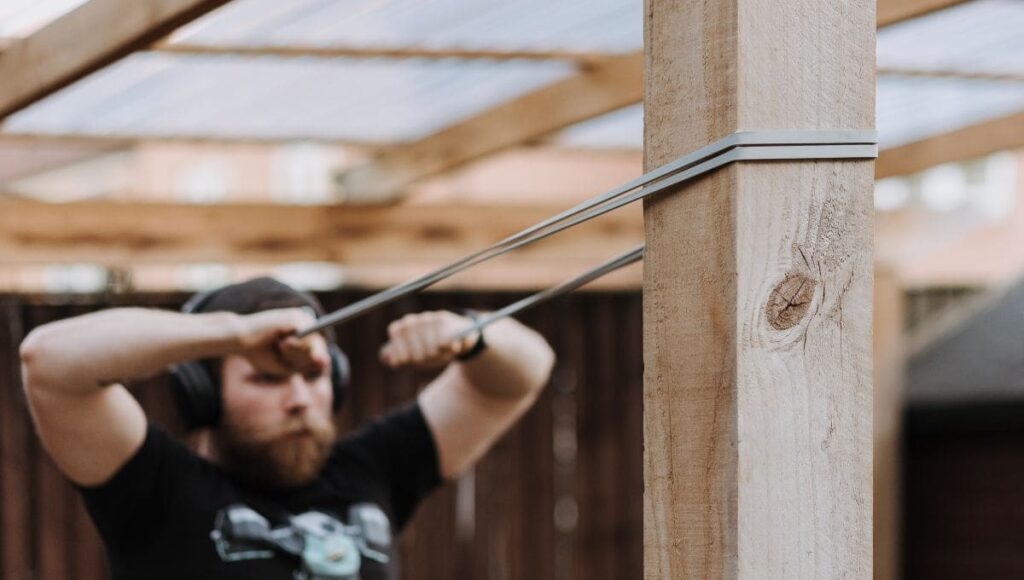
Overhead extensions: 6–8 sets
Pushdowns: 6–10 sets
Banded push-ups: 4–6 sets
Frequency
Higher training frequency allows better volume distribution and improved recovery. Studies show similar or superior hypertrophy outcomes when training muscles 2–3 times per week versus once weekly (Schoenfeld et al., 2016).
Bands are especially useful here because they reduce joint stress, allowing frequent stimulation without excessive soreness.
Progression With Bands
Progressive overload with bands can be achieved by:
Using thicker bands
Increasing stretch length
Adding reps or sets
Reducing rest intervals
Research confirms that progressive tension, not just heavier loads, drives hypertrophy (Morton et al., 2016).
Recovery and Injury Prevention
Elastic resistance reduces peak joint loading compared to free weights while still providing high muscular tension (Wallace et al., 2006). This makes bands ideal for lifters dealing with elbow pain or high training volumes.
However, recovery still matters. Aim for:
7–9 hours of sleep
Adequate protein intake (1.6–2.2 g/kg bodyweight)
At least 48 hours between intense triceps sessions
Protein intake in this range is strongly supported for maximizing muscle protein synthesis (Morton et al., 2018).
Final Thoughts
Banded triceps training is not a compromise. When programmed intelligently, it is a highly effective, science-backed approach to building massive arms. By emphasizing constant tension, accommodating resistance, and joint-friendly loading, bands allow you to train harder, more often, and more safely.
If your goal is bigger triceps, these three exercises cover every functional role of the muscle and align perfectly with what modern hypertrophy research tells us works best.
Bibliography
• Andersen, V., Fimland, M.S., Mo, D.A., Iversen, V.M., Vederhus, T., Rockland Hellebø, L.R. and Saeterbakken, A.H. (2016) ‘Electromyographic comparison of barbell deadlift, hex bar deadlift, and hip thrust exercises’, Journal of Strength and Conditioning Research, 30(8), pp. 2048–2055.
• Behm, D.G. and Anderson, K.G. (2006) ‘The role of instability with resistance training’, Journal of Strength and Conditioning Research, 20(3), pp. 716–722.
• Calatayud, J., Borreani, S., Colado, J.C., Martin, F., Tella, V. and Andersen, L.L. (2015) ‘Bench press and push-up at comparable levels of muscle activity results in similar strength gains’, Journal of Strength and Conditioning Research, 29(1), pp. 246–253.
• Cogley, R.M., Archambault, T.A., Fibeger, J.F., Koverman, M.M., Youdas, J.W. and Hollman, J.H. (2005) ‘Comparison of muscle activation using various hand positions during the push-up exercise’, Journal of Strength and Conditioning Research, 19(3), pp. 628–633.
• Madsen, N. and McLaughlin, T. (1984) ‘Kinematic factors influencing performance and injury risk in the bench press exercise’, Medicine and Science in Sports and Exercise, 16(4), pp. 376–381.
Was this article helpful?
